

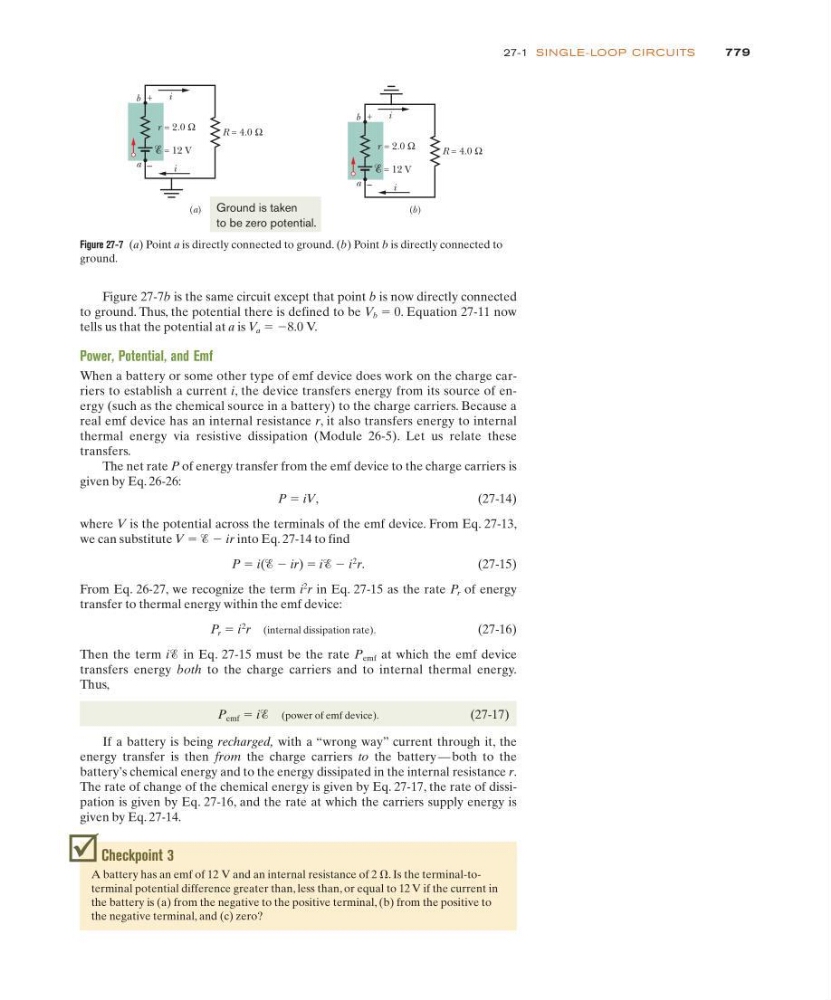
Figure 27-7b is the same circuit except that point b is now directly connected
to ground. Thus, the potential there is defined to be V b ϭ 0. Equation 27-11 now
tells us that the potential at a is V a ϭ Ϫ8.0 V.
Power, Potential, and Emf
When a battery or some other type of emf device does work on the charge carriers to establish a current i, the device transfers energy from its source of energy (such as the chemical source in a battery) to the charge carriers. Because a
real emf device has an internal resistance r, it also transfers energy to internal
thermal energy via resistive dissipation (Module 26-5). Let us relate these
transfers.
The net rate P of energy transfer from the emf device to the charge carriers is
given by Eq. 26-26:
P ϭ iV,
( 2 7 - 1 4 )
where V is the potential across the terminals of the emf device. From Eq. 27-13,
we can substitute V ϭ Ᏹ Ϫ ir into Eq. 27-14 to find
P ϭ i(Ᏹ Ϫ ir) ϭ iᏱ Ϫ i
2
r.
( 2 7 - 1 5 )
From Eq. 26-27, we recognize the term i
2
r in Eq. 27-15 as the rate P r of energy
transfer to thermal energy within the emf device:
P r ϭ i
2
r (internal dissipation rate).
(27-16)
Then the term iᏱ in Eq. 27-15 must be the rate P emf at which the emf device
transfers energy both to the charge carriers and to internal thermal energy.
Thus,
P emf ϭ iᏱ (power of emf device).
(27-17)
If a battery is being recharged, with a “wrong way” current through it, the
energy transfer is then from the charge carriers to the battery — both to the
battery’s chemical energy and to the energy dissipated in the internal resistance r.
The rate of change of the chemical energy is given by Eq. 27-17, the rate of dissipation is given by Eq. 27-16, and the rate at which the carriers supply energy is
given by Eq. 27-14.
779
27-1 SI NG LE-LOOP CI RCU ITS
Figure 27-7 (a) Point a is directly connected to ground. (b) Point b is directly connected to
ground.
R = 4.0 Ω
i
r = 2.0 Ω
= 12 V
i
a
b +
–
(a)
R = 4.0 Ω
i
r = 2.0 Ω
= 12 V
i
a
b +
–
(b)
Ground is taken
to be zero potential.
Checkpoint 3
A battery has an emf of 12 V and an internal resistance of 2 ⍀. Is the terminal-toterminal potential difference greater than, less than, or equal to 12 V if the current in
the battery is (a) from the negative to the positive terminal, (b) from the positive to
the negative terminal, and (c) zero?