

What Is Physics?
You are surrounded by electric circuits. You might take pride in the number of
electrical devices you own and might even carry a mental list of the devices you
wish you owned. Every one of those devices, as well as the electrical grid that
powers your home, depends on modern electrical engineering. We cannot easily
estimate the current financial worth of electrical engineering and its products, but
we can be certain that the financial worth continues to grow yearly as more and
more tasks are handled electrically. Radios are now tuned electronically instead
of manually. Messages are now sent by email instead of through the postal
system. Research journals are now read on a computer instead of in a library
building, and research papers are now copied and filed electronically instead of
photocopied and tucked into a filing cabinet. Indeed, you may be reading an electronic version of this book.
The basic science of electrical engineering is physics. In this chapter we
cover the physics of electric circuits that are combinations of resistors and batteries (and, in Module 27-4, capacitors). We restrict our discussion to circuits
through which charge flows in one direction, which are called either directcurrent circuits or DC circuits. We begin with the question: How can you get
charges to flow?
“Pumping” Charges
If you want to make charge carriers flow through a resistor, you must establish a
potential difference between the ends of the device. One way to do this is to connect each end of the resistor to one plate of a charged capacitor. The trouble with
this scheme is that the flow of charge acts to discharge the capacitor, quickly
bringing the plates to the same potential. When that happens, there is no longer
an electric field in the resistor, and thus the flow of charge stops.
To produce a steady flow of charge, you need a “charge pump,” a device
that — by doing work on the charge carriers — maintains a potential difference
between a pair of terminals. We call such a device an emf device, and the device is
said to provide an emf Ᏹ, which means that it does work on charge carriers.
An emf device is sometimes called a seat of emf. The term emf comes from the
outdated phrase electromotive force, which was adopted before scientists clearly
understood the function of an emf device.
In Chapter 26, we discussed the motion of charge carriers through a circuit in
terms of the electric field set up in the circuit — the field produces forces that
move the charge carriers. In this chapter we take a different approach: We discuss
the motion of the charge carriers in terms of the required energy — an emf device
supplies the energy for the motion via the work it does.
A common emf device is the battery, used to power a wide variety of
machines from wristwatches to submarines. The emf device that most influences
our daily lives, however, is the electric generator, which, by means of electrical
connections (wires) from a generating plant, creates a potential difference in our
homes and workplaces. The emf devices known as solar cells, long familiar as the
wing-like panels on spacecraft, also dot the countryside for domestic applications.
Less familiar emf devices are the fuel cells that powered the space shuttles and
the thermopiles that provide onboard electrical power for some spacecraft and
for remote stations in Antarctica and elsewhere. An emf device does not have to
be an instrument — living systems, ranging from electric eels and human beings to
plants, have physiological emf devices.
Although the devices we have listed differ widely in their modes of operation, they all perform the same basic function — they do work on charge carriers
and thus maintain a potential difference between their terminals.
772
CHAPTE R 27 CI RCU ITS
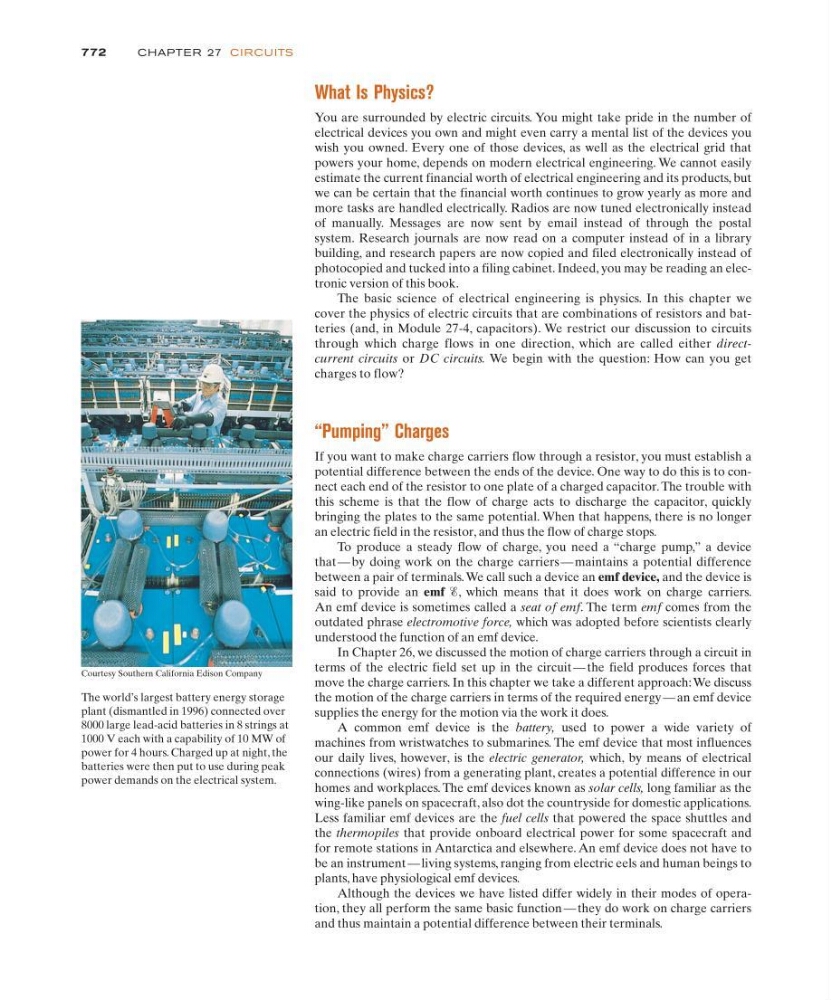
Courtesy Southern California Edison Company
The world’s largest battery energy storage
plant (dismantled in 1996) connected over
8000 large lead-acid batteries in 8 strings at
1000 V each with a capability of 10 MW of
power for 4 hours. Charged up at night, the
batteries were then put to use during peak
power demands on the electrical system.