

770
CHAPTE R 26 CU R R E NT AN D R ESISTANCE
Fig. 26-10.) (b) Does this same “doubling temperature” hold for all
copper conductors, regardless of shape or size?
72 A steel trolley-car rail has a cross-sectional area of 56.0 cm
2
.
What is the resistance of 10.0 km of rail? The resistivity of the steel
is 3.00 ϫ 10
Ϫ7 ⍀иm.
73 A coil of current-carrying Nichrome wire is immersed in a liquid. (Nichrome is a nickel – chromium – iron alloy commonly used
in heating elements.) When the potential difference across the coil
is 12 V and the current through the coil is 5.2 A, the liquid evaporates at the steady rate of 21 mg/s. Calculate the heat of vaporization of the liquid (see Module 18-4).
74
The current density in a wire is uniform and has magnitude
2.0 10
6
A/m
2
, the wire’s length is 5.0 m, and the density of conduction electrons is 8.49 ϫ 10
28
m
Ϫ3
. How long does an electron
take (on the average) to travel the length of the wire?
75 A certain x-ray tube operates at a current of 7.00 mA and a
potential difference of 80.0 kV. What is its power in watts?
76 A current is established in a gas discharge tube when a sufficiently high potential difference is applied across the two electrodes
in the tube. The gas ionizes; electrons move toward the positive terminal and singly charged positive ions toward the negative terminal. (a) What is the current in a hydrogen discharge tube in which
3.1 ϫ 10
18
electrons and 1.1 ϫ 10
18
protons move past a crosssectional area of the tube each second? (b) Is the direction of the
current density toward or away from the negative terminal?
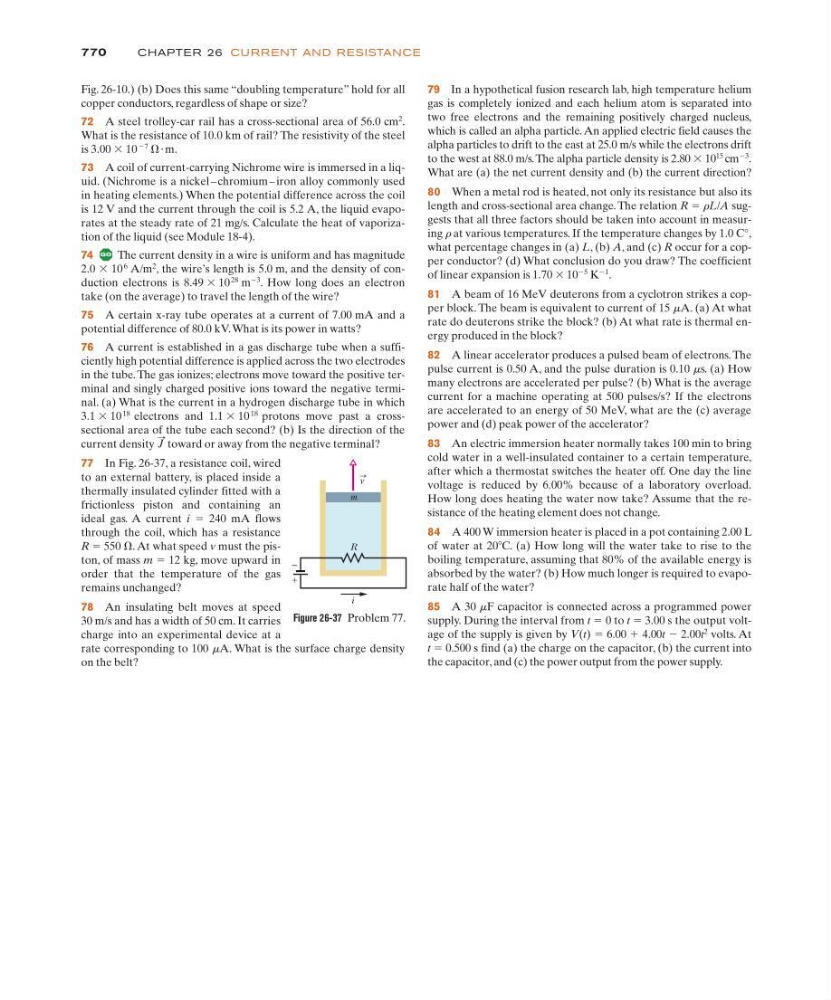
77 In Fig. 26-37, a resistance coil, wired
to an external battery, is placed inside a
thermally insulated cylinder fitted with a
frictionless piston and containing an
ideal gas. A current i ϭ 240 mA flows
through the coil, which has a resistance
R ϭ 550 ⍀. At what speed v must the piston, of mass m ϭ 12 kg, move upward in
order that the temperature of the gas
remains unchanged?
78 An insulating belt moves at speed
30 m/s and has a width of 50 cm. It carries
charge into an experimental device at a
rate corresponding to 100 mA. What is the surface charge density
on the belt?
J
:
ϫ
79 In a hypothetical fusion research lab, high temperature helium
gas is completely ionized and each helium atom is separated into
two free electrons and the remaining positively charged nucleus,
which is called an alpha particle. An applied electric field causes the
alpha particles to drift to the east at 25.0 m/s while the electrons drift
to the west at 88.0 m/s. The alpha particle density is 2.80 ϫ 10
15
cm
Ϫ3
.
What are (a) the net current density and (b) the current direction?
80 When a metal rod is heated, not only its resistance but also its
length and cross-sectional area change. The relation R ϭ rL/A suggests that all three factors should be taken into account in measuring r at various temperatures. If the temperature changes by 1.0 C°,
what percentage changes in (a) L, (b) A, and (c) R occur for a copper conductor? (d) What conclusion do you draw? The coefficient
of linear expansion is 1.70 ϫ 10
Ϫ5
K
Ϫ1
.
81 A beam of 16 MeV deuterons from a cyclotron strikes a copper block. The beam is equivalent to current of 15 mA. (a) At what
rate do deuterons strike the block? (b) At what rate is thermal energy produced in the block?
82 A linear accelerator produces a pulsed beam of electrons. The
pulse current is 0.50 A, and the pulse duration is 0.10 ms. (a) How
many electrons are accelerated per pulse? (b) What is the average
current for a machine operating at 500 pulses/s? If the electrons
are accelerated to an energy of 50 MeV, what are the (c) average
power and (d) peak power of the accelerator?
83 An electric immersion heater normally takes 100 min to bring
cold water in a well-insulated container to a certain temperature,
after which a thermostat switches the heater off. One day the line
voltage is reduced by 6.00% because of a laboratory overload.
How long does heating the water now take? Assume that the resistance of the heating element does not change.
84 A 400 W immersion heater is placed in a pot containing 2.00 L
of water at 20ЊC. (a) How long will the water take to rise to the
boiling temperature, assuming that 80% of the available energy is
absorbed by the water? (b) How much longer is required to evaporate half of the water?
85 A 30 mF capacitor is connected across a programmed power
supply. During the interval from t ϭ 0 to t ϭ 3.00 s the output voltage of the supply is given by V(t) ϭ 6.00 ϩ 4.00t Ϫ 2.00t
2
volts. At
t ϭ 0.500 s find (a) the charge on the capacitor, (b) the current into
the capacitor, and (c) the power output from the power supply.
Figure 26-37 Problem 77.
m
R
i
–
+
v