

769
PROB LE M S
•••54
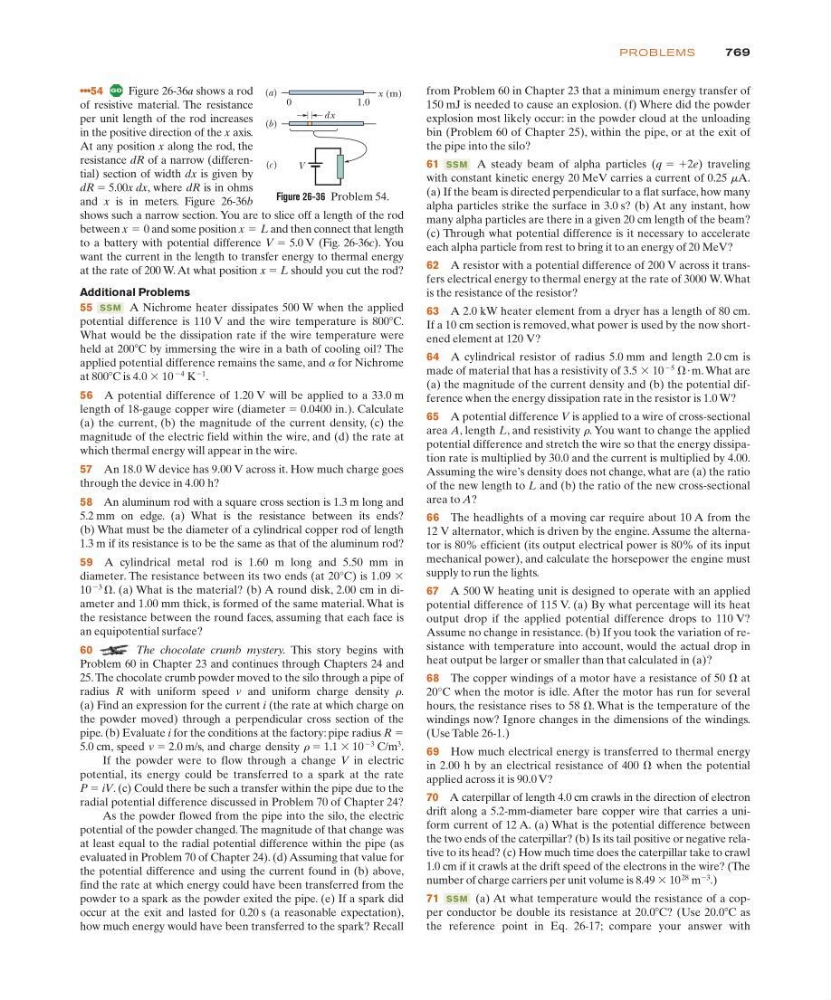
Figure 26-36a shows a rod
of resistive material. The resistance
per unit length of the rod increases
in the positive direction of the x axis.
At any position x along the rod, the
resistance dR of a narrow (differential) section of width dx is given by
dR ϭ 5.00x dx, where dR is in ohms
and x is in meters. Figure 26-36b
shows such a narrow section. You are to slice off a length of the rod
between x 0 and some position x Land then connect that length
to a battery with potential difference V 5.0 V (Fig. 26-36c). You
want the current in the length to transfer energy to thermal energy
at the rate of 200 W. At what position x ϭ L should you cut the rod?
Additional Problems
55
A Nichrome heater dissipates 500 W when the applied
potential difference is 110 V and the wire temperature is 800 C.
What would be the dissipation rate if the wire temperature were
held at 200 C by immersing the wire in a bath of cooling oil? The
applied potential difference remains the same, and a for Nichrome
at 800 C is 4.0 ϫ 10
Ϫ4
K
Ϫ1
.
56 A potential difference of 1.20 V will be applied to a 33.0 m
length of 18-gauge copper wire (diameter ϭ 0.0400 in.). Calculate
(a) the current, (b) the magnitude of the current density, (c) the
magnitude of the electric field within the wire, and (d) the rate at
which thermal energy will appear in the wire.
57 An 18.0 W device has 9.00 V across it. How much charge goes
through the device in 4.00 h?
58 An aluminum rod with a square cross section is 1.3 m long and
5.2 mm on edge. (a) What is the resistance between its ends?
(b) What must be the diameter of a cylindrical copper rod of length
1.3 m if its resistance is to be the same as that of the aluminum rod?
59 A cylindrical metal rod is 1.60 m long and 5.50 mm in
diameter. The resistance between its two ends (at 20°C) is 1.09 ϫ
10
Ϫ3 ⍀. (a) What is the material? (b) A round disk, 2.00 cm in diameter and 1.00 mm thick, is formed of the same material. What is
the resistance between the round faces, assuming that each face is
an equipotential surface?
60
The chocolate crumb mystery. This story begins with
Problem 60 in Chapter 23 and continues through Chapters 24 and
25. The chocolate crumb powder moved to the silo through a pipe of
radius R with uniform speed v and uniform charge density r.
(a) Find an expression for the current i (the rate at which charge on
the powder moved) through a perpendicular cross section of the
pipe. (b) Evaluate i for the conditions at the factory: pipe radius R ϭ
5.0 cm, speed v ϭ 2.0 m/s, and charge density r ϭ 1.1 ϫ 10
Ϫ3
C/m
3
.
If the powder were to flow through a change V in electric
potential, its energy could be transferred to a spark at the rate
P ϭ iV. (c) Could there be such a transfer within the pipe due to the
radial potential difference discussed in Problem 70 of Chapter 24?
As the powder flowed from the pipe into the silo, the electric
potential of the powder changed. The magnitude of that change was
at least equal to the radial potential difference within the pipe (as
evaluated in Problem 70 of Chapter 24). (d) Assuming that value for
the potential difference and using the current found in (b) above,
find the rate at which energy could have been transferred from the
powder to a spark as the powder exited the pipe. (e) If a spark did
occur at the exit and lasted for 0.20 s (a reasonable expectation),
how much energy would have been transferred to the spark? Recall
8
8
8
SSM
ϭ
ϭ
ϭ
from Problem 60 in Chapter 23 that a minimum energy transfer of
150 mJ is needed to cause an explosion. (f) Where did the powder
explosion most likely occur: in the powder cloud at the unloading
bin (Problem 60 of Chapter 25), within the pipe, or at the exit of
the pipe into the silo?
61
A steady beam of alpha particles (q
2e) traveling
with constant kinetic energy 20 MeV carries a current of 0.25 mA.
(a) If the beam is directed perpendicular to a flat surface, how many
alpha particles strike the surface in 3.0 s? (b) At any instant, how
many alpha particles are there in a given 20 cm length of the beam?
(c) Through what potential difference is it necessary to accelerate
each alpha particle from rest to bring it to an energy of 20 MeV?
62 A resistor with a potential difference of 200 V across it transfers electrical energy to thermal energy at the rate of 3000 W. What
is the resistance of the resistor?
63 A 2.0 kW heater element from a dryer has a length of 80 cm.
If a 10 cm section is removed, what power is used by the now shortened element at 120 V?
64 A cylindrical resistor of radius 5.0 mm and length 2.0 cm is
made of material that has a resistivity of 3.5 ϫ 10
Ϫ5 ⍀иm. What are
(a) the magnitude of the current density and (b) the potential difference when the energy dissipation rate in the resistor is 1.0 W?
65 A potential difference V is applied to a wire of cross-sectional
area A, length L, and resistivity r. You want to change the applied
potential difference and stretch the wire so that the energy dissipation rate is multiplied by 30.0 and the current is multiplied by 4.00.
Assuming the wire’s density does not change, what are (a) the ratio
of the new length to L and (b) the ratio of the new cross-sectional
area to A?
66 The headlights of a moving car require about 10 A from the
12 V alternator, which is driven by the engine. Assume the alternator is 80% efficient (its output electrical power is 80% of its input
mechanical power), and calculate the horsepower the engine must
supply to run the lights.
67 A 500 W heating unit is designed to operate with an applied
potential difference of 115 V. (a) By what percentage will its heat
output drop if the applied potential difference drops to 110 V?
Assume no change in resistance. (b) If you took the variation of resistance with temperature into account, would the actual drop in
heat output be larger or smaller than that calculated in (a)?
68 The copper windings of a motor have a resistance of 50 ⍀ at
20°C when the motor is idle. After the motor has run for several
hours, the resistance rises to 58 ⍀. What is the temperature of the
windings now? Ignore changes in the dimensions of the windings.
(Use Table 26-1.)
69 How much electrical energy is transferred to thermal energy
in 2.00 h by an electrical resistance of 400 ⍀ when the potential
applied across it is 90.0 V?
70 A caterpillar of length 4.0 cm crawls in the direction of electron
drift along a 5.2-mm-diameter bare copper wire that carries a uniform current of 12 A. (a) What is the potential difference between
the two ends of the caterpillar? (b) Is its tail positive or negative relative to its head? (c) How much time does the caterpillar take to crawl
1.0 cm if it crawls at the drift speed of the electrons in the wire? (The
number of charge carriers per unit volume is 8.49 ϫ 10
28
m
Ϫ3
.)
71
(a) At what temperature would the resistance of a copper conductor be double its resistance at 20.0 C? (Use 20.0 C as
the reference point in Eq. 26-17; compare your answer with
8
8
SSM
ϭ ϩ
SSM
Figure 26-36 Problem 54.
(a)
x (m)
0
1.0
(b)
(c)
dx
V