

742
CHAPTE R 25 CAPACITANCE
•••28
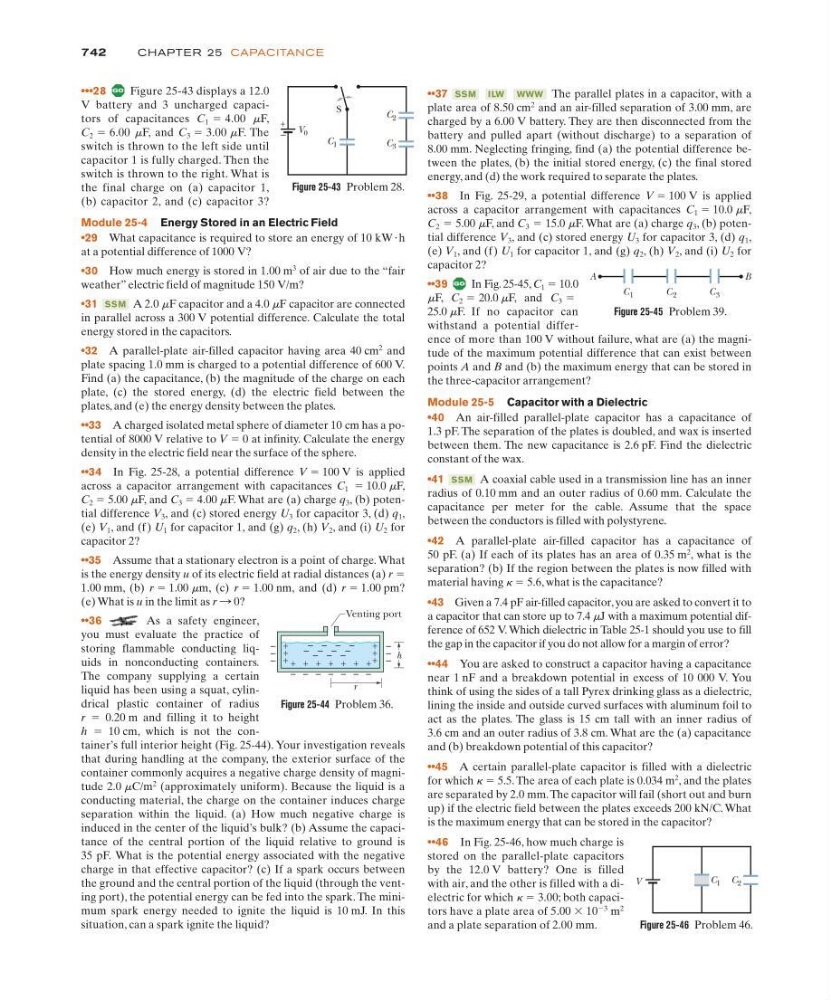
Figure 25-43 displays a 12.0
V battery and 3 uncharged capacitors of capacitances C 1 4.00 mF,
C 2 6.00 mF, and C 3 ϭ 3.00 mF. The
switch is thrown to the left side until
capacitor 1 is fully charged. Then the
switch is thrown to the right. What is
the final charge on (a) capacitor 1,
(b) capacitor 2, and (c) capacitor 3?
Module 25-4 Energy Stored in an Electric Field
•29 What capacitance is required to store an energy of 10 kW иh
at a potential difference of 1000 V?
•30 How much energy is stored in 1.00 m
3
of air due to the “fair
weather” electric field of magnitude 150 V/m?
•31
A 2.0 mF capacitor and a 4.0 mF capacitor are connected
in parallel across a 300 V potential difference. Calculate the total
energy stored in the capacitors.
•32 A parallel-plate air-filled capacitor having area 40 cm
2
and
plate spacing 1.0 mm is charged to a potential difference of 600 V.
Find (a) the capacitance, (b) the magnitude of the charge on each
plate, (c) the stored energy, (d) the electric field between the
plates, and (e) the energy density between the plates.
••33 A charged isolated metal sphere of diameter 10 cm has a potential of 8000 V relative to V ϭ 0 at infinity. Calculate the energy
density in the electric field near the surface of the sphere.
••34 In Fig. 25-28, a potential difference V ϭ 100 V is applied
across a capacitor arrangement with capacitances C 1 ϭ 10.0 mF,
C 2 ϭ 5.00 mF, and C 3 ϭ 4.00 mF. What are (a) charge q 3 , (b) potential difference V 3 , and (c) stored energy U 3 for capacitor 3, (d) q 1 ,
(e) V 1 , and (f) U 1 for capacitor 1, and (g) q 2 , (h) V 2 , and (i) U 2 for
capacitor 2?
••35 Assume that a stationary electron is a point of charge. What
is the energy density u of its electric field at radial distances (a) r ϭ
1.00 mm, (b) r ϭ 1.00 mm, (c) r ϭ 1.00 nm, and (d) r ϭ 1.00 pm?
(e) What is u in the limit as r : 0?
••36
As a safety engineer,
you must evaluate the practice of
storing flammable conducting liquids in nonconducting containers.
The company supplying a certain
liquid has been using a squat, cylindrical plastic container of radius
r ϭ 0.20 m and filling it to height
h ϭ 10 cm, which is not the container’s full interior height (Fig. 25-44). Your investigation reveals
that during handling at the company, the exterior surface of the
container commonly acquires a negative charge density of magnitude 2.0 mC/m
2
(approximately uniform). Because the liquid is a
conducting material, the charge on the container induces charge
separation within the liquid. (a) How much negative charge is
induced in the center of the liquid’s bulk? (b) Assume the capacitance of the central portion of the liquid relative to ground is
35 pF. What is the potential energy associated with the negative
charge in that effective capacitor? (c) If a spark occurs between
the ground and the central portion of the liquid (through the venting port), the potential energy can be fed into the spark. The minimum spark energy needed to ignite the liquid is 10 mJ. In this
situation, can a spark ignite the liquid?
SSM
ϭ
ϭ
••37
The parallel plates in a capacitor, with a
plate area of 8.50 cm
2
and an air-filled separation of 3.00 mm, are
charged by a 6.00 V battery. They are then disconnected from the
battery and pulled apart (without discharge) to a separation of
8.00 mm. Neglecting fringing, find (a) the potential difference between the plates, (b) the initial stored energy, (c) the final stored
energy, and (d) the work required to separate the plates.
••38 In Fig. 25-29, a potential difference V ϭ 100 V is applied
across a capacitor arrangement with capacitances C 1 ϭ 10.0 mF,
C 2 5.00 mF, and C 3 15.0 mF. What are (a) charge q 3 , (b) potential difference V 3 , and (c) stored energy U 3 for capacitor 3, (d) q 1 ,
(e) V 1 , and (f) U 1 for capacitor 1, and (g) q 2 , (h) V 2 , and (i) U 2 for
capacitor 2?
••39
In Fig. 25-45, C 1 ϭ 10.0
mF, C 2 20.0 mF, and C 3
25.0 mF. If no capacitor can
withstand a potential difference of more than 100 V without failure, what are (a) the magnitude of the maximum potential difference that can exist between
points A and B and (b) the maximum energy that can be stored in
the three-capacitor arrangement?
Module 25-5 Capacitor with a Dielectric
•40 An air-filled parallel-plate capacitor has a capacitance of
1.3 pF. The separation of the plates is doubled, and wax is inserted
between them. The new capacitance is 2.6 pF. Find the dielectric
constant of the wax.
•41
A coaxial cable used in a transmission line has an inner
radius of 0.10 mm and an outer radius of 0.60 mm. Calculate the
capacitance per meter for the cable. Assume that the space
between the conductors is filled with polystyrene.
•42 A parallel-plate air-filled capacitor has a capacitance of
50 pF. (a) If each of its plates has an area of 0.35 m
2
, what is the
separation? (b) If the region between the plates is now filled with
material having k ϭ 5.6, what is the capacitance?
•43 Given a 7.4 pF air-filled capacitor, you are asked to convert it to
a capacitor that can store up to 7.4 mJ with a maximum potential difference of 652 V. Which dielectric in Table 25-1 should you use to fill
the gap in the capacitor if you do not allow for a margin of error?
••44 You are asked to construct a capacitor having a capacitance
near 1 nF and a breakdown potential in excess of 10 000 V. You
think of using the sides of a tall Pyrex drinking glass as a dielectric,
lining the inside and outside curved surfaces with aluminum foil to
act as the plates. The glass is 15 cm tall with an inner radius of
3.6 cm and an outer radius of 3.8 cm. What are the (a) capacitance
and (b) breakdown potential of this capacitor?
••45 A certain parallel-plate capacitor is filled with a dielectric
for which k ϭ 5.5. The area of each plate is 0.034 m
2
, and the plates
are separated by 2.0 mm. The capacitor will fail (short out and burn
up) if the electric field between the plates exceeds 200 kN/C. What
is the maximum energy that can be stored in the capacitor?
••46 In Fig. 25-46, how much charge is
stored on the parallel-plate capacitors
by the 12.0 V battery? One is filled
with air, and the other is filled with a dielectric for which k ϭ 3.00; both capacitors have a plate area of 5.00 ϫ 10
Ϫ3
m
2
and a plate separation of 2.00 mm.
SSM
ϭ
ϭ
ϭ
ϭ
WWW
ILW
SSM
Figure 25-44 Problem 36.
Venting port
–
–
–
+
+
+ + + + + + + +
– – – – – –
– – – –
– – – –
– – –
–
+
+
+
–
–
– h
r
Figure 25-45 Problem 39.
B
A
C 1
C 2
C 3
Figure 25-46 Problem 46.
C 1 C 2
V
S
C 2
C 3
C 1
V 0
+
–
Figure 25-43 Problem 28.