

Dielectrics and Gauss’ Law
In our discussion of Gauss’ law in Chapter 23, we assumed that the charges
existed in a vacuum. Here we shall see how to modify and generalize that law if
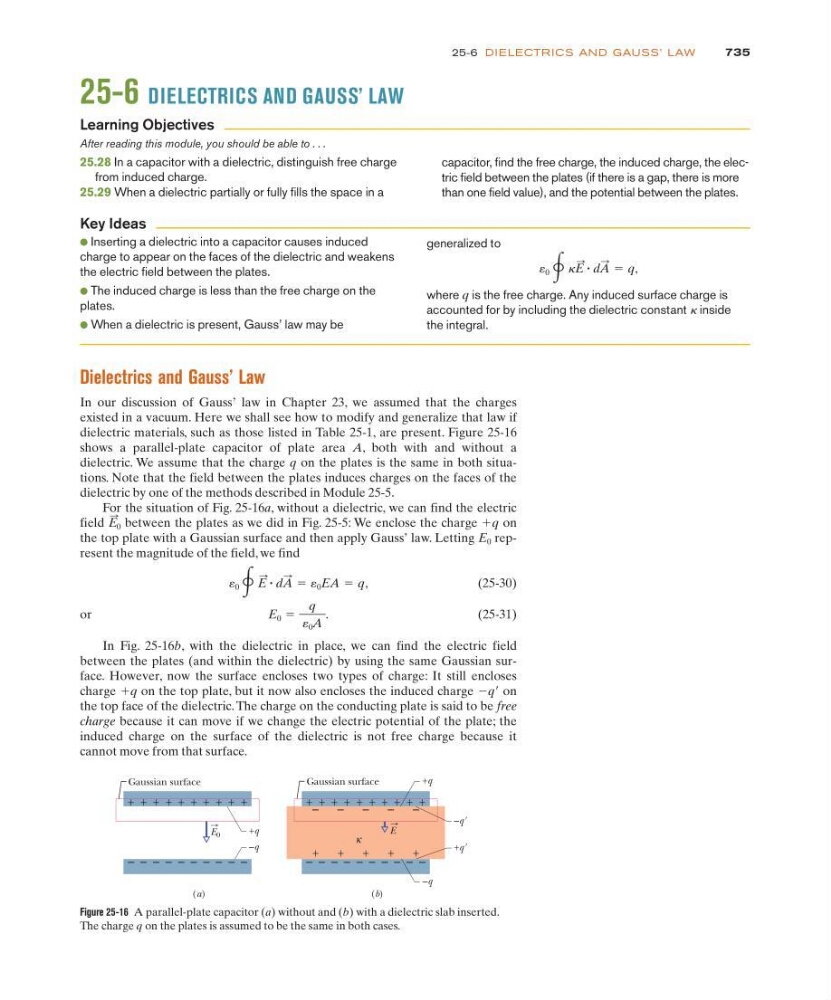
dielectric materials, such as those listed in Table 25-1, are present. Figure 25-16
shows a parallel-plate capacitor of plate area A, both with and without a
dielectric. We assume that the charge q on the plates is the same in both situations. Note that the field between the plates induces charges on the faces of the
dielectric by one of the methods described in Module 25-5.
For the situation of Fig. 25-16a, without a dielectric, we can find the electric
field
between the plates as we did in Fig. 25-5: We enclose the charge ϩq on
the top plate with a Gaussian surface and then apply Gauss’ law. Letting E 0 represent the magnitude of the field, we find
(25-30)
or
(25-31)
In Fig. 25-16b, with the dielectric in place, we can find the electric field
between the plates (and within the dielectric) by using the same Gaussian surface. However, now the surface encloses two types of charge: It still encloses
charge ϩq on the top plate, but it now also encloses the induced charge ϪqЈ on
the top face of the dielectric. The charge on the conducting plate is said to be free
charge because it can move if we change the electric potential of the plate; the
induced charge on the surface of the dielectric is not free charge because it
cannot move from that surface.
E 0 ϭ
q
´ 0 A
.
´ 0 ͶE
: ؒ dA
: ϭ ´ 0 EA ϭ q,
E
:
0
735
25-6 DI E LECTR ICS AN D GAUSS’ L AW
25-6 DIELECTRICS AND GAUSS’ LAW
After reading this module, you should be able to . . .
25.28 In a capacitor with a dielectric, distinguish free charge
from induced charge.
25.29 When a dielectric partially or fully fills the space in a
capacitor, find the free charge, the induced charge, the electric field between the plates (if there is a gap, there is more
than one field value), and the potential between the plates.
Learning Objectives
● Inserting a dielectric into a capacitor causes induced
charge to appear on the faces of the dielectric and weakens
the electric field between the plates.
● The induced charge is less than the free charge on the
plates.
● When a dielectric is present, Gauss’ law may be
Key Ideas
generalized to
where q is the free charge. Any induced surface charge is
accounted for by including the dielectric constant k inside
the integral.
´ 0 ͶkE
: ؒ dA
: ϭ q,
Figure 25-16 A parallel-plate capacitor (a) without and (b) with a dielectric slab inserted.
The charge q on the plates is assumed to be the same in both cases.
(b)
–q'
+q'
+ + + + + + + +
+
+
– – – – – – – –
–
–
+ + + +
+
– – – –
–
κ
+q
–q
Gaussian surface
E
E 0
Gaussian surface
+q
–q
(a)
+ + + + + + + +
+
+
– – – – – – – –
–
–