

(a)
E 0 = 0
The initial electric field
inside this nonpolar
dielectric slab is zero.
+
–
+
–
+
–
+
–
+
–
+
–
+
–
+
–
+
–
+
–
+
–
+
–
E 0
(b)
+ + + + + + +
+
–
–
–
–
–
–
–
–
The applied field
aligns the atomic
dipole moments.
+
–
+
–
+
–
E'
E 0
(c)
+ + + + + + +
+
–
–
–
–
–
–
–
–
E
The field of the aligned
atoms is opposite the
applied field.
734
CHAPTE R 25 CAPACITANCE
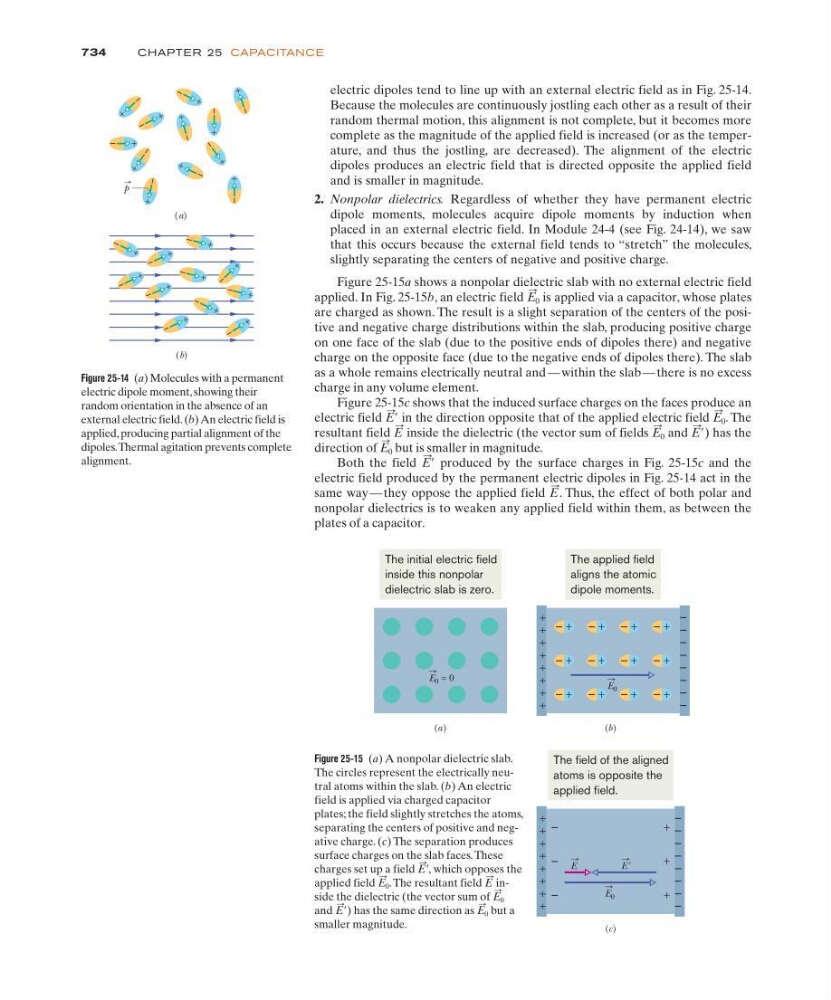
Figure 25-15 (a) A nonpolar dielectric slab.
The circles represent the electrically neutral atoms within the slab. (b) An electric
field is applied via charged capacitor
plates; the field slightly stretches the atoms,
separating the centers of positive and negative charge. (c) The separation produces
surface charges on the slab faces. These
charges set up a field
which opposes the
applied field . The resultant field inside the dielectric (the vector sum of
and ) has the same direction as but a
smaller magnitude.
E
:
0
E
:
Ј
E
:
0
E
:
E
:
0
E
:
Ј,
Figure 25-14 (a) Molecules with a permanent
electric dipole moment, showing their
random orientation in the absence of an
external electric field. (b) An electric field is
applied, producing partial alignment of the
dipoles.Thermal agitation prevents complete
alignment.
+
–
+
–
+
–
+
–
+
–
+
–
+
–
+
–
+
–
+
–
+
–
(b)
+
–
+
–
+ –
+
–
+
–
+
–
+
–
+
–
+
–
+
–
+
–
+
–
(a)
p
electric dipoles tend to line up with an external electric field as in Fig. 25-14.
Because the molecules are continuously jostling each other as a result of their
random thermal motion, this alignment is not complete, but it becomes more
complete as the magnitude of the applied field is increased (or as the temperature, and thus the jostling, are decreased). The alignment of the electric
dipoles produces an electric field that is directed opposite the applied field
and is smaller in magnitude.
2. Nonpolar dielectrics. Regardless of whether they have permanent electric
dipole moments, molecules acquire dipole moments by induction when
placed in an external electric field. In Module 24-4 (see Fig. 24-14), we saw
that this occurs because the external field tends to “stretch” the molecules,
slightly separating the centers of negative and positive charge.
Figure 25-15a shows a nonpolar dielectric slab with no external electric field
applied. In Fig. 25-15b, an electric field
is applied via a capacitor, whose plates
are charged as shown. The result is a slight separation of the centers of the positive and negative charge distributions within the slab, producing positive charge
on one face of the slab (due to the positive ends of dipoles there) and negative
charge on the opposite face (due to the negative ends of dipoles there). The slab
as a whole remains electrically neutral and — within the slab — there is no excess
charge in any volume element.
Figure 25-15c shows that the induced surface charges on the faces produce an
electric field
in the direction opposite that of the applied electric field . The
resultant field inside the dielectric (the vector sum of fields
and ) has the
direction of but is smaller in magnitude.
Both the field
produced by the surface charges in Fig. 25-15c and the
electric field produced by the permanent electric dipoles in Fig. 25-14 act in the
same way — they oppose the applied field . Thus, the effect of both polar and
nonpolar dielectrics is to weaken any applied field within them, as between the
plates of a capacitor.
E
:
E
:
Ј
E
:
0
E
:
Ј
E
:
0
E
:
E
:
0
E
:
Ј
E
:
0