

49
the vector forms the hypotenuse. We find the magnitude and
angle of net with Eq. 3-6. The magnitude is
d net ϭ
(3-18)
ϭ
ϭ 13.9 m. (Answer)
To find the angle (measured from the positive direction of x),
we take an inverse tangent:
ϭ tan
Ϫ1
(3-19)
ϭ tan
Ϫ1
ϭ Ϫ12.7°.
(Answer)
The angle is negative because it is measured clockwise from
positive x. We must always be alert when we take an inverse
–3.07 m
13.60 m
d net,y
d net,x
2(13.60 m)
2 ϩ (Ϫ3.07 m)
2
2d
2
net,x ϩ d
2
net,y
d
:
tangent on a calculator. The answer it displays is mathematically correct but it may not be the correct answer for
the physical situation. In those cases, we have to add 180°
to the displayed answer, to reverse the vector. To check,
we always need to draw the vector and its components as
we did in Fig. 3-16d. In our physical situation, the figure
shows us that ϭ Ϫ12.7° is a reasonable answer, whereas
Ϫ12.7° ϩ 180° ϭ 167° is clearly not.
We can see all this on the graph of tangent versus angle
in Fig. 3-12c. In our maze problem, the argument of the inverse tangent is Ϫ3.07/13.60, or Ϫ0.226. On the graph draw
a horizontal line through that value on the vertical axis. The
line cuts through the darker plotted branch at Ϫ12.7° and
also through the lighter branch at 167°. The first cut is what
a calculator displays.
3-2 UNIT VECTORS, ADDING VECTORS BY COM PONENTS
KEY IDEA
We can add the three vectors by components, axis by axis,
and then combine the components to write the vector
sum .
Calculations: For the x axis, we add the x components of
and to get the x component of the vector sum :
r x ϭ a x ϩ b x ϩ c x
ϭ 4.2 m Ϫ 1.6 m ϩ 0 ϭ 2.6 m.
Similarly, for the y axis,
r y ϭ a y ϩ b y ϩ c y
ϭ Ϫ1.5 m ϩ 2.9 m Ϫ 3.7 m ϭ Ϫ2.3 m.
We then combine these components of to write the vector
in unit-vector notation:
(Answer)
where (2.6 m)i ˆ is the vector component of along the x axis
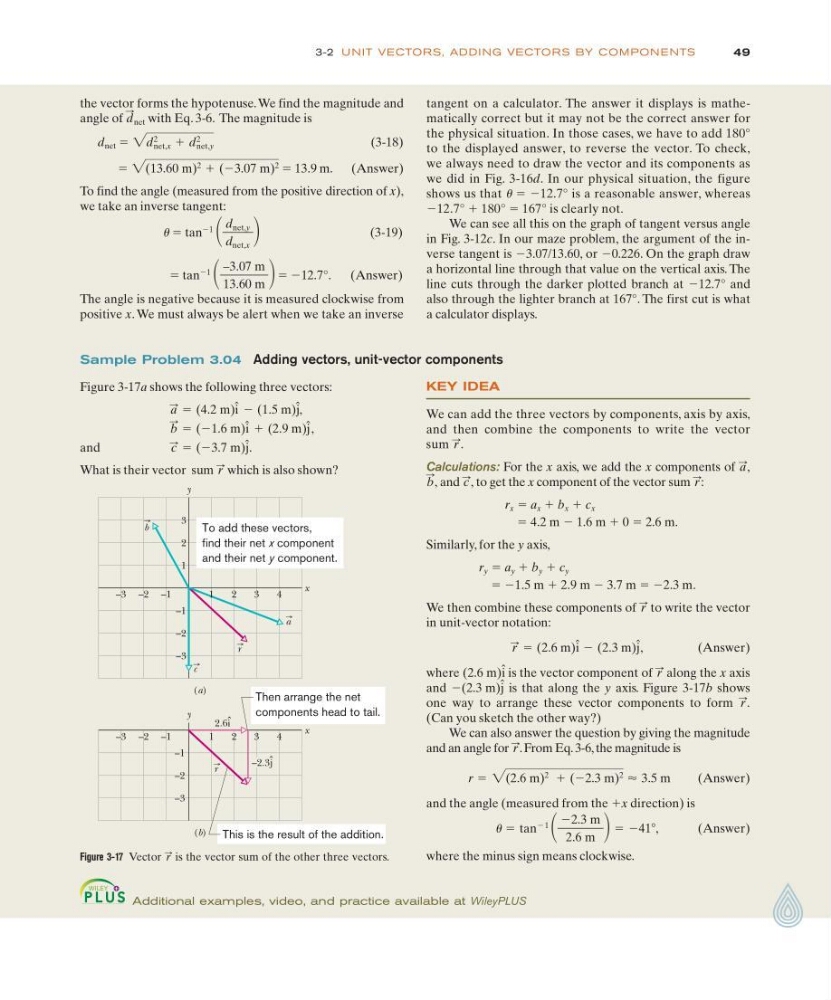
and (2.3 m)j ˆ is that along the y axis. Figure 3-17b shows
one way to arrange these vector components to form .
(Can you sketch the other way?)
We can also answer the question by giving the magnitude
and an angle for . From Eq. 3-6, the magnitude is
(Answer)
and the angle (measured from the ϩx direction) is
(Answer)
where the minus sign means clockwise.
ϭ tan
Ϫ1
Ϫ2.3 m
2.6 m ϭ Ϫ41Њ,
r ϭ 2(2.6 m)
2 ϩ (Ϫ2.3 m)
2
Ϸ 3.5 m
r
:
r
:
Ϫ
r
:
r
: ϭ (2.6 m)i ˆ Ϫ (2.3 m)j ˆ ,
r
:
r
:
c
:
,
b
: ,
a
: ,
r
:
Sample Problem 3.04 Adding vectors, unit-vector components
Figure 3-17a shows the following three vectors:
and
What is their vector sum which is also shown?
r
:
c
: ϭ (Ϫ3.7 m)j ˆ .
b
: ϭ (Ϫ1.6 m)i ˆ ϩ (2.9 m)j ˆ ,
a
: ϭ (4.2 m)i ˆ Ϫ (1.5 m)j ˆ ,
Additional examples, video, and practice available at WileyPLUS
x
y
–1
3
4
–2
–3
2
–3
–2
–1
1
x
y
–1
3
4
–2
–3
2
–3
–2
–1
2
3
1
1
(a)
2.6i
(b)
r
r
a
c
b
ˆ
–2.3j ˆ
To add these vectors,
find their net x component
and their net y component.
Then arrange the net
components head to tail.
This is the result of the addition.
Figure 3-17 Vector is the vector sum of the other three vectors.
r
:
the vector forms the hypotenuse. We find the magnitude and
angle of net with Eq. 3-6. The magnitude is
d net ϭ
(3-18)
ϭ
ϭ 13.9 m. (Answer)
To find the angle (measured from the positive direction of x),
we take an inverse tangent:
ϭ tan
Ϫ1
(3-19)
ϭ tan
Ϫ1
ϭ Ϫ12.7°.
(Answer)
The angle is negative because it is measured clockwise from
positive x. We must always be alert when we take an inverse
–3.07 m
13.60 m
d net,y
d net,x
2(13.60 m)
2 ϩ (Ϫ3.07 m)
2
2d
2
net,x ϩ d
2
net,y
d
:
tangent on a calculator. The answer it displays is mathematically correct but it may not be the correct answer for
the physical situation. In those cases, we have to add 180°
to the displayed answer, to reverse the vector. To check,
we always need to draw the vector and its components as
we did in Fig. 3-16d. In our physical situation, the figure
shows us that ϭ Ϫ12.7° is a reasonable answer, whereas
Ϫ12.7° ϩ 180° ϭ 167° is clearly not.
We can see all this on the graph of tangent versus angle
in Fig. 3-12c. In our maze problem, the argument of the inverse tangent is Ϫ3.07/13.60, or Ϫ0.226. On the graph draw
a horizontal line through that value on the vertical axis. The
line cuts through the darker plotted branch at Ϫ12.7° and
also through the lighter branch at 167°. The first cut is what
a calculator displays.
3-2 UNIT VECTORS, ADDING VECTORS BY COM PONENTS
KEY IDEA
We can add the three vectors by components, axis by axis,
and then combine the components to write the vector
sum .
Calculations: For the x axis, we add the x components of
and to get the x component of the vector sum :
r x ϭ a x ϩ b x ϩ c x
ϭ 4.2 m Ϫ 1.6 m ϩ 0 ϭ 2.6 m.
Similarly, for the y axis,
r y ϭ a y ϩ b y ϩ c y
ϭ Ϫ1.5 m ϩ 2.9 m Ϫ 3.7 m ϭ Ϫ2.3 m.
We then combine these components of to write the vector
in unit-vector notation:
(Answer)
where (2.6 m)i ˆ is the vector component of along the x axis
and (2.3 m)j ˆ is that along the y axis. Figure 3-17b shows
one way to arrange these vector components to form .
(Can you sketch the other way?)
We can also answer the question by giving the magnitude
and an angle for . From Eq. 3-6, the magnitude is
(Answer)
and the angle (measured from the ϩx direction) is
(Answer)
where the minus sign means clockwise.
ϭ tan
Ϫ1
Ϫ2.3 m
2.6 m ϭ Ϫ41Њ,
r ϭ 2(2.6 m)
2 ϩ (Ϫ2.3 m)
2
Ϸ 3.5 m
r
:
r
:
Ϫ
r
:
r
: ϭ (2.6 m)i ˆ Ϫ (2.3 m)j ˆ ,
r
:
r
:
c
:
,
b
: ,
a
: ,
r
:
Sample Problem 3.04 Adding vectors, unit-vector components
Figure 3-17a shows the following three vectors:
and
What is their vector sum which is also shown?
r
:
c
: ϭ (Ϫ3.7 m)j ˆ .
b
: ϭ (Ϫ1.6 m)i ˆ ϩ (2.9 m)j ˆ ,
a
: ϭ (4.2 m)i ˆ Ϫ (1.5 m)j ˆ ,
Additional examples, video, and practice available at WileyPLUS
x
y
–1
3
4
–2
–3
2
–3
–2
–1
1
x
y
–1
3
4
–2
–3
2
–3
–2
–1
2
3
1
1
(a)
2.6i
(b)
r
r
a
c
b
ˆ
–2.3j ˆ
To add these vectors,
find their net x component
and their net y component.
Then arrange the net
components head to tail.
This is the result of the addition.
Figure 3-17 Vector is the vector sum of the other three vectors.
r
: