

CHAPTE R 3 VECTORS
48
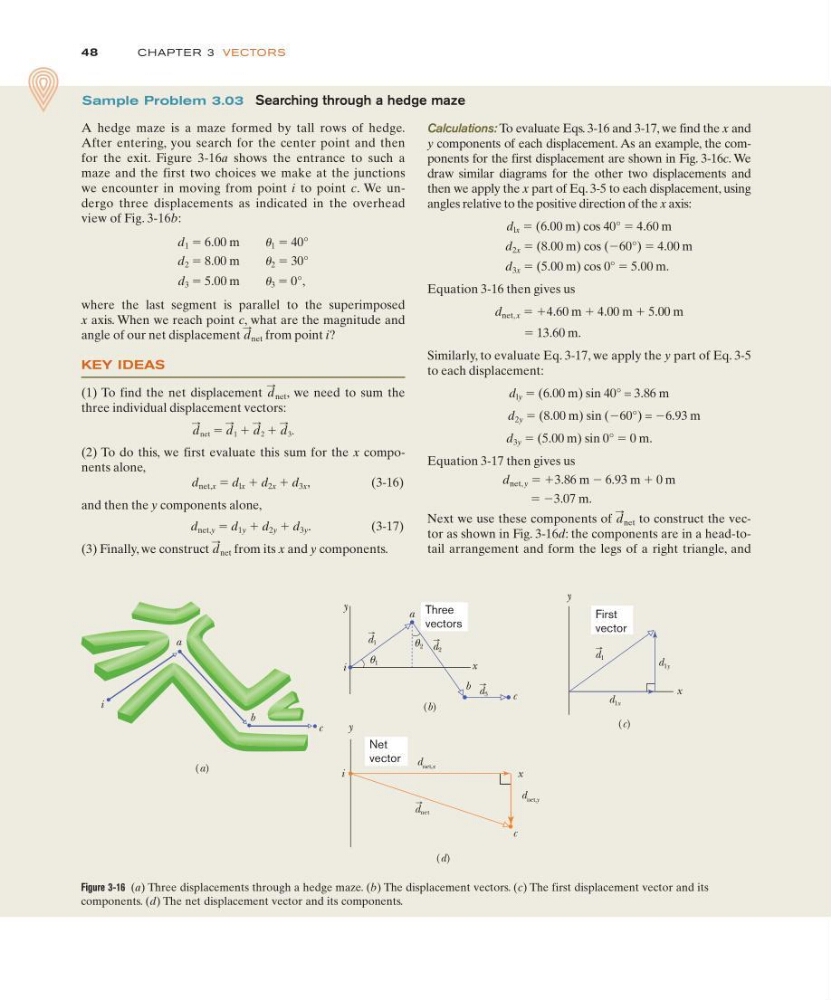
Calculations: To evaluate Eqs. 3-16 and 3-17, we find the x and
y components of each displacement. As an example, the components for the first displacement are shown in Fig. 3-16c. We
draw similar diagrams for the other two displacements and
then we apply the x part of Eq. 3-5 to each displacement, using
angles relative to the positive direction of the x axis:
d lx ϭ (6.00 m) cos 40° ϭ 4.60 m
d 2x ϭ (8.00 m) cos (Ϫ60°) ϭ 4.00 m
d 3x ϭ (5.00 m) cos 0° ϭ 5.00 m.
Equation 3-16 then gives us
d net, x ϭ ϩ4.60 m ϩ 4.00 m ϩ 5.00 m
ϭ 13.60 m.
Similarly, to evaluate Eq. 3-17, we apply the y part of Eq. 3-5
to each displacement:
d ly ϭ (6.00 m) sin 40° = 3.86 m
d 2y ϭ (8.00 m) sin (Ϫ60°) = Ϫ6.93 m
d 3y ϭ (5.00 m) sin 0° ϭ 0 m.
Equation 3-17 then gives us
d net, y ϭ ϩ3.86 m Ϫ 6.93 m ϩ 0 m
ϭ Ϫ3.07 m.
Next we use these components of net to construct the vector as shown in Fig. 3-16d: the components are in a head-totail arrangement and form the legs of a right triangle, and
d
:
Sample Problem 3.03 Searching through a hedge maze
A hedge maze is a maze formed by tall rows of hedge.
After entering, you search for the center point and then
for the exit. Figure 3-16a shows the entrance to such a
maze and the first two choices we make at the junctions
we encounter in moving from point i to point c. We undergo three displacements as indicated in the overhead
view of Fig. 3-16b:
d 1 ϭ 6.00 m
1 ϭ 40°
d 2 ϭ 8.00 m
2 ϭ 30°
d 3 ϭ 5.00 m
3 ϭ 0°,
where the last segment is parallel to the superimposed
x axis. When we reach point c, what are the magnitude and
angle of our net displacement net from point i?
KEY IDEAS
(1) To find the net displacement net , we need to sum the
three individual displacement vectors:
net ϭ 1 ϩ 2 ϩ 3 .
(2) To do this, we first evaluate this sum for the x components alone,
d net,x ϭ d lx ϩ d 2x ϩ d 3x ,
( 3 - 1 6 )
and then the y components alone,
d net,y ϭ d 1y ϩ d 2y ϩ d 3y .
( 3 - 1 7 )
(3) Finally, we construct net from its x and y components.
d
:
d
:
d
:
d
:
d
:
d
:
d
:
Figure 3-16 (a) Three displacements through a hedge maze. (b) The displacement vectors. (c) The first displacement vector and its
components. (d) The net displacement vector and its components.
(a)
y
x
d 1y
d 1x
(c)
a
b
c
i
(b)
y
x
a
b
c
i
u 1
u 2
y
x
d net,x
d net,y
c
(d)
d 1
d 2
d 3
d 1
i
d net
Three
vectors
First
vector
Net
vector
48
Calculations: To evaluate Eqs. 3-16 and 3-17, we find the x and
y components of each displacement. As an example, the components for the first displacement are shown in Fig. 3-16c. We
draw similar diagrams for the other two displacements and
then we apply the x part of Eq. 3-5 to each displacement, using
angles relative to the positive direction of the x axis:
d lx ϭ (6.00 m) cos 40° ϭ 4.60 m
d 2x ϭ (8.00 m) cos (Ϫ60°) ϭ 4.00 m
d 3x ϭ (5.00 m) cos 0° ϭ 5.00 m.
Equation 3-16 then gives us
d net, x ϭ ϩ4.60 m ϩ 4.00 m ϩ 5.00 m
ϭ 13.60 m.
Similarly, to evaluate Eq. 3-17, we apply the y part of Eq. 3-5
to each displacement:
d ly ϭ (6.00 m) sin 40° = 3.86 m
d 2y ϭ (8.00 m) sin (Ϫ60°) = Ϫ6.93 m
d 3y ϭ (5.00 m) sin 0° ϭ 0 m.
Equation 3-17 then gives us
d net, y ϭ ϩ3.86 m Ϫ 6.93 m ϩ 0 m
ϭ Ϫ3.07 m.
Next we use these components of net to construct the vector as shown in Fig. 3-16d: the components are in a head-totail arrangement and form the legs of a right triangle, and
d
:
Sample Problem 3.03 Searching through a hedge maze
A hedge maze is a maze formed by tall rows of hedge.
After entering, you search for the center point and then
for the exit. Figure 3-16a shows the entrance to such a
maze and the first two choices we make at the junctions
we encounter in moving from point i to point c. We undergo three displacements as indicated in the overhead
view of Fig. 3-16b:
d 1 ϭ 6.00 m
1 ϭ 40°
d 2 ϭ 8.00 m
2 ϭ 30°
d 3 ϭ 5.00 m
3 ϭ 0°,
where the last segment is parallel to the superimposed
x axis. When we reach point c, what are the magnitude and
angle of our net displacement net from point i?
KEY IDEAS
(1) To find the net displacement net , we need to sum the
three individual displacement vectors:
net ϭ 1 ϩ 2 ϩ 3 .
(2) To do this, we first evaluate this sum for the x components alone,
d net,x ϭ d lx ϩ d 2x ϩ d 3x ,
( 3 - 1 6 )
and then the y components alone,
d net,y ϭ d 1y ϩ d 2y ϩ d 3y .
( 3 - 1 7 )
(3) Finally, we construct net from its x and y components.
d
:
d
:
d
:
d
:
d
:
d
:
d
:
Figure 3-16 (a) Three displacements through a hedge maze. (b) The displacement vectors. (c) The first displacement vector and its
components. (d) The net displacement vector and its components.
(a)
y
x
d 1y
d 1x
(c)
a
b
c
i
(b)
y
x
a
b
c
i
u 1
u 2
y
x
d net,x
d net,y
c
(d)
d 1
d 2
d 3
d 1
i
d net
Three
vectors
First
vector
Net
vector