

722
CHAPTE R 25 CAPACITANCE
Checkpoint 2
For capacitors charged by the same battery, does the charge stored by the capacitor
increase, decrease, or remain the same in each of the following situations? (a) The
plate separation of a parallel-plate capacitor is increased. (b) The radius of the inner
cylinder of a cylindrical capacitor is increased. (c) The radius of the outer spherical
shell of a spherical capacitor is increased.
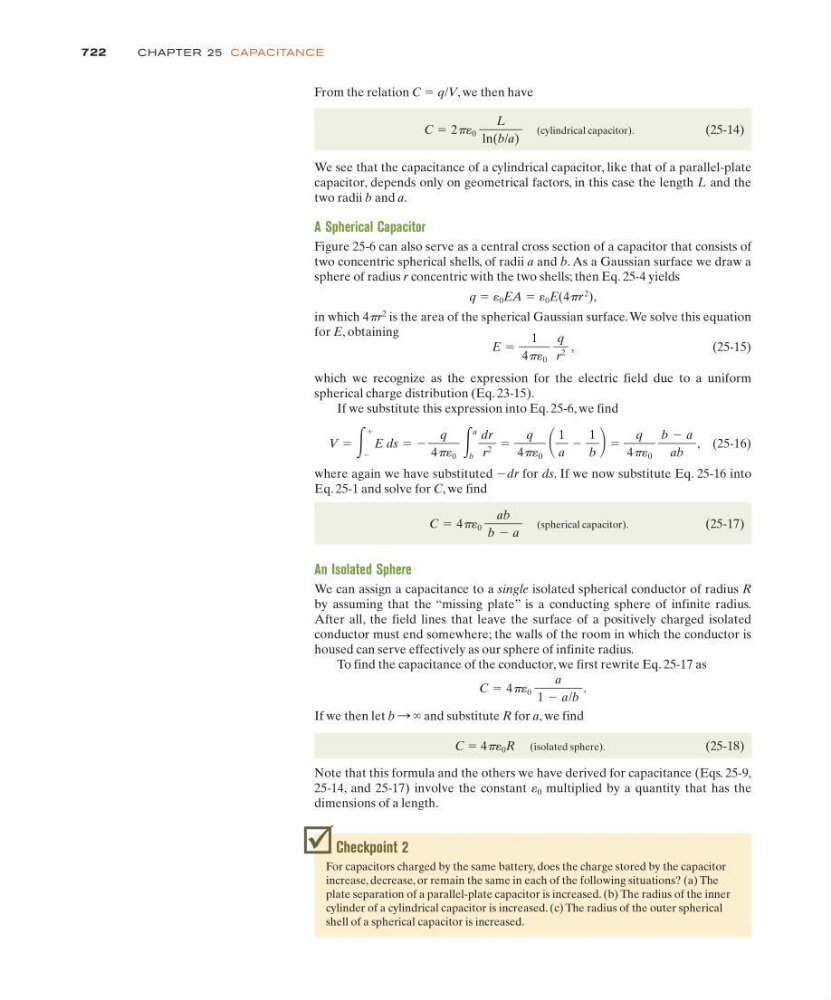
From the relation C ϭ q/V, we then have
(cylindrical capacitor).
(25-14)
We see that the capacitance of a cylindrical capacitor, like that of a parallel-plate
capacitor, depends only on geometrical factors, in this case the length L and the
two radii b and a.
A Spherical Capacitor
Figure 25-6 can also serve as a central cross section of a capacitor that consists of
two concentric spherical shells, of radii a and b. As a Gaussian surface we draw a
sphere of radius r concentric with the two shells; then Eq. 25-4 yields
q ϭ ´ 0 EA ϭ ´ 0 E(4pr
2
),
in which 4pr
2
is the area of the spherical Gaussian surface. We solve this equation
for E, obtaining
(25-15)
which we recognize as the expression for the electric field due to a uniform
spherical charge distribution (Eq. 23-15).
If we substitute this expression into Eq. 25-6, we find
(25-16)
where again we have substituted Ϫdr for ds. If we now substitute Eq. 25-16 into
Eq. 25-1 and solve for C, we find
(spherical capacitor).
(25-17)
An Isolated Sphere
We can assign a capacitance to a single isolated spherical conductor of radius R
by assuming that the “missing plate” is a conducting sphere of infinite radius.
After all, the field lines that leave the surface of a positively charged isolated
conductor must end somewhere; the walls of the room in which the conductor is
housed can serve effectively as our sphere of infinite radius.
To find the capacitance of the conductor, we first rewrite Eq. 25-17 as
If we then let b : ϱ and substitute R for a, we find
C ϭ 4p´ 0 R (isolated sphere).
(25-18)
Note that this formula and the others we have derived for capacitance (Eqs. 25-9,
25-14, and 25-17) involve the constant ´ 0 multiplied by a quantity that has the
dimensions of a length.
C ϭ 4p´ 0
a
1 Ϫ a/b
.
C ϭ 4p´ 0
ab
b Ϫ a
V ϭ ͵
ϩ
Ϫ
E ds ϭ Ϫ
q
4p´ 0
͵
a
b
dr
r
2
ϭ
q
4p´ 0
1
a
Ϫ
1
b ϭ
q
4p´ 0
b Ϫ a
ab
,
E ϭ
1
4p´ 0
q
r
2
,
C ϭ 2p´ 0
L
ln(b/a)