

702
CHAPTE R 24 ELECTRIC POTENTIAL
Checkpoint 5
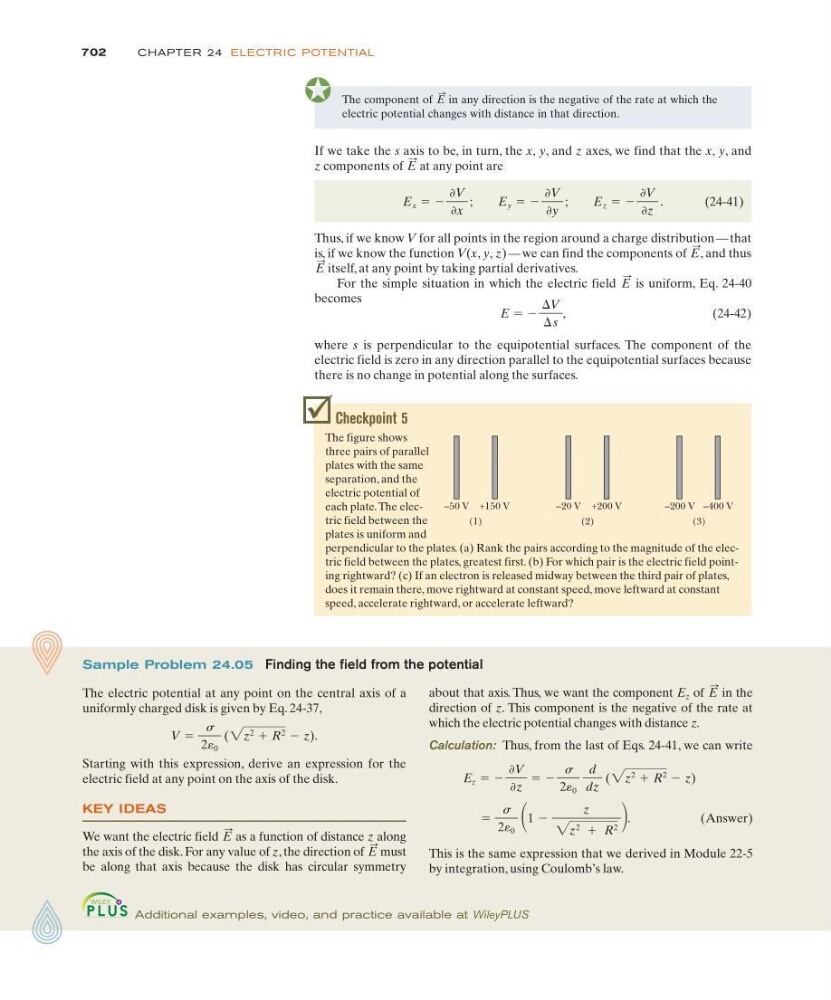
The figure shows
three pairs of parallel
plates with the same
separation, and the
electric potential of
each plate. The electric field between the
plates is uniform and
perpendicular to the plates. (a) Rank the pairs according to the magnitude of the electric field between the plates, greatest first. (b) For which pair is the electric field pointing rightward? (c) If an electron is released midway between the third pair of plates,
does it remain there, move rightward at constant speed, move leftward at constant
speed, accelerate rightward, or accelerate leftward?
–50 V +150 V
–20 V +200 V
–200 V –400 V
(1)
( 2)
( 3)
about that axis. Thus, we want the component E z of in the
direction of z. This component is the negative of the rate at
which the electric potential changes with distance z.
Calculation: Thus, from the last of Eqs. 24-41, we can write
(Answer)
This is the same expression that we derived in Module 22-5
by integration, using Coulomb’s law.
ϭ
s
2´ 0
1 Ϫ
z
2z
2 ϩ R
2
.
E z ϭ Ϫ
ѨV
Ѩz
ϭ Ϫ
s
2´ 0
d
dz
(2z
2 ϩ R
2 Ϫ z)
E
:
Sample Problem 24.05 Finding the field from the potential
The electric potential at any point on the central axis of a
uniformly charged disk is given by Eq. 24-37,
Starting with this expression, derive an expression for the
electric field at any point on the axis of the disk.
KEY IDEAS
We want the electric field as a function of distance z along
the axis of the disk. For any value of z, the direction of must
be along that axis because the disk has circular symmetry
E
:
E
:
V ϭ
s
2´ 0
( 2z
2 ϩ R
2 Ϫ z).
Additional examples, video, and practice available at WileyPLUS
If we take the s axis to be, in turn, the x, y, and z axes, we find that the x, y, and
z components of at any point are
(24-41)
Thus, if we know V for all points in the region around a charge distribution — that
is, if we know the function V(x, y, z) — we can find the components of , and thus
itself, at any point by taking partial derivatives.
For the simple situation in which the electric field
is uniform, Eq. 24-40
becomes
(24-42)
where s is perpendicular to the equipotential surfaces. The component of the
electric field is zero in any direction parallel to the equipotential surfaces because
there is no change in potential along the surfaces.
E ϭ Ϫ
⌬V
⌬ s
,
E
:
E
:
E
:
E x ϭ Ϫ
ѨV
Ѩx
;
E y ϭ Ϫ
ѨV
Ѩy
;
E z ϭ Ϫ
ѨV
Ѩz
.
E
:
The component of in any direction is the negative of the rate at which the
electric potential changes with distance in that direction.
E
: