

CHAPTE R 3 VECTORS
46
3-2 UNIT VECTORS, ADDING VECTORS BY COMPONENTS
After reading this module, you should be able to . . .
3.06 Convert a vector between magnitude-angle and unitvector notations.
3.07 Add and subtract vectors in magnitude-angle notation
and in unit-vector notation.
3.08 Identify that, for a given vector, rotating the coordinate
system about the origin can change the vector’s components but not the vector itself.
● Unit vectors , , and have magnitudes of unity and are
directed in the positive directions of the x, y, and z axes,
respectively, in a right-handed coordinate system. We can
write a vector in terms of unit vectors as
ϭ a x i
ˆ ϩ a y j ˆ ϩ a z k ˆ ,
a
:
a
:
k ˆ
j
ˆ
i
ˆ
in which , , and
are the vector components of and
a x , a y , and a z are its scalar components.
● To add vectors in component form, we use the rules
r x ϭ a x ϩ b x r y ϭ a y ϩ b y r z ϭ a z ϩ b z .
Here and are the vectors to be added, and is the vector
sum. Note that we add components axis by axis.
r
:
b
:
a
:
a
:
a z k ˆ
a y j ˆ
a x i ˆ
Learning Objectives
Key Ideas
ˆ
ˆ
y
x
O
a x i
a y j
θ
(a)
a
b x i
ˆ
ˆ
θ
O
x
y
b y j
(b)
b
This is the x vector
component.
This is the y vector component.
Figure 3-14 (a) The vector components
of vector . (b) The vector components
of vector .
b
:
a
:
Unit Vectors
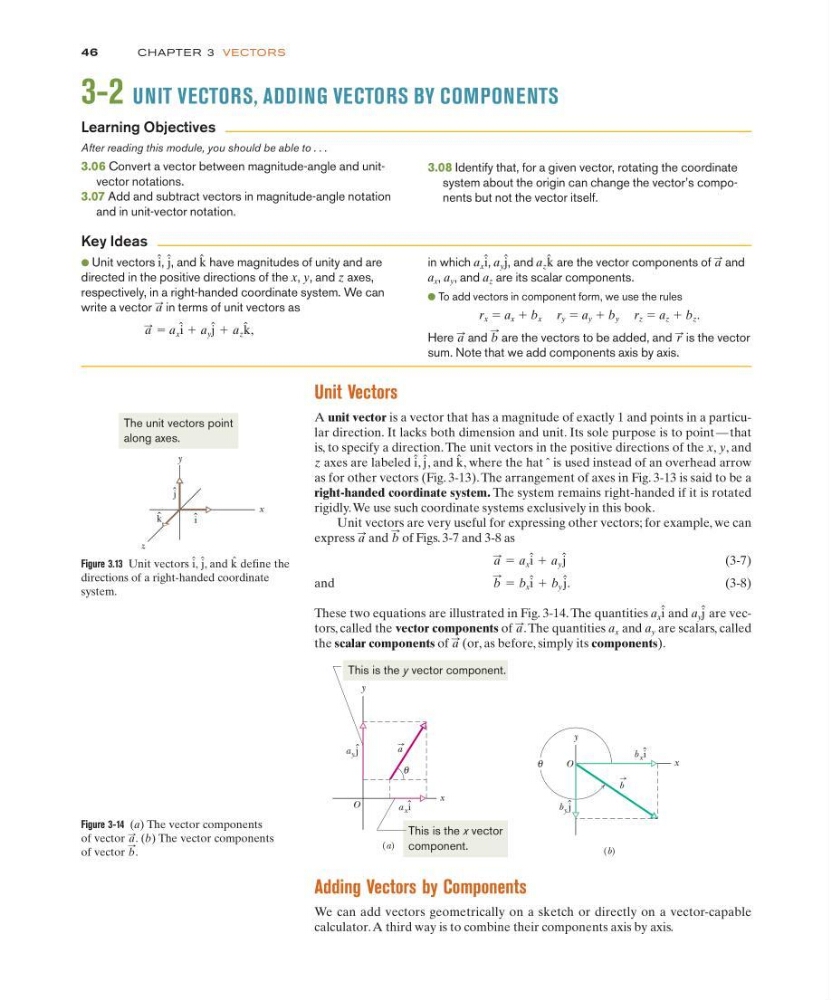
A unit vector is a vector that has a magnitude of exactly 1 and points in a particular direction. It lacks both dimension and unit. Its sole purpose is to point — that
is, to specify a direction. The unit vectors in the positive directions of the x, y, and
z axes are labeled , , and , where the hat is used instead of an overhead arrow
as for other vectors (Fig. 3-13). The arrangement of axes in Fig. 3-13 is said to be a
right-handed coordinate system. The system remains right-handed if it is rotated
rigidly. We use such coordinate systems exclusively in this book.
Unit vectors are very useful for expressing other vectors; for example, we can
express and of Figs. 3-7 and 3-8 as
(3-7)
and
.
(3-8)
These two equations are illustrated in Fig. 3-14. The quantities a x and a y are vectors, called the vector components of . The quantities a x and a y are scalars, called
the scalar components of (or, as before, simply its components).
a
:
a
:
j
ˆ
i
ˆ
b
: ϭ b x i
ˆ ϩ b y j
ˆ
a
: ϭ a x i
ˆ ϩ a y j
ˆ
b
:
a
:
ˆ
k ˆ
j ˆ
i ˆ
Adding Vectors by Components
We can add vectors geometrically on a sketch or directly on a vector-capable
calculator. A third way is to combine their components axis by axis.
Figure 3.13 Unit vectors i ˆ , , and define the
directions of a right-handed coordinate
system.
k ˆ
j
ˆ
y
x
z
j
ˆ
i
ˆ
k
ˆ
The unit vectors point
along axes.
46
3-2 UNIT VECTORS, ADDING VECTORS BY COMPONENTS
After reading this module, you should be able to . . .
3.06 Convert a vector between magnitude-angle and unitvector notations.
3.07 Add and subtract vectors in magnitude-angle notation
and in unit-vector notation.
3.08 Identify that, for a given vector, rotating the coordinate
system about the origin can change the vector’s components but not the vector itself.
● Unit vectors , , and have magnitudes of unity and are
directed in the positive directions of the x, y, and z axes,
respectively, in a right-handed coordinate system. We can
write a vector in terms of unit vectors as
ϭ a x i
ˆ ϩ a y j ˆ ϩ a z k ˆ ,
a
:
a
:
k ˆ
j
ˆ
i
ˆ
in which , , and
are the vector components of and
a x , a y , and a z are its scalar components.
● To add vectors in component form, we use the rules
r x ϭ a x ϩ b x r y ϭ a y ϩ b y r z ϭ a z ϩ b z .
Here and are the vectors to be added, and is the vector
sum. Note that we add components axis by axis.
r
:
b
:
a
:
a
:
a z k ˆ
a y j ˆ
a x i ˆ
Learning Objectives
Key Ideas
ˆ
ˆ
y
x
O
a x i
a y j
θ
(a)
a
b x i
ˆ
ˆ
θ
O
x
y
b y j
(b)
b
This is the x vector
component.
This is the y vector component.
Figure 3-14 (a) The vector components
of vector . (b) The vector components
of vector .
b
:
a
:
Unit Vectors
A unit vector is a vector that has a magnitude of exactly 1 and points in a particular direction. It lacks both dimension and unit. Its sole purpose is to point — that
is, to specify a direction. The unit vectors in the positive directions of the x, y, and
z axes are labeled , , and , where the hat is used instead of an overhead arrow
as for other vectors (Fig. 3-13). The arrangement of axes in Fig. 3-13 is said to be a
right-handed coordinate system. The system remains right-handed if it is rotated
rigidly. We use such coordinate systems exclusively in this book.
Unit vectors are very useful for expressing other vectors; for example, we can
express and of Figs. 3-7 and 3-8 as
(3-7)
and
.
(3-8)
These two equations are illustrated in Fig. 3-14. The quantities a x and a y are vectors, called the vector components of . The quantities a x and a y are scalars, called
the scalar components of (or, as before, simply its components).
a
:
a
:
j
ˆ
i
ˆ
b
: ϭ b x i
ˆ ϩ b y j
ˆ
a
: ϭ a x i
ˆ ϩ a y j
ˆ
b
:
a
:
ˆ
k ˆ
j ˆ
i ˆ
Adding Vectors by Components
We can add vectors geometrically on a sketch or directly on a vector-capable
calculator. A third way is to combine their components axis by axis.
Figure 3.13 Unit vectors i ˆ , , and define the
directions of a right-handed coordinate
system.
k ˆ
j
ˆ
y
x
z
j
ˆ
i
ˆ
k
ˆ
The unit vectors point
along axes.