

45
the x axis. If it is measured relative to some other direction, then the trig functions in Eq. 3-5 may have to be interchanged and the ratio in Eq. 3-6 may have to be
inverted. A safer method is to convert the angle to one
measured from the positive direction of the x axis. In
WileyPLUS, the system expects you to report an angle of
direction like this (and positive if counterclockwise and
negative if clockwise).
Problem-Solving Tactics Angles, trig functions, and inverse trig functions
Tactic 1: Angles—Degrees and Radians Angles that are
measured relative to the positive direction of the x axis are
positive if they are measured in the counterclockwise direction and negative if measured clockwise. For example, 210°
and Ϫ150° are the same angle.
Angles may be measured in degrees or radians (rad). To
relate the two measures, recall that a full circle is 360° and
2p rad. To convert, say, 40° to radians, write
Tactic 2: Trig Functions You need to know the definitions
of the common trigonometric functions — sine, cosine, and
tangent — because they are part of the language of science
and engineering. They are given in Fig. 3-11 in a form that
does not depend on how the triangle is labeled.
You should also be able to sketch how the trig functions
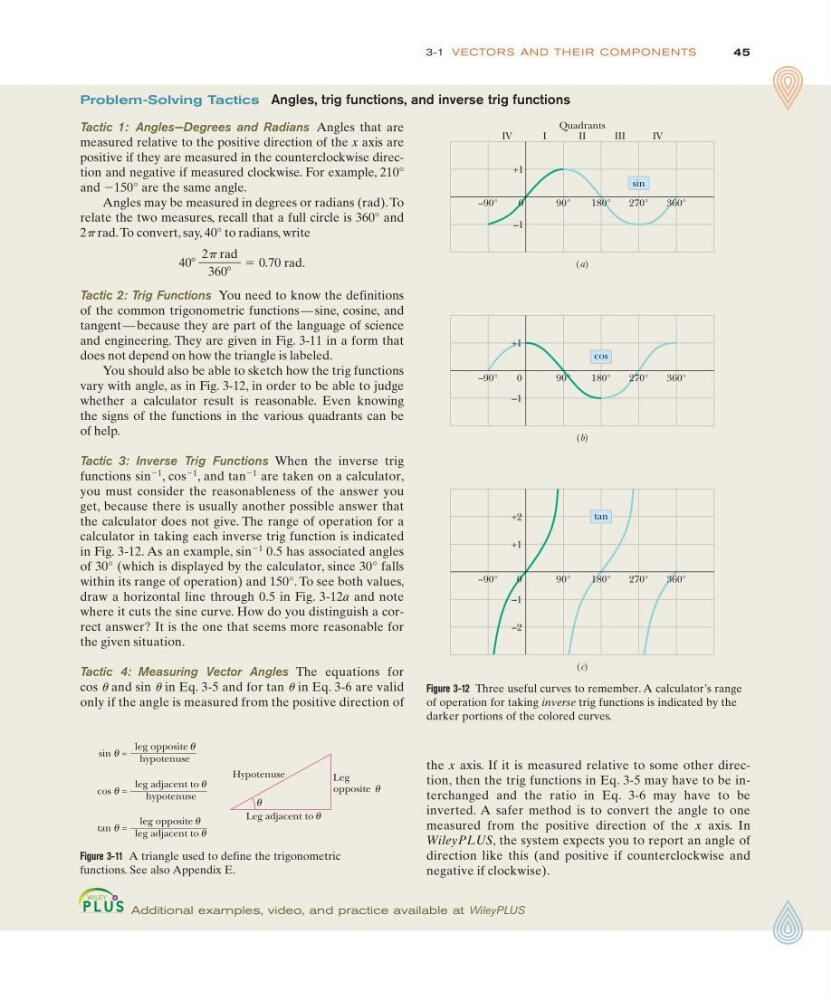
vary with angle, as in Fig. 3-12, in order to be able to judge
whether a calculator result is reasonable. Even knowing
the signs of the functions in the various quadrants can be
of help.
Tactic 3: Inverse Trig Functions When the inverse trig
functions sin
Ϫ1
, cos
Ϫ1
, and tan
Ϫ1
are taken on a calculator,
you must consider the reasonableness of the answer you
get, because there is usually another possible answer that
the calculator does not give. The range of operation for a
calculator in taking each inverse trig function is indicated
in Fig. 3-12. As an example, sin
Ϫ1
0.5 has associated angles
of 30° (which is displayed by the calculator, since 30° falls
within its range of operation) and 150°. To see both values,
draw a horizontal line through 0.5 in Fig. 3-12a and note
where it cuts the sine curve. How do you distinguish a correct answer? It is the one that seems more reasonable for
the given situation.
Tactic 4: Measuring Vector Angles The equations for
cos u and sin u in Eq. 3-5 and for tan u in Eq. 3-6 are valid
only if the angle is measured from the positive direction of
40Њ
2 rad
360Њ
ϭ 0.70 rad.
Figure 3-11 A triangle used to define the trigonometric
functions. See also Appendix E.
θ
Hypotenuse
Leg adjacent to θ
Leg
opposite θ
sin θ
leg opposite θ
hypotenuse
=
cos θ
hypotenuse
=
leg adjacent to θ
tan θ = leg adjacent to θ
leg opposite θ
3-1 VECTORS AN D TH E I R COM PON E NTS
Additional examples, video, and practice available at WileyPLUS
Figure 3-12 Three useful curves to remember. A calculator’s range
of operation for taking inverse trig functions is indicated by the
darker portions of the colored curves.
90°
270°
–90°
+1
–1
IV
I
II
III
IV
Quadrants
(a)
0
sin
180°
360°
(b)
0
cos
90°
180°
270°
360°
–90°
+1
–1
(c)
90°
270°
–90°
+1
+2
–1
–2
tan
180°
360°
0
the x axis. If it is measured relative to some other direction, then the trig functions in Eq. 3-5 may have to be interchanged and the ratio in Eq. 3-6 may have to be
inverted. A safer method is to convert the angle to one
measured from the positive direction of the x axis. In
WileyPLUS, the system expects you to report an angle of
direction like this (and positive if counterclockwise and
negative if clockwise).
Problem-Solving Tactics Angles, trig functions, and inverse trig functions
Tactic 1: Angles—Degrees and Radians Angles that are
measured relative to the positive direction of the x axis are
positive if they are measured in the counterclockwise direction and negative if measured clockwise. For example, 210°
and Ϫ150° are the same angle.
Angles may be measured in degrees or radians (rad). To
relate the two measures, recall that a full circle is 360° and
2p rad. To convert, say, 40° to radians, write
Tactic 2: Trig Functions You need to know the definitions
of the common trigonometric functions — sine, cosine, and
tangent — because they are part of the language of science
and engineering. They are given in Fig. 3-11 in a form that
does not depend on how the triangle is labeled.
You should also be able to sketch how the trig functions
vary with angle, as in Fig. 3-12, in order to be able to judge
whether a calculator result is reasonable. Even knowing
the signs of the functions in the various quadrants can be
of help.
Tactic 3: Inverse Trig Functions When the inverse trig
functions sin
Ϫ1
, cos
Ϫ1
, and tan
Ϫ1
are taken on a calculator,
you must consider the reasonableness of the answer you
get, because there is usually another possible answer that
the calculator does not give. The range of operation for a
calculator in taking each inverse trig function is indicated
in Fig. 3-12. As an example, sin
Ϫ1
0.5 has associated angles
of 30° (which is displayed by the calculator, since 30° falls
within its range of operation) and 150°. To see both values,
draw a horizontal line through 0.5 in Fig. 3-12a and note
where it cuts the sine curve. How do you distinguish a correct answer? It is the one that seems more reasonable for
the given situation.
Tactic 4: Measuring Vector Angles The equations for
cos u and sin u in Eq. 3-5 and for tan u in Eq. 3-6 are valid
only if the angle is measured from the positive direction of
40Њ
2 rad
360Њ
ϭ 0.70 rad.
Figure 3-11 A triangle used to define the trigonometric
functions. See also Appendix E.
θ
Hypotenuse
Leg adjacent to θ
Leg
opposite θ
sin θ
leg opposite θ
hypotenuse
=
cos θ
hypotenuse
=
leg adjacent to θ
tan θ = leg adjacent to θ
leg opposite θ
3-1 VECTORS AN D TH E I R COM PON E NTS
Additional examples, video, and practice available at WileyPLUS
Figure 3-12 Three useful curves to remember. A calculator’s range
of operation for taking inverse trig functions is indicated by the
darker portions of the colored curves.
90°
270°
–90°
+1
–1
IV
I
II
III
IV
Quadrants
(a)
0
sin
180°
360°
(b)
0
cos
90°
180°
270°
360°
–90°
+1
–1
(c)
90°
270°
–90°
+1
+2
–1
–2
tan
180°
360°
0