

are (c) ⌽ and (d) q enc if
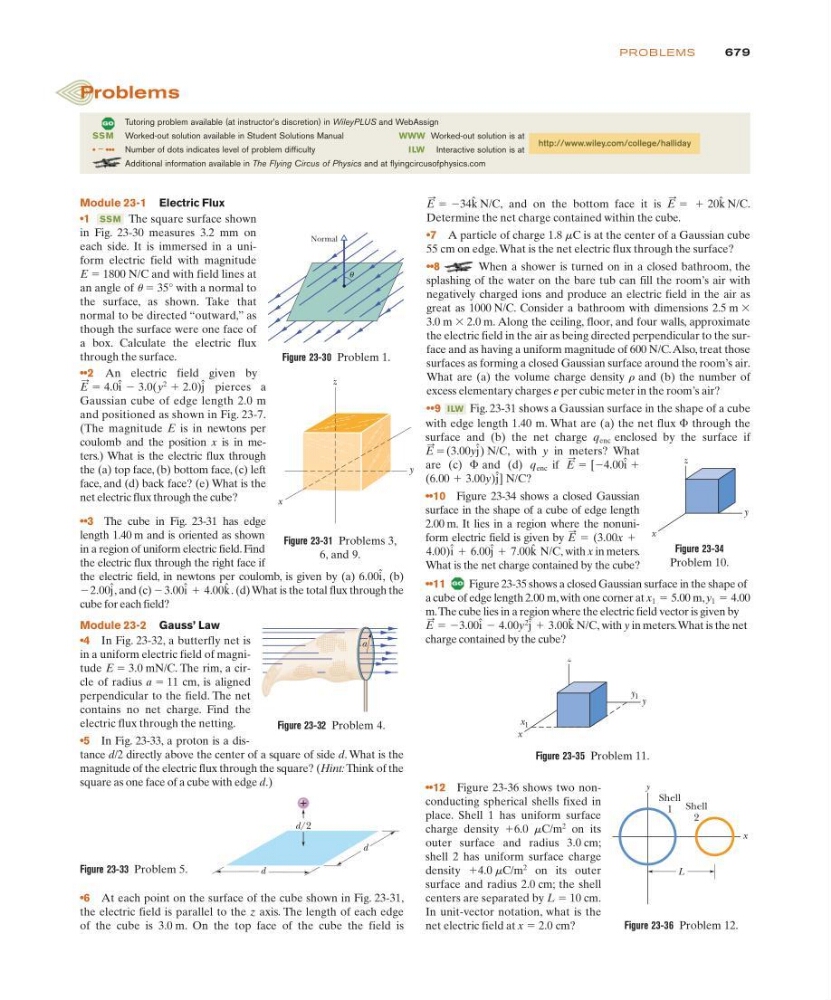
••10 Figure 23-34 shows a closed Gaussian
surface in the shape of a cube of edge length
2.00 m. It lies in a region where the nonuniform electric field is given by
with x in meters.
What is the net charge contained by the cube?
••11
Figure 23-35 shows a closed Gaussian surface in the shape of
a cube of edge length 2.00 m, with one corner at x 1 5.00 m, y 1 4.00
m.The cube lies in a region where the electric field vector is given by
with y in meters.What is the net
charge contained by the cube?
E
: ϭ Ϫ3.00i ˆ Ϫ 4.00y
2
j ˆ ϩ 3.00k ˆ N/C,
ϭ
ϭ
7.00k ˆ N/C,
ϩ
6.00j ˆ
ϩ
4.00)i ˆ
ϩ
(3.00x
ϭ
E
:
(6.00 ϩ 3.00y)j ˆ ] N/C?
E
: ϭ [Ϫ4.00i ˆ ϩ
with edge length 1.40 m. What are (a) the net flux ⌽ through the
surface and (b) the net charge q enc enclosed by the surface if
with y in meters? What
E
: ϭ(3.00yj ˆ ) N/C,
679
PROB LE M S
and on the bottom face it is
Determine the net charge contained within the cube.
•7 A particle of charge 1.8 mC is at the center of a Gaussian cube
55 cm on edge. What is the net electric flux through the surface?
••8
When a shower is turned on in a closed bathroom, the
splashing of the water on the bare tub can fill the room’s air with
negatively charged ions and produce an electric field in the air as
great as 1000 N/C. Consider a bathroom with dimensions 2.5 m ϫ
3.0 m ϫ 2.0 m. Along the ceiling, floor, and four walls, approximate
the electric field in the air as being directed perpendicular to the surface and as having a uniform magnitude of 600 N/C.Also, treat those
surfaces as forming a closed Gaussian surface around the room’s air.
What are (a) the volume charge density r and (b) the number of
excess elementary charges e per cubic meter in the room’s air?
••9
Fig. 23-31 shows a Gaussian surface in the shape of a cube
ILW
E
: ϭ ϩ 20k ˆ N/C.
E
: ϭ Ϫ34k ˆ N/C,
Module 23-1 Electric Flux
•1
The square surface shown
in Fig. 23-30 measures 3.2 mm on
each side. It is immersed in a uniform electric field with magnitude
E ϭ 1800 N/C and with field lines at
an angle of u ϭ 35° with a normal to
the surface, as shown. Take that
normal to be directed “outward,” as
though the surface were one face of
a box. Calculate the electric flux
through the surface.
••2 An electric field given by
pierces a
Gaussian cube of edge length 2.0 m
and positioned as shown in Fig. 23-7.
(The magnitude E is in newtons per
coulomb and the position x is in meters.) What is the electric flux through
the (a) top face, (b) bottom face, (c) left
face, and (d) back face? (e) What is the
net electric flux through the cube?
••3 The cube in Fig. 23-31 has edge
length 1.40 m and is oriented as shown
in a region of uniform electric field. Find
the electric flux through the right face if
the electric field, in newtons per coulomb, is given by (a)
(b)
and (c)
(d) What is the total flux through the
cube for each field?
Module 23-2 Gauss’ Law
•4 In Fig. 23-32, a butterfly net is
in a uniform electric field of magnitude E ϭ 3.0 mN/C. The rim, a circle of radius a ϭ 11 cm, is aligned
perpendicular to the field. The net
contains no net charge. Find the
electric flux through the netting.
•5 In Fig. 23-33, a proton is a distance d/2 directly above the center of a square of side d. What is the
magnitude of the electric flux through the square? (Hint: Think of the
square as one face of a cube with edge d.)
Ϫ3.00i ˆ ϩ 4.00k ˆ .
Ϫ2.00j ˆ ,
6.00i ˆ ,
E
: ϭ 4.0i ˆ Ϫ 3.0(y
2 ϩ 2.0)j ˆ
SSM
Tutoring problem available (at instructor’s discretion) in WileyPLUS and WebAssign
SSM Worked-out solution available in Student Solutions Manual
• – ••• Number of dots indicates level of problem difficulty
Additional information available in The Flying Circus of Physics and at flyingcircusofphysics.com
WWW Worked-out solution is at
ILW Interactive solution is at
http://www.wiley.com/college/halliday
Problems
Normal
θ
Figure 23-30 Problem 1.
z
y
x
Figure 23-31 Problems 3,
6, and 9.
a
Figure 23-32 Problem 4.
d/2
d
d
+
Figure 23-33 Problem 5.
x
y
z
Figure 23-34
Problem 10.
Figure 23-35 Problem 11.
x
y
z
x 1
y 1
••12 Figure 23-36 shows two nonconducting spherical shells fixed in
place. Shell 1 has uniform surface
charge density ϩ6.0 mC/m
2
on its
outer surface and radius 3.0 cm;
shell 2 has uniform surface charge
density ϩ4.0 mC/m
2
on its outer
surface and radius 2.0 cm; the shell
centers are separated by L ϭ 10 cm.
In unit-vector notation, what is the
net electric field at x ϭ 2.0 cm?
Shell
1 Shell
2
y
x
L
Figure 23-36 Problem 12.
•6 At each point on the surface of the cube shown in Fig. 23-31,
the electric field is parallel to the z axis. The length of each edge
of the cube is 3.0 m. On the top face of the cube the field is