

678
CHAPTE R 23 GAUSS’ L AW
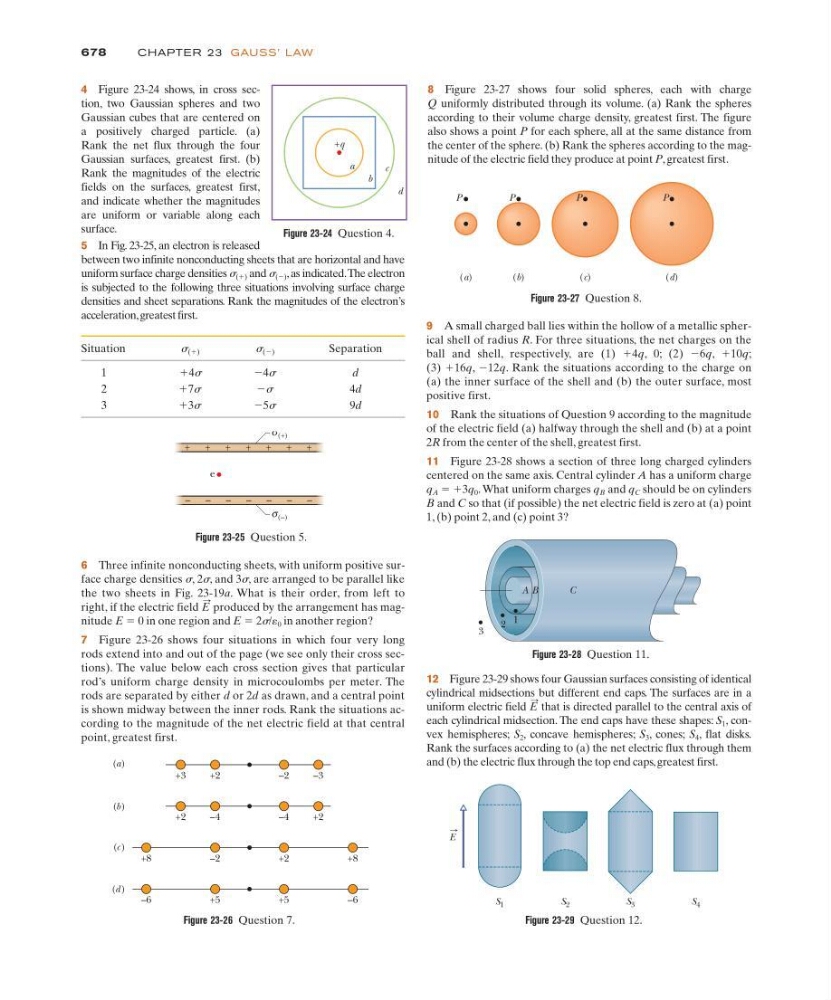
Figure 23-26 Question 7.
(a)
(b)
(c)
(d )
+3
+2
–2
–3
–2
+2
+8
+5
+8
–6
+5
–6
+2
–4
–4
+2
E
S 1
S 2
S 3
S 4
C
A
1
B
2
3
Figure 23-28 Question 11.
Figure 23-29 Question 12.
4 Figure 23-24 shows, in cross section, two Gaussian spheres and two
Gaussian cubes that are centered on
a positively charged particle. (a)
Rank the net flux through the four
Gaussian surfaces, greatest first. (b)
Rank the magnitudes of the electric
fields on the surfaces, greatest first,
and indicate whether the magnitudes
are uniform or variable along each
surface.
5 In Fig. 23-25, an electron is released
between two infinite nonconducting sheets that are horizontal and have
uniform surface charge densities s (ϩ) and s (Ϫ) , as indicated.The electron
is subjected to the following three situations involving surface charge
densities and sheet separations. Rank the magnitudes of the electron’s
acceleration,greatest first.
Situation
s (ϩ)
s (Ϫ)
Separation
1
ϩ4s
Ϫ4s
d
2
ϩ7s
Ϫs
4d
3
ϩ3s
Ϫ5s
9d
Figure 23-24 Question 4.
a
b
c
d
+q
+
+
+
+
+
+
+
–
–
–
–
–
–
–
e
(–)
σ
(+)
σ
Figure 23-25 Question 5.
6 Three infinite nonconducting sheets, with uniform positive surface charge densities s, 2s, and 3s, are arranged to be parallel like
the two sheets in Fig. 23-19a. What is their order, from left to
right, if the electric field produced by the arrangement has magnitude E ϭ 0 in one region and E ϭ 2s/´ 0 in another region?
7 Figure 23-26 shows four situations in which four very long
rods extend into and out of the page (we see only their cross sections). The value below each cross section gives that particular
rod’s uniform charge density in microcoulombs per meter. The
rods are separated by either d or 2d as drawn, and a central point
is shown midway between the inner rods. Rank the situations according to the magnitude of the net electric field at that central
point, greatest first.
E
:
8 Figure 23-27 shows four solid spheres, each with charge
Q uniformly distributed through its volume. (a) Rank the spheres
according to their volume charge density, greatest first. The figure
also shows a point P for each sphere, all at the same distance from
the center of the sphere. (b) Rank the spheres according to the magnitude of the electric field they produce at point P, greatest first.
(a)
( b)
( c)
( d)
P
P
P
P
Figure 23-27 Question 8.
9 A small charged ball lies within the hollow of a metallic spherical shell of radius R. For three situations, the net charges on the
ball and shell, respectively, are (1) ϩ4q, 0; (2) Ϫ6q, ϩ10q;
(3) ϩ16q, Ϫ12q. Rank the situations according to the charge on
(a) the inner surface of the shell and (b) the outer surface, most
positive first.
10 Rank the situations of Question 9 according to the magnitude
of the electric field (a) halfway through the shell and (b) at a point
2R from the center of the shell, greatest first.
11 Figure 23-28 shows a section of three long charged cylinders
centered on the same axis. Central cylinder A has a uniform charge
q A ϭ ϩ3q 0 . What uniform charges q B and q C should be on cylinders
B and C so that (if possible) the net electric field is zero at (a) point
1, (b) point 2, and (c) point 3?
12 Figure 23-29 shows four Gaussian surfaces consisting of identical
cylindrical midsections but different end caps. The surfaces are in a
uniform electric field that is directed parallel to the central axis of
each cylindrical midsection. The end caps have these shapes: S 1 , convex hemispheres; S 2 , concave hemispheres; S 3 , cones; S 4 , flat disks.
Rank the surfaces according to (a) the net electric flux through them
and (b) the electric flux through the top end caps, greatest first.
E
: