

The loop on the integral sign indicates that we must integrate over the entire closed
surface, to get the net flux through the surface (as in Fig. 23-5, flux might enter on
one side and leave on another side). Keep in mind that we want to determine the
net flux through a surface because that is what Gauss’ law relates to the charge enclosed by the surface. (The law is coming up next.) Note that flux is a scalar (yes, we
talk about field vectors but flux is the amount of piercing field, not a vector itself).
The SI unit of flux is the newton–square-meter per coulomb
.
(Nиm
2
/C)
662
CHAPTE R 23 GAUSS’ L AW
Checkpoint 1
The figure here shows a Gaussian cube of face area A
immersed in a uniform electric field that has the positive
direction of the z axis. In terms of E and A, what is the flux
through (a) the front face (which is in the xy plane), (b) the
rear face, (c) the top face, and (d) the whole cube?
E
:
y
x
z
A
E
where
gives the cap’s area A (ϭ pR
2
). Similarly, for the
right cap, where
0 for all points,
Finally, for the cylindrical surface, where the angle u is 90Њ at
all points,
Substituting these results into Eq. 23-5 leads us to
⌽ ϭ ϪEA ϩ 0 ϩ EA ϭ 0.
(Answer)
The net flux is zero because the field lines that represent the
electric field all pass entirely through the Gaussian surface,
from the left to the right.
͵
b
E
: ؒ dA
: ϭ ͵E(cos 90Њ) dA ϭ 0.
͵
c
E
: ؒ dA
: ϭ ͵E(cos 0) dA ϭ EA.
u ϭ
͵ dA
͵
a
E
: ؒ dA
: ϭ ͵E(cos 180Њ) dA ϭ ϪE ͵dA ϭ ϪEA,
Sample Problem 23.01 Flux through a closed cylinder, uniform field
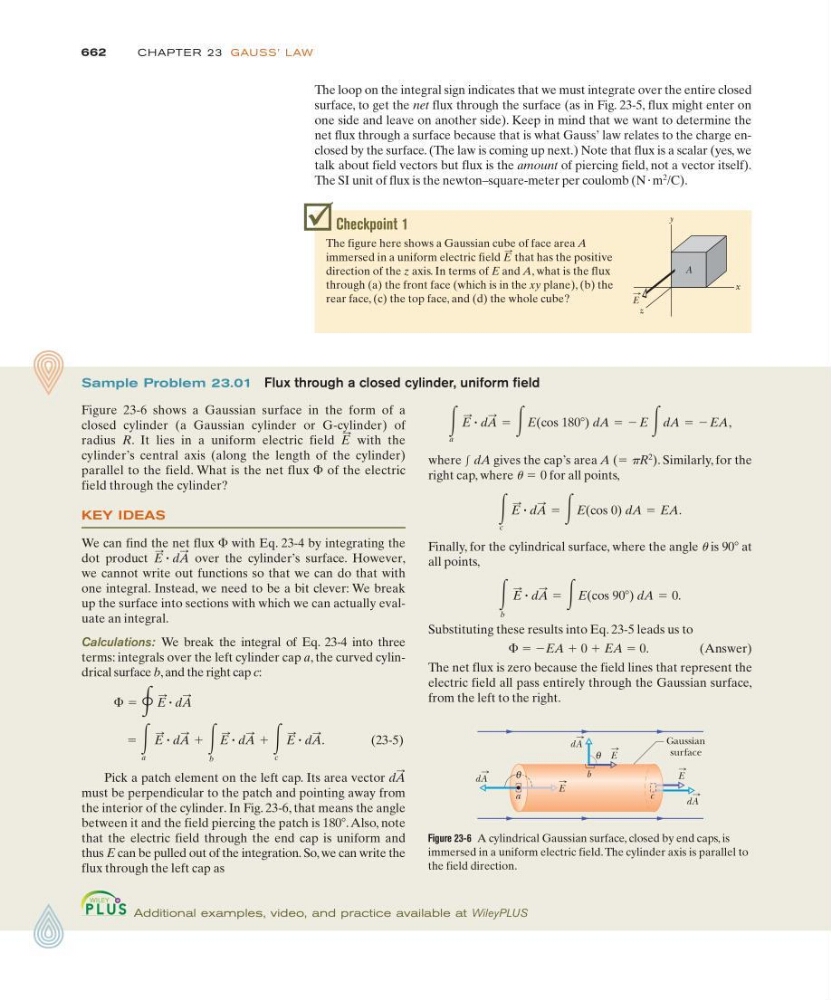
Figure 23-6 shows a Gaussian surface in the form of a
closed cylinder (a Gaussian cylinder or G-cylinder) of
radius R. It lies in a uniform electric field
with the
cylinder’s central axis (along the length of the cylinder)
parallel to the field. What is the net flux ⌽ of the electric
field through the cylinder?
KEY IDEAS
We can find the net flux ⌽ with Eq. 23-4 by integrating the
dot product
over the cylinder’s surface. However,
we cannot write out functions so that we can do that with
one integral. Instead, we need to be a bit clever: We break
up the surface into sections with which we can actually evaluate an integral.
Calculations: We break the integral of Eq. 23-4 into three
terms: integrals over the left cylinder cap a, the curved cylindrical surface b, and the right cap c:
(23-5)
Pick a patch element on the left cap. Its area vector
must be perpendicular to the patch and pointing away from
the interior of the cylinder. In Fig. 23-6, that means the angle
between it and the field piercing the patch is 180Њ. Also, note
that the electric field through the end cap is uniform and
thus E can be pulled out of the integration. So, we can write the
flux through the left cap as
dA
:
ϭ ͵
a
E
: ؒ dA
: ϩ ͵
b
E
: ؒ dA
: ϩ ͵
c
E
: ؒ dA
: .
⌽ ϭ Ͷ E
: ؒ dA
:
E
: ؒ dA
:
E
:
Additional examples, video, and practice available at WileyPLUS
Figure 23-6 A cylindrical Gaussian surface, closed by end caps, is
immersed in a uniform electric field. The cylinder axis is parallel to
the field direction.
Gaussian
surface
θ
a
c
θ
b
dA
dA
dA
E
E
E