

655
PROB LE M S
rod and the component perpendicular to the rod.)
Module 22-5 The Electric Field Due to a Charged Disk
•34 A disk of radius 2.5 cm has a surface charge density of
5.3 mC/m
2
on its upper face. What is the magnitude of the electric
field produced by the disk at a point on its central axis at distance z ϭ
12 cm from the disk?
•35
At what distance along the central perpendicular axis of a uniformly charged plastic disk of radius 0.600 m is the
magnitude of the electric field equal to one-half the magnitude of
the field at the center of the surface of the disk?
••36 A circular plastic disk with radius R ϭ 2.00 cm has a uniformly distributed charge Q ϭ ϩ(2.00 ϫ 10
6
)e on one face. A circular ring of width 30 mm is centered on that face, with the center
of that width at radius r ϭ 0.50 cm. In coulombs, what charge is
contained within the width of the ring?
WWW
SSM
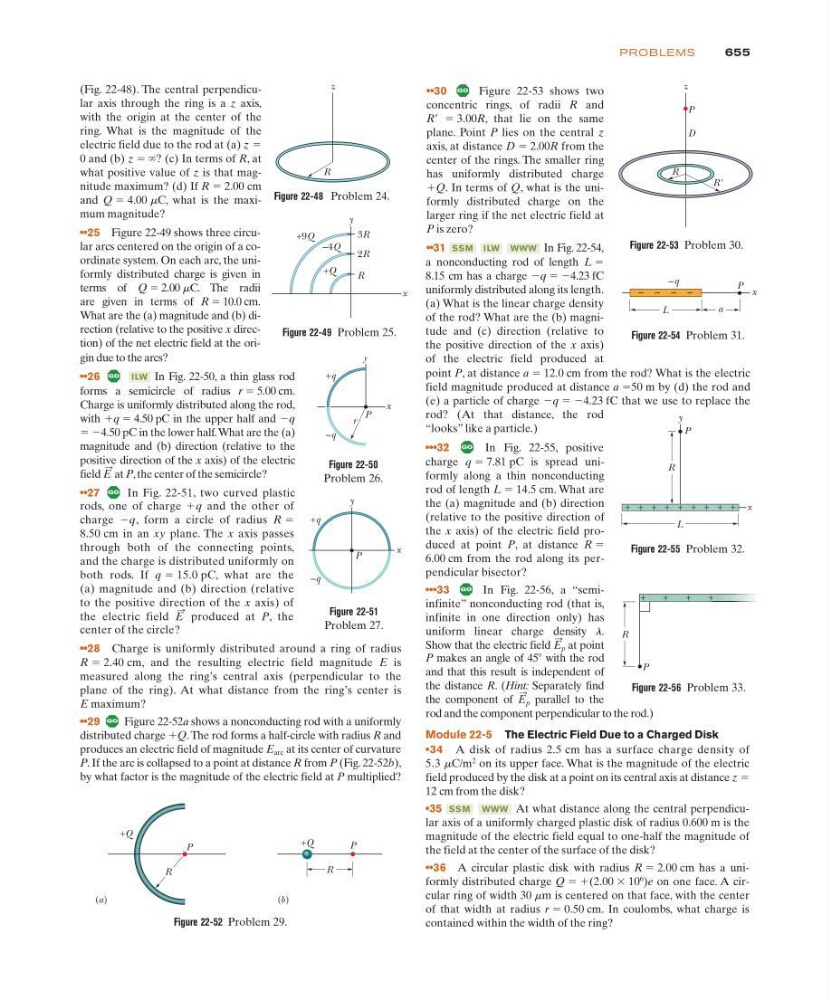
(Fig. 22-48). The central perpendicular axis through the ring is a z axis,
with the origin at the center of the
ring. What is the magnitude of the
electric field due to the rod at (a) z ϭ
0 and (b) z ϭ ϱ? (c) In terms of R, at
what positive value of z is that magnitude maximum? (d) If R ϭ 2.00 cm
and Q ϭ 4.00 mC, what is the maximum magnitude?
••25 Figure 22-49 shows three circular arcs centered on the origin of a coordinate system. On each arc, the uniformly distributed charge is given in
terms of Q ϭ 2.00 mC. The radii
are given in terms of R ϭ 10.0 cm.
What are the (a) magnitude and (b) direction (relative to the positive x direction) of the net electric field at the ori••30
Figure 22-53 shows two
concentric rings, of radii R and
RЈ ϭ 3.00R, that lie on the same
plane. Point P lies on the central z
axis, at distance D ϭ 2.00R from the
center of the rings. The smaller ring
has uniformly distributed charge
ϩQ. In terms of Q, what is the uniformly distributed charge on the
larger ring if the net electric field at
P is zero?
••31
In Fig. 22-54,
WWW
ILW
SSM
Figure 22-49 Problem 25.
+9Q
–4Q
+Q
3R
2R
R
y
x
P
r
+q
–q
y
x
Figure 22-50
Problem 26.
Figure 22-48 Problem 24.
z
R
rods, one of charge ϩq and the other of
charge Ϫq, form a circle of radius R ϭ
8.50 cm in an xy plane. The x axis passes
through both of the connecting points,
and the charge is distributed uniformly on
both rods. If q ϭ 15.0 pC, what are the
(a) magnitude and (b) direction (relative
to the positive direction of the x axis) of
the electric field
produced at P, the
E
:
Figure 22-51
Problem 27.
P
x
y
+q
–q
center of the circle?
••28 Charge is uniformly distributed around a ring of radius
R ϭ 2.40 cm, and the resulting electric field magnitude E is
measured along the ring’s central axis (perpendicular to the
plane of the ring). At what distance from the ring’s center is
E maximum?
Figure 22-52 Problem 29.
P
P
+Q
+Q
R
(a)
(b)
R
Figure 22-53 Problem 30.
z
D
R'
P
R
Figure 22-54 Problem 31.
x
–
– –
–
P
–q
L
a
a nonconducting rod of length L ϭ
8.15 cm has a charge Ϫq ϭ Ϫ4.23 fC
uniformly distributed along its length.
(a) What is the linear charge density
of the rod? What are the (b) magnitude and (c) direction (relative to
the positive direction of the x axis)
of the electric field produced at
point P, at distance a ϭ 12.0 cm from the rod? What is the electric
field magnitude produced at distance a ϭ50 m by (d) the rod and
(e) a particle of charge Ϫq ϭ Ϫ4.23 fC that we use to replace the
+ + + + +
+
+
+
+
L
R
P
y
x
Figure 22-55 Problem 32.
rod? (At that distance, the rod
“looks” like a particle.)
+
+
+
+
R
P
Figure 22-56 Problem 33.
•••32
In Fig. 22-55, positive
charge q ϭ 7.81 pC is spread uniformly along a thin nonconducting
rod of length L ϭ 14.5 cm. What are
the (a) magnitude and (b) direction
(relative to the positive direction of
the x axis) of the electric field produced at point P, at distance R ϭ
6.00 cm from the rod along its perpendicular bisector?
•••33
In Fig. 22-56, a “semiinfinite” nonconducting rod (that is,
infinite in one direction only) has
uniform linear charge density l.
Show that the electric field
at point
E
:
p
P makes an angle of 45Њ with the rod
and that this result is independent of
the distance R. (Hint: Separately find
the component of
parallel to the
E
:
p
gin due to the arcs?
••26
In Fig. 22-50, a thin glass rod
ILW
forms a semicircle of radius r ϭ 5.00 cm.
Charge is uniformly distributed along the rod,
with ϩq ϭ 4.50 pC in the upper half and Ϫq
ϭ Ϫ4.50 pC in the lower half.What are the (a)
magnitude and (b) direction (relative to the
positive direction of the x axis) of the electric
field at P, the center of the semicircle?
••27
In Fig. 22-51, two curved plastic
E
:
••29
Figure 22-52a shows a nonconducting rod with a uniformly
distributed charge Q.The rod forms a half-circle with radius R and
produces an electric field of magnitude E arc at its center of curvature
P. If the arc is collapsed to a point at distance R from P (Fig. 22-52b),
by what factor is the magnitude of the electric field at P multiplied?
ϩ