

654
CHAPTE R 22 ELECTRIC FIELDS
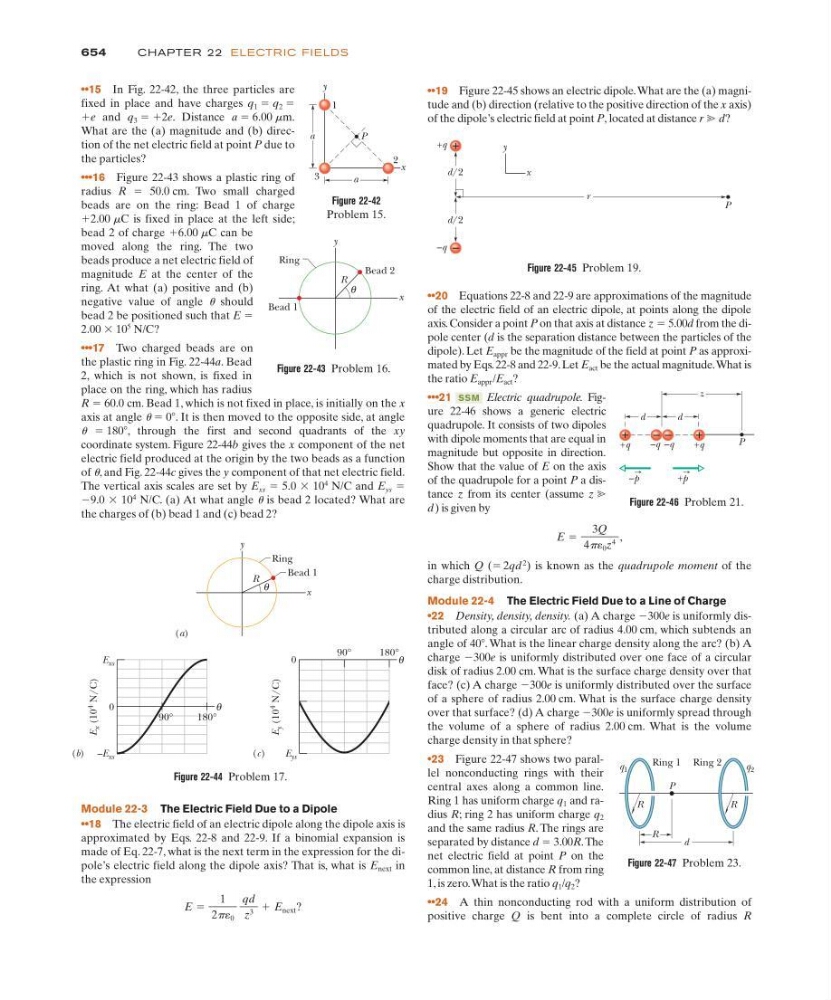
Figure 22-44 Problem 17.
E
x (10
4
N/C)
–E xs
0
θ
θ
90°
180°
(b)
(a)
E
y (10 4
N/C)
E ys
0
θ
90°
180°
(c)
y
x
R
Bead 1
Ring
E xs
r
P
d/2
+q
d/2
–q –
+
y
x
Figure 22-45 Problem 19.
••19 Figure 22-45 shows an electric dipole. What are the (a) magnitude and (b) direction (relative to the positive direction of the x axis)
of the dipole’s electric field at point P, located at distance r d?
ӷ
••15 In Fig. 22-42, the three particles are
fixed in place and have charges q 1 ϭ q 2 ϭ
ϩe and q 3 ϭ ϩ2e. Distance a ϭ 6.00 mm.
What are the (a) magnitude and (b) direction of the net electric field at point P due to
the particles?
•••16 Figure 22-43 shows a plastic ring of
radius R ϭ 50.0 cm. Two small charged
beads are on the ring: Bead 1 of charge
ϩ2.00 mC is fixed in place at the left side;
bead 2 of charge ϩ6.00 mC can be
moved along the ring. The two
beads produce a net electric field of
magnitude E at the center of the
ring. At what (a) positive and (b)
negative value of angle u should
bead 2 be positioned such that E ϭ
2.00 ϫ 10
5
N/C?
•••17 Two charged beads are on
the plastic ring in Fig. 22-44a. Bead
2, which is not shown, is fixed in
place on the ring, which has radius
R ϭ 60.0 cm. Bead 1, which is not fixed in place, is initially on the x
axis at angle u ϭ 0Њ. It is then moved to the opposite side, at angle
u ϭ 180Њ, through the first and second quadrants of the xy
coordinate system. Figure 22-44b gives the x component of the net
electric field produced at the origin by the two beads as a function
of u, and Fig. 22-44c gives the y component of that net electric field.
The vertical axis scales are set by E xs ϭ 5.0 ϫ 10
4
N/C and E ys ϭ
Ϫ9.0 ϫ 10
4
N/C. (a) At what angle u is bead 2 located? What are
the charges of (b) bead 1 and (c) bead 2?
••20 Equations 22-8 and 22-9 are approximations of the magnitude
of the electric field of an electric dipole, at points along the dipole
axis. Consider a point P on that axis at distance z ϭ 5.00d from the dipole center (d is the separation distance between the particles of the
dipole). Let E appr be the magnitude of the field at point P as approximated by Eqs. 22-8 and 22-9. Let E act be the actual magnitude.What is
the ratio E appr /E act ?
•••21
Electric quadrupole. Figure 22-46 shows a generic electric
quadrupole. It consists of two dipoles
with dipole moments that are equal in
magnitude but opposite in direction.
Show that the value of E on the axis
of the quadrupole for a point P a distance z from its center (assume z
d) is given by
in which Q (ϭ 2qd
2
) is known as the quadrupole moment of the
charge distribution.
Module 22-4 The Electric Field Due to a Line of Charge
•22 Density, density, density. (a) A charge Ϫ300e is uniformly distributed along a circular arc of radius 4.00 cm, which subtends an
angle of 40Њ. What is the linear charge density along the arc? (b) A
charge Ϫ300e is uniformly distributed over one face of a circular
disk of radius 2.00 cm. What is the surface charge density over that
face? (c) A charge Ϫ300e is uniformly distributed over the surface
of a sphere of radius 2.00 cm. What is the surface charge density
over that surface? (d) A charge Ϫ300e is uniformly spread through
the volume of a sphere of radius 2.00 cm. What is the volume
charge density in that sphere?
•23 Figure 22-47 shows two parallel nonconducting rings with their
central axes along a common line.
Ring 1 has uniform charge q 1 and radius R; ring 2 has uniform charge q 2
and the same radius R. The rings are
separated by distance d ϭ 3.00R.The
net electric field at point P on the
common line, at distance R from ring
1, is zero.What is the ratio q 1 /q 2 ?
••24 A thin nonconducting rod with a uniform distribution of
positive charge Q is bent into a complete circle of radius R
E ϭ
3Q
4p´ 0 z
4
,
ӷ
SSM
a
a
P
2
3
1
y
x
Figure 22-42
Problem 15.
Figure 22-43 Problem 16.
Bead 1
Bead 2
y
R
x
Ring
θ
Module 22-3 The Electric Field Due to a Dipole
••18 The electric field of an electric dipole along the dipole axis is
approximated by Eqs. 22-8 and 22-9. If a binomial expansion is
made of Eq. 22-7, what is the next term in the expression for the dipole’s electric field along the dipole axis? That is, what is E next in
the expression
E ϭ
1
2p´ 0
qd
z
3
ϩ E next ?
z
–q
–q
+q
+q
d
P
+
–
–
– +
d
+p
–p
Figure 22-46 Problem 21.
Ring 1 Ring 2
P
q 1
q 2
R
R
d
R
Figure 22-47 Problem 23.