

C
H
A
P
T
E
R
2
2
Electric Fields
22-1 THE ELECTRIC FIELD
After reading this module, you should be able to . . .
22.01 Identify that at every point in the space surrounding
a charged particle, the particle sets up an electric field ,
which is a vector quantity and thus has both magnitude
and direction.
22.02 Identify how an electric field can be used to explain
how a charged particle can exert an electrostatic force F
:
E
:
E
:
on a second charged particle even though there is no contact between the particles.
22.03 Explain how a small positive test charge is used (in
principle) to measure the electric field at any given point.
22.04 Explain electric field lines, including where they
originate and terminate and what their spacing represents.
Key Ideas
Learning Objectives
630
● A charged particle sets up an electric field (a vector quantity)
in the surrounding space. If a second charged particle is
located in that space, an electrostatic force acts on it due to
the magnitude and direction of the field at its location.
● The electric field at any point is defined in terms of the electrostatic force that would be exerted on a positive test charge
q 0 placed there:
E
: ϭ
F
:
q 0
.
F
:
E
:
● Electric field lines help us visualize the direction and
magnitude of electric fields. The electric field vector at any
point is tangent to the field line through that point. The density
of field lines in that region is proportional to the magnitude of
the electric field there. Thus, closer field lines represent a
stronger field.
● Electric field lines originate on positive charges and
terminate on negative charges. So, a field line extending from
a positive charge must end on a negative charge.
What Is Physics?
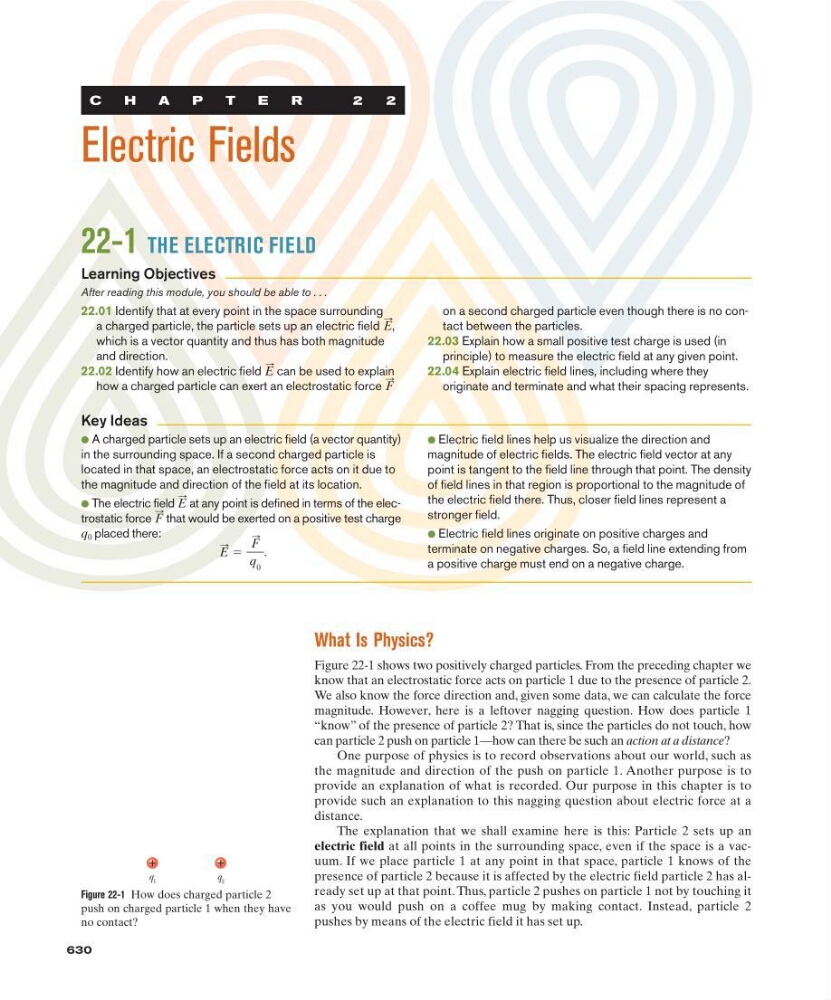
Figure 22-1 shows two positively charged particles. From the preceding chapter we
know that an electrostatic force acts on particle 1 due to the presence of particle 2.
We also know the force direction and, given some data, we can calculate the force
magnitude. However, here is a leftover nagging question. How does particle 1
“know” of the presence of particle 2? That is, since the particles do not touch, how
can particle 2 push on particle 1—how can there be such an action at a distance?
One purpose of physics is to record observations about our world, such as
the magnitude and direction of the push on particle 1. Another purpose is to
provide an explanation of what is recorded. Our purpose in this chapter is to
provide such an explanation to this nagging question about electric force at a
distance.
The explanation that we shall examine here is this: Particle 2 sets up an
electric field at all points in the surrounding space, even if the space is a vacuum. If we place particle 1 at any point in that space, particle 1 knows of the
presence of particle 2 because it is affected by the electric field particle 2 has already set up at that point. Thus, particle 2 pushes on particle 1 not by touching it
as you would push on a coffee mug by making contact. Instead, particle 2
pushes by means of the electric field it has set up.
+
+
q 1
q 2
Figure 22-1 How does charged particle 2
push on charged particle 1 when they have
no contact?