

629
PROB LE M S
58 In Fig. 21-26, particle 1 of charge Ϫ80.0 mC and particle 2 of
charge ϩ40.0 mC are held at separation L ϭ 20.0 cm on an x axis.
In unit-vector notation, what is the net electrostatic force on particle 3, of charge q 3 ϭ 20.0 mC, if particle 3 is placed at (a) x ϭ 40.0
cm and (b) x ϭ 80.0 cm? What should be the (c) x and (d) y coordinates of particle 3 if the net electrostatic force on it due to particles
1 and 2 is zero?
59 What is the total charge in coulombs of 75.0 kg of electrons?
60
In Fig. 21-43, six charged particles surround particle 7 at ra65 The initial charges on the three identical metal spheres in
Fig. 21-24 are the following: sphere A, Q; sphere B, ϪQ/4; and
sphere C, Q/2, where Q ϭ 2.00 ϫ 10
Ϫ14
C. Spheres A and B are
fixed in place, with a center-to-center separation of d ϭ 1.20 m,
which is much larger than the spheres. Sphere C is touched first to
sphere A and then to sphere B and is then removed. What then is
the magnitude of the electrostatic force between spheres A and B?
66 An electron is in a vacuum near Earth’s surface and located at
y ϭ 0 on a vertical y axis. At what value of y should a second electron
be placed such that its electrostatic force on the first electron balances
the gravitational force on the first electron?
67
In Fig. 21-26, particle 1 of charge Ϫ5.00q and particle 2 of
SSM
61 Three charged particles form a triangle: particle 1 with charge
Q 1 ϭ 80.0 nC is at xy coordinates (0, 3.00 mm), particle 2 with
charge Q 2 is at (0, Ϫ3.00 mm), and particle 3 with charge q ϭ 18.0
nC is at (4.00 mm, 0). In unit-vector notation, what is the electrostatic force on particle 3 due to the other two particles if Q 2 is
equal to (a) 80.0 nC and (b) Ϫ80.0 nC?
62
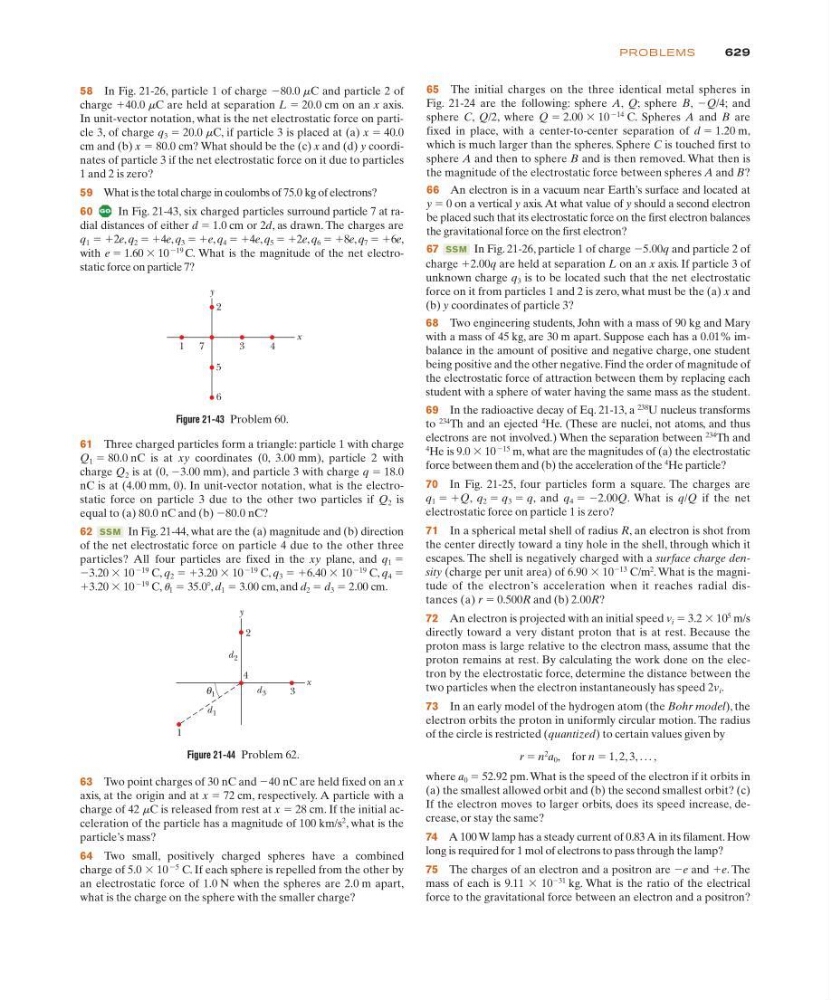
In Fig. 21-44, what are the (a) magnitude and (b) direction
of the net electrostatic force on particle 4 due to the other three
particles? All four particles are fixed in the xy plane, and q 1 ϭ
Ϫ3.20 ϫ 10
Ϫ19
C, q 2 ϭ ϩ3.20 ϫ 10
Ϫ19
C, q 3 ϭ ϩ6.40 ϫ 10
Ϫ19
C, q 4 ϭ
ϩ3.20 ϫ 10
Ϫ19
C, u 1 ϭ 35.0Њ, d 1 ϭ 3.00 cm, and d 2 ϭ d 3 ϭ 2.00 cm.
SSM
x
y
2
5
1 7
3
4
6
Figure 21-43 Problem 60.
dial distances of either d ϭ 1.0 cm or 2d, as drawn. The charges are
q 1 ϭ ϩ2e, q 2 ϭ ϩ4e, q 3 ϭ ϩe, q 4 ϭ ϩ4e, q 5 ϭ ϩ2e, q 6 ϭ ϩ8e, q 7 ϭ ϩ6e,
with e ϭ 1.60 ϫ 10
Ϫ19
C. What is the magnitude of the net electrostatic force on particle 7?
Figure 21-44 Problem 62.
d 1
d 2
d 3
1
x
y
4
1
2
3
θ
63 Two point charges of 30 nC and Ϫ40 nC are held fixed on an x
axis, at the origin and at x ϭ 72 cm, respectively. A particle with a
charge of 42 mC is released from rest at x ϭ 28 cm. If the initial acceleration of the particle has a magnitude of 100 km/s
2
, what is the
particle’s mass?
64 Two small, positively charged spheres have a combined
charge of 5.0 ϫ 10
Ϫ5
C. If each sphere is repelled from the other by
an electrostatic force of 1.0 N when the spheres are 2.0 m apart,
what is the charge on the sphere with the smaller charge?
charge ϩ2.00q are held at separation L on an x axis. If particle 3 of
unknown charge q 3 is to be located such that the net electrostatic
force on it from particles 1 and 2 is zero, what must be the (a) x and
(b) y coordinates of particle 3?
68 Two engineering students, John with a mass of 90 kg and Mary
with a mass of 45 kg, are 30 m apart. Suppose each has a 0.01% imbalance in the amount of positive and negative charge, one student
being positive and the other negative. Find the order of magnitude of
the electrostatic force of attraction between them by replacing each
student with a sphere of water having the same mass as the student.
69 In the radioactive decay of Eq. 21-13, a
238
U nucleus transforms
to
234
Th and an ejected
4
He. (These are nuclei, not atoms, and thus
electrons are not involved.) When the separation between
234
Th and
4
He is 9.0 ϫ 10
Ϫ15
m, what are the magnitudes of (a) the electrostatic
force between them and (b) the acceleration of the
4
He particle?
70 In Fig. 21-25, four particles form a square. The charges are
q 1 ϭ ϩQ, q 2 ϭ q 3 ϭ q, and q 4 ϭ Ϫ2.00Q. What is q/Q if the net
electrostatic force on particle 1 is zero?
71 In a spherical metal shell of radius R, an electron is shot from
the center directly toward a tiny hole in the shell, through which it
escapes. The shell is negatively charged with a surface charge density (charge per unit area) of 6.90 ϫ 10
Ϫ13
C/m
2
. What is the magnitude of the electron’s acceleration when it reaches radial distances (a) r ϭ 0.500R and (b) 2.00R?
72 An electron is projected with an initial speed v i ϭ 3.2 ϫ 10
5
m/s
directly toward a very distant proton that is at rest. Because the
proton mass is large relative to the electron mass, assume that the
proton remains at rest. By calculating the work done on the electron by the electrostatic force, determine the distance between the
two particles when the electron instantaneously has speed 2v i .
73 In an early model of the hydrogen atom (the Bohr model), the
electron orbits the proton in uniformly circular motion. The radius
of the circle is restricted (quantized) to certain values given by
r ϭ n
2
a 0 , for n ϭ 1, 2, 3, . . . ,
where a 0 ϭ 52.92 pm. What is the speed of the electron if it orbits in
(a) the smallest allowed orbit and (b) the second smallest orbit? (c)
If the electron moves to larger orbits, does its speed increase, decrease, or stay the same?
74 A 100 W lamp has a steady current of 0.83 A in its filament. How
long is required for 1 mol of electrons to pass through the lamp?
75 The charges of an electron and a positron are Ϫe and ϩe. The
mass of each is 9.11 ϫ 10
Ϫ31
kg. What is the ratio of the electrical
force to the gravitational force between an electron and a positron?