

599
20-4 A STATISTICAL VI EW OF E NTROPY
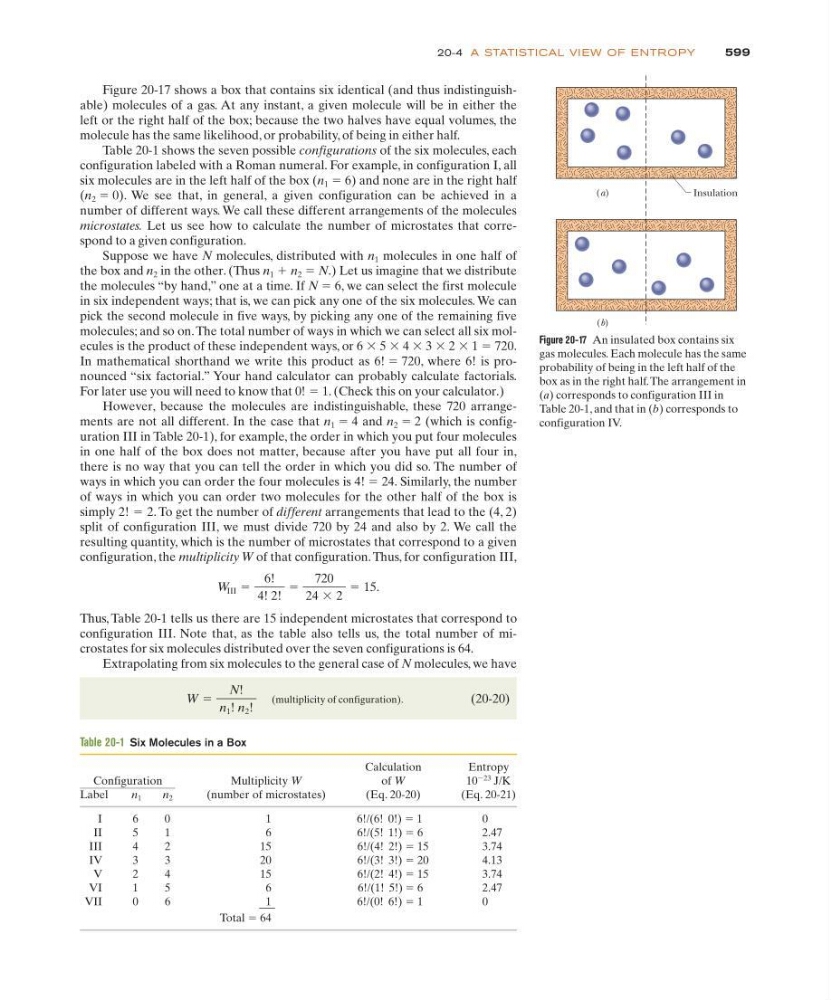
Figure 20-17 shows a box that contains six identical (and thus indistinguishable) molecules of a gas. At any instant, a given molecule will be in either the
left or the right half of the box; because the two halves have equal volumes, the
molecule has the same likelihood, or probability, of being in either half.
Table 20-1 shows the seven possible configurations of the six molecules, each
configuration labeled with a Roman numeral. For example, in configuration I, all
six molecules are in the left half of the box (n 1 ϭ 6) and none are in the right half
(n 2 ϭ 0). We see that, in general, a given configuration can be achieved in a
number of different ways. We call these different arrangements of the molecules
microstates. Let us see how to calculate the number of microstates that correspond to a given configuration.
Suppose we have N molecules, distributed with n 1 molecules in one half of
the box and n 2 in the other. (Thus n 1 ϩ n 2 ϭ N.) Let us imagine that we distribute
the molecules “by hand,” one at a time. If N ϭ 6, we can select the first molecule
in six independent ways; that is, we can pick any one of the six molecules. We can
pick the second molecule in five ways, by picking any one of the remaining five
molecules; and so on. The total number of ways in which we can select all six molecules is the product of these independent ways, or 6 ϫ 5 ϫ 4 ϫ 3 ϫ 2 ϫ 1 ϭ 720.
In mathematical shorthand we write this product as 6! ϭ 720, where 6! is pronounced “six factorial.” Your hand calculator can probably calculate factorials.
For later use you will need to know that 0! ϭ 1. (Check this on your calculator.)
However, because the molecules are indistinguishable, these 720 arrangements are not all different. In the case that n 1 ϭ 4 and n 2 ϭ 2 (which is configuration III in Table 20-1), for example, the order in which you put four molecules
in one half of the box does not matter, because after you have put all four in,
there is no way that you can tell the order in which you did so. The number of
ways in which you can order the four molecules is 4! ϭ 24. Similarly, the number
of ways in which you can order two molecules for the other half of the box is
simply 2! 2. To get the number of different arrangements that lead to the (4, 2)
split of configuration III, we must divide 720 by 24 and also by 2. We call the
resulting quantity, which is the number of microstates that correspond to a given
configuration, the multiplicity W of that configuration. Thus, for configuration III,
Thus, Table 20-1 tells us there are 15 independent microstates that correspond to
configuration III. Note that, as the table also tells us, the total number of microstates for six molecules distributed over the seven configurations is 64.
Extrapolating from six molecules to the general case of N molecules, we have
(multiplicity of configuration).
(20-20)
W ϭ
N!
n 1 ! n 2 !
W III ϭ
6!
4! 2!
ϭ
720
24 ϫ 2
ϭ 15.
ϭ
Table 20-1 Six Molecules in a Box
Calculation
Entropy
Configuration
Multiplicity W
of W
10
Ϫ23
J/K
Label
n 1
n 2
(number of microstates)
(Eq. 20-20)
(Eq. 20-21)
I
6
0
1
6!/(6! 0!)ϭ 1
0
II
5
1
6
6!/(5! 1!) ϭ 6
2.47
III
4
2
15
6!/(4! 2!) ϭ 15
3.74
IV
3
3
20
6!/(3! 3!) ϭ 20
4.13
V
2
4
15
6!/(2! 4!) ϭ 15
3.74
VI
1
5
6
6!/(1! 5!) ϭ 6
2.47
VII
0
6
1
6!/(0! 6!) ϭ 1
0
Total ϭ 64
Figure 20-17 An insulated box contains six
gas molecules. Each molecule has the same
probability of being in the left half of the
box as in the right half. The arrangement in
(a) corresponds to configuration III in
Table 20-1, and that in (b) corresponds to
configuration IV.
(a)
Insulation
(b)