

576
CHAPTE R 19 TH E KI N ETIC TH EORY OF GASES
1 For four situations for an
ideal gas, the table gives the
energy transferred to or from
the gas as heat Q and either the
work W done by the gas or the
work W on done on the gas, all in
joules. Rank the four situations in terms of the temperature change
of the gas, most positive first.
Questions
a
b
c
V
p
Figure 19-17 Question 2.
a
b
c
d
Q
Ϫ50 ϩ35 Ϫ15 ϩ20
W
Ϫ50 ϩ35
W on
Ϫ40 ϩ40
Ideal Gas An ideal gas is one for which the pressure p, volume
V, and temperature T are related by
pV ϭ nRT (ideal gas law).
(19-5)
Here n is the number of moles of the gas present and R is a constant
(8.31 J/mol иK) called the gas constant. The ideal gas law can also be
written as
pV ϭ NkT,
( 1 9 - 9 )
where the Boltzmann constant k is
(19-7)
Work in an Isothermal Volume Change The work done
by an ideal gas during an isothermal (constant-temperature)
change from volume V i to volume V f is
(ideal gas, isothermal process).
(19-14)
Pressure, Temperature, and Molecular Speed The pressure exerted by n moles of an ideal gas, in terms of the speed of its
molecules, is
(19-21)
where
is the root-mean-square speed of the molecules of the gas. With Eq. 19-5 this gives
(19-22)
Temperature and Kinetic Energy The average translational kinetic energy K avg per molecule of an ideal gas is
(19-24)
Mean Free Path The mean free path l of a gas molecule is its
average path length between collisions and is given by
(19-25)
where N/V is the number of molecules per unit volume and d is the
molecular diameter.
Maxwell Speed Distribution The Maxwell speed distribution P(v) is a function such that P(v) dv gives the fraction
of molecules with speeds in the interval dv at speed v:
(19-27)
Three measures of the distribution of speeds among the molecules of
P(v) ϭ 4p
M
2pRT
3/2
v
2
e
ϪMv 2 /2RT
.
l ϭ
1
12pd
2
N/V
,
K avg ϭ
3
2 kT.
v rms ϭ A
3RT
M
.
v rms ϭ 2(v
2
) avg
p ϭ
nMv
2
rms
3V
,
W ϭ nRT ln
V f
V i
k ϭ
R
N A
ϭ 1.38 ϫ 10
Ϫ23
J/K.
a gas are
(average speed),
(19-31)
(most probable speed),
(19-35)
and the rms speed defined above in Eq. 19-22.
Molar Specific Heats The molar specific heat C V of a gas at
constant volume is defined as
(19-39, 19-41)
in which Q is the energy transferred as heat to or from a sample of
n moles of the gas, ⌬T is the resulting temperature change of the
gas, and ⌬E int is the resulting change in the internal energy of the
gas. For an ideal monatomic gas,
(19-43)
The molar specific heat C p of a gas at constant pressure is defined to be
(19-46)
in which Q, n, and ⌬T are defined as above. C p is also given by
C p ϭ C V ϩ R.
( 1 9 - 4 9 )
For n moles of an ideal gas,
E int ϭ nC V T (ideal gas).
(19-44)
If n moles of a confined ideal gas undergo a temperature change ⌬T
due to any process, the change in the internal energy of the gas is
⌬E int ϭ nC V ⌬T (ideal gas, any process).
(19-45)
Degrees of Freedom and C V The equipartition of energy
theorem states that every degree of freedom of a molecule has an
energy
per molecule (
per mole). If f is the number of
degrees of freedom, then E int ( f/2)nRT and
(19-51)
For monatomic gases f ϭ 3 (three translational degrees); for diatomic gases f ϭ 5 (three translational and two rotational degrees).
Adiabatic Process When an ideal gas undergoes an adiabatic
volume change (a change for which Q ϭ 0),
pV
g ϭ a constant (adiabatic process),
(19-53)
in which g (ϭ C p /C V ) is the ratio of molar specific heats for the gas.
For a free expansion, however, pV ϭ a constant.
C V ϭ
f
2 R ϭ 4.16f J/molиK.
ϭ
ϭ
1
2 RT
1
2 kT
C p ϭ
Q
n ⌬T
,
C V ϭ
3
2 R ϭ 12.5 J/molиK.
C V ϭ
Q
n ⌬T
ϭ
⌬E int
n ⌬T
,
v P ϭ A
2RT
M
v avg ϭ A
8RT
pM
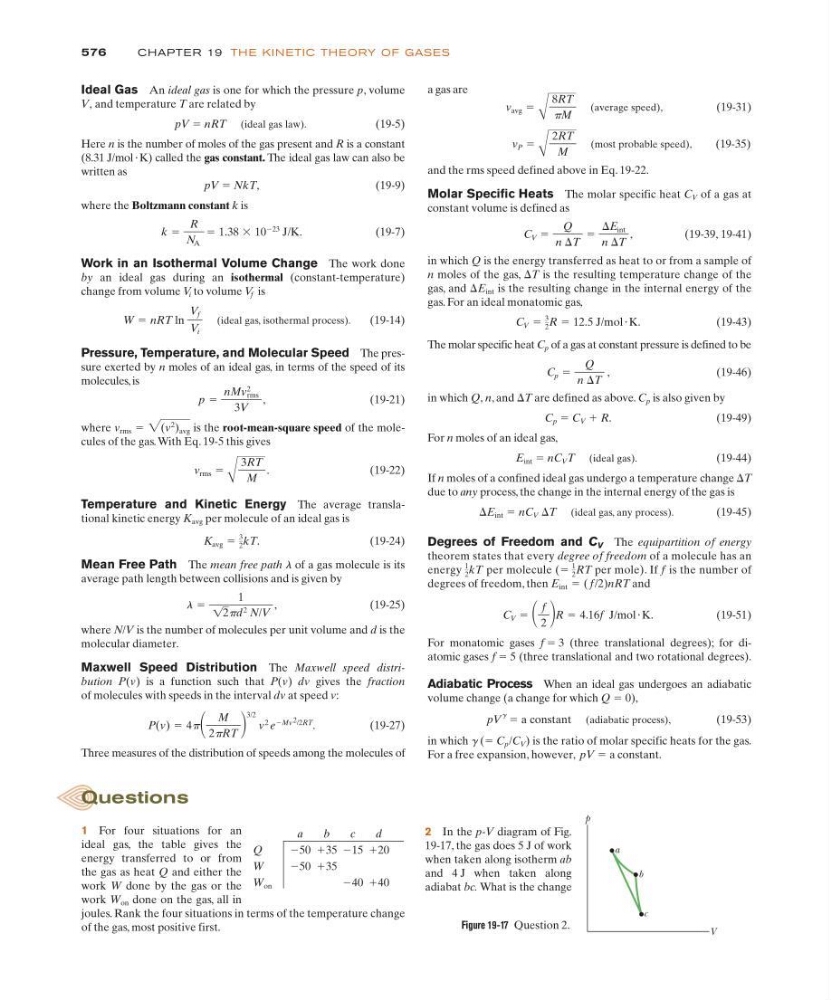
2 In the p-V diagram of Fig.
19-17, the gas does 5 J of work
when taken along isotherm ab
and 4 J when taken along
adiabat bc. What is the change
CHAPTE R 19 TH E KI N ETIC TH EORY OF GASES
1 For four situations for an
ideal gas, the table gives the
energy transferred to or from
the gas as heat Q and either the
work W done by the gas or the
work W on done on the gas, all in
joules. Rank the four situations in terms of the temperature change
of the gas, most positive first.
Questions
a
b
c
V
p
Figure 19-17 Question 2.
a
b
c
d
Q
Ϫ50 ϩ35 Ϫ15 ϩ20
W
Ϫ50 ϩ35
W on
Ϫ40 ϩ40
Ideal Gas An ideal gas is one for which the pressure p, volume
V, and temperature T are related by
pV ϭ nRT (ideal gas law).
(19-5)
Here n is the number of moles of the gas present and R is a constant
(8.31 J/mol иK) called the gas constant. The ideal gas law can also be
written as
pV ϭ NkT,
( 1 9 - 9 )
where the Boltzmann constant k is
(19-7)
Work in an Isothermal Volume Change The work done
by an ideal gas during an isothermal (constant-temperature)
change from volume V i to volume V f is
(ideal gas, isothermal process).
(19-14)
Pressure, Temperature, and Molecular Speed The pressure exerted by n moles of an ideal gas, in terms of the speed of its
molecules, is
(19-21)
where
is the root-mean-square speed of the molecules of the gas. With Eq. 19-5 this gives
(19-22)
Temperature and Kinetic Energy The average translational kinetic energy K avg per molecule of an ideal gas is
(19-24)
Mean Free Path The mean free path l of a gas molecule is its
average path length between collisions and is given by
(19-25)
where N/V is the number of molecules per unit volume and d is the
molecular diameter.
Maxwell Speed Distribution The Maxwell speed distribution P(v) is a function such that P(v) dv gives the fraction
of molecules with speeds in the interval dv at speed v:
(19-27)
Three measures of the distribution of speeds among the molecules of
P(v) ϭ 4p
M
2pRT
3/2
v
2
e
ϪMv 2 /2RT
.
l ϭ
1
12pd
2
N/V
,
K avg ϭ
3
2 kT.
v rms ϭ A
3RT
M
.
v rms ϭ 2(v
2
) avg
p ϭ
nMv
2
rms
3V
,
W ϭ nRT ln
V f
V i
k ϭ
R
N A
ϭ 1.38 ϫ 10
Ϫ23
J/K.
a gas are
(average speed),
(19-31)
(most probable speed),
(19-35)
and the rms speed defined above in Eq. 19-22.
Molar Specific Heats The molar specific heat C V of a gas at
constant volume is defined as
(19-39, 19-41)
in which Q is the energy transferred as heat to or from a sample of
n moles of the gas, ⌬T is the resulting temperature change of the
gas, and ⌬E int is the resulting change in the internal energy of the
gas. For an ideal monatomic gas,
(19-43)
The molar specific heat C p of a gas at constant pressure is defined to be
(19-46)
in which Q, n, and ⌬T are defined as above. C p is also given by
C p ϭ C V ϩ R.
( 1 9 - 4 9 )
For n moles of an ideal gas,
E int ϭ nC V T (ideal gas).
(19-44)
If n moles of a confined ideal gas undergo a temperature change ⌬T
due to any process, the change in the internal energy of the gas is
⌬E int ϭ nC V ⌬T (ideal gas, any process).
(19-45)
Degrees of Freedom and C V The equipartition of energy
theorem states that every degree of freedom of a molecule has an
energy
per molecule (
per mole). If f is the number of
degrees of freedom, then E int ( f/2)nRT and
(19-51)
For monatomic gases f ϭ 3 (three translational degrees); for diatomic gases f ϭ 5 (three translational and two rotational degrees).
Adiabatic Process When an ideal gas undergoes an adiabatic
volume change (a change for which Q ϭ 0),
pV
g ϭ a constant (adiabatic process),
(19-53)
in which g (ϭ C p /C V ) is the ratio of molar specific heats for the gas.
For a free expansion, however, pV ϭ a constant.
C V ϭ
f
2 R ϭ 4.16f J/molиK.
ϭ
ϭ
1
2 RT
1
2 kT
C p ϭ
Q
n ⌬T
,
C V ϭ
3
2 R ϭ 12.5 J/molиK.
C V ϭ
Q
n ⌬T
ϭ
⌬E int
n ⌬T
,
v P ϭ A
2RT
M
v avg ϭ A
8RT
pM
2 In the p-V diagram of Fig.
19-17, the gas does 5 J of work
when taken along isotherm ab
and 4 J when taken along
adiabat bc. What is the change