

575
REVIEW & SUM MARY
Problem-Solving Tactics A Graphical Summary of Four Gas Processes
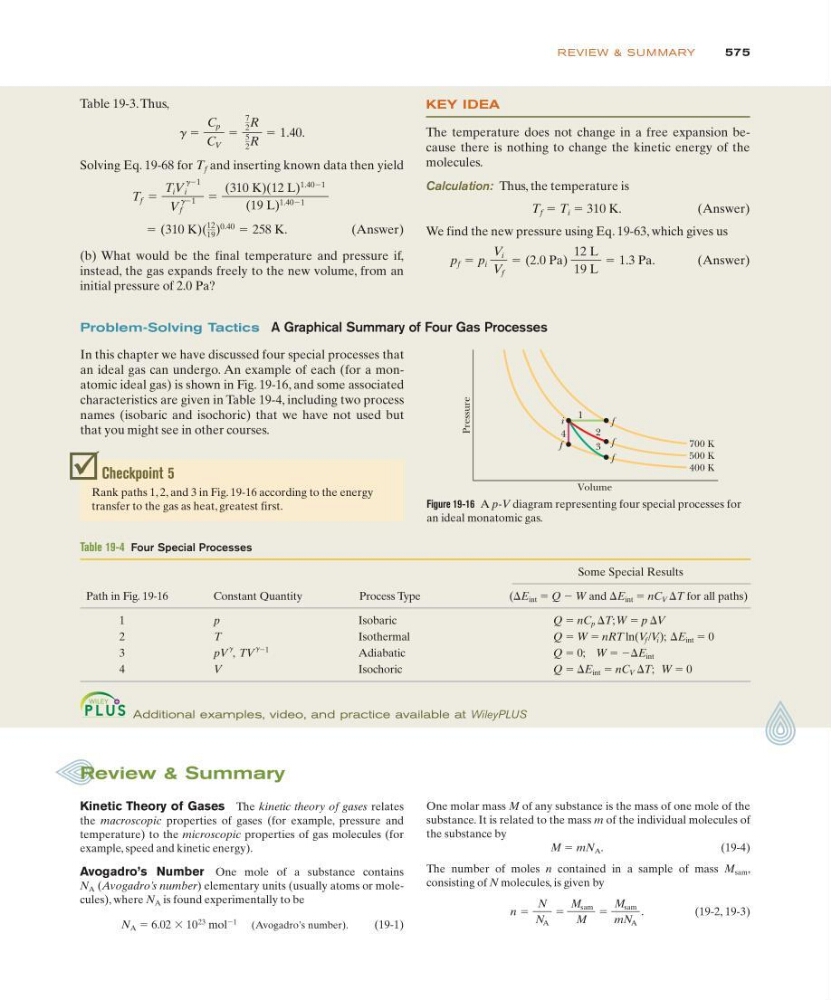
In this chapter we have discussed four special processes that
an ideal gas can undergo. An example of each (for a monatomic ideal gas) is shown in Fig. 19-16, and some associated
characteristics are given in Table 19-4, including two process
names (isobaric and isochoric) that we have not used but
that you might see in other courses.
Additional examples, video, and practice available at WileyPLUS
Checkpoint 5
Rank paths 1, 2, and 3 in Fig. 19-16 according to the energy
transfer to the gas as heat, greatest first.
700 K
500 K
400 K
i
Volume
Pressure
f
f
f
f
1
2
3
4
Figure 19-16 A p-V diagram representing four special processes for
an ideal monatomic gas.
Table 19-4 Four Special Processes
Some Special Results
Path in Fig. 19-16
Constant Quantity
Process Type
(⌬E int ϭ Q Ϫ W and ⌬E int ϭ nC V ⌬T for all paths)
1
p
Isobaric
Q ϭ nC p ⌬T; W ϭ p ⌬V
2
T
Isothermal
Q ϭ W ϭ nRT ln(V f /V i ); ⌬E int ϭ 0
3
pV
g
, TV
gϪ1
Adiabatic
Q ϭ 0; W ϭ Ϫ⌬E int
4
V
Isochoric
Q ϭ ⌬E int ϭ nC V ⌬T; W ϭ 0
Table 19-3. Thus,
Solving Eq. 19-68 for T f and inserting known data then yield
(Answer)
(b) What would be the final temperature and pressure if,
instead, the gas expands freely to the new volume, from an
initial pressure of 2.0 Pa?
ϭ (310 K)(
12
19 )
0.40 ϭ 258 K.
T f ϭ
T i V
gϪ1
i
V
gϪ1
f
ϭ
(310 K)(12 L)
1.40Ϫ1
(19 L)
1.40Ϫ1
g ϭ
C p
C V
ϭ
7
2 R
5
2 R
ϭ 1.40.
KEY IDEA
The temperature does not change in a free expansion because there is nothing to change the kinetic energy of the
molecules.
Calculation: Thus, the temperature is
T f ϭ T i ϭ 310 K.
(Answer)
We find the new pressure using Eq. 19-63, which gives us
(Answer)
p f ϭ p i
V i
V f
ϭ (2.0 Pa)
12 L
19 L
ϭ 1.3 Pa.
Kinetic Theory of Gases The kinetic theory of gases relates
the macroscopic properties of gases (for example, pressure and
temperature) to the microscopic properties of gas molecules (for
example, speed and kinetic energy).
Avogadro’s Number One mole of a substance contains
N A (Avogadro’s number) elementary units (usually atoms or molecules), where N A is found experimentally to be
N A ϭ 6.02 ϫ 10
23
mol
Ϫ1
(Avogadro’s number).
(19-1)
Review & Summary
One molar mass M of any substance is the mass of one mole of the
substance. It is related to the mass m of the individual molecules of
the substance by
M ϭ mN A .
( 1 9 - 4 )
The number of moles n contained in a sample of mass M sam ,
consisting of N molecules, is given by
(19-2, 19-3)
n ϭ
N
N A
ϭ
M sam
M
ϭ
M sam
mN A
.
REVIEW & SUM MARY
Problem-Solving Tactics A Graphical Summary of Four Gas Processes
In this chapter we have discussed four special processes that
an ideal gas can undergo. An example of each (for a monatomic ideal gas) is shown in Fig. 19-16, and some associated
characteristics are given in Table 19-4, including two process
names (isobaric and isochoric) that we have not used but
that you might see in other courses.
Additional examples, video, and practice available at WileyPLUS
Checkpoint 5
Rank paths 1, 2, and 3 in Fig. 19-16 according to the energy
transfer to the gas as heat, greatest first.
700 K
500 K
400 K
i
Volume
Pressure
f
f
f
f
1
2
3
4
Figure 19-16 A p-V diagram representing four special processes for
an ideal monatomic gas.
Table 19-4 Four Special Processes
Some Special Results
Path in Fig. 19-16
Constant Quantity
Process Type
(⌬E int ϭ Q Ϫ W and ⌬E int ϭ nC V ⌬T for all paths)
1
p
Isobaric
Q ϭ nC p ⌬T; W ϭ p ⌬V
2
T
Isothermal
Q ϭ W ϭ nRT ln(V f /V i ); ⌬E int ϭ 0
3
pV
g
, TV
gϪ1
Adiabatic
Q ϭ 0; W ϭ Ϫ⌬E int
4
V
Isochoric
Q ϭ ⌬E int ϭ nC V ⌬T; W ϭ 0
Table 19-3. Thus,
Solving Eq. 19-68 for T f and inserting known data then yield
(Answer)
(b) What would be the final temperature and pressure if,
instead, the gas expands freely to the new volume, from an
initial pressure of 2.0 Pa?
ϭ (310 K)(
12
19 )
0.40 ϭ 258 K.
T f ϭ
T i V
gϪ1
i
V
gϪ1
f
ϭ
(310 K)(12 L)
1.40Ϫ1
(19 L)
1.40Ϫ1
g ϭ
C p
C V
ϭ
7
2 R
5
2 R
ϭ 1.40.
KEY IDEA
The temperature does not change in a free expansion because there is nothing to change the kinetic energy of the
molecules.
Calculation: Thus, the temperature is
T f ϭ T i ϭ 310 K.
(Answer)
We find the new pressure using Eq. 19-63, which gives us
(Answer)
p f ϭ p i
V i
V f
ϭ (2.0 Pa)
12 L
19 L
ϭ 1.3 Pa.
Kinetic Theory of Gases The kinetic theory of gases relates
the macroscopic properties of gases (for example, pressure and
temperature) to the microscopic properties of gas molecules (for
example, speed and kinetic energy).
Avogadro’s Number One mole of a substance contains
N A (Avogadro’s number) elementary units (usually atoms or molecules), where N A is found experimentally to be
N A ϭ 6.02 ϫ 10
23
mol
Ϫ1
(Avogadro’s number).
(19-1)
Review & Summary
One molar mass M of any substance is the mass of one mole of the
substance. It is related to the mass m of the individual molecules of
the substance by
M ϭ mN A .
( 1 9 - 4 )
The number of moles n contained in a sample of mass M sam ,
consisting of N molecules, is given by
(19-2, 19-3)
n ϭ
N
N A
ϭ
M sam
M
ϭ
M sam
mN A
.