

the temperature of the gas also decreases and so does the number of water molecules that can remain as a vapor. So, lots of the water molecules condense into
tiny drops of fog.
Proof of Eq. 19-53
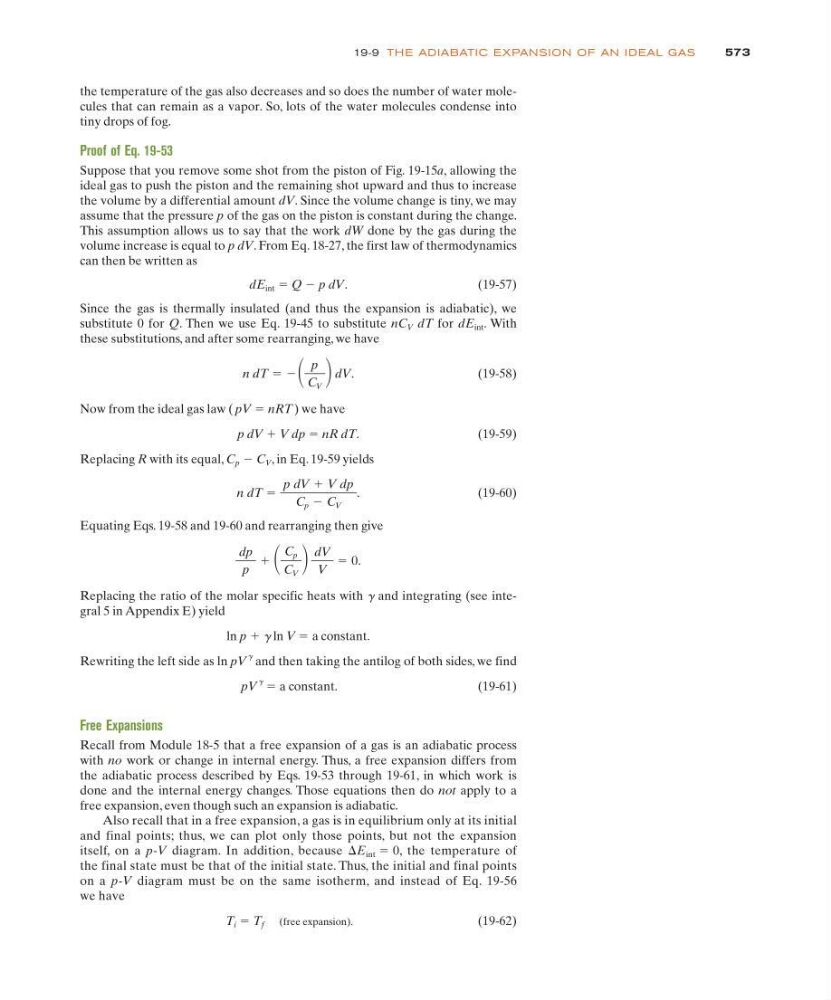
Suppose that you remove some shot from the piston of Fig. 19-15a, allowing the
ideal gas to push the piston and the remaining shot upward and thus to increase
the volume by a differential amount dV. Since the volume change is tiny, we may
assume that the pressure p of the gas on the piston is constant during the change.
This assumption allows us to say that the work dW done by the gas during the
volume increase is equal to p dV. From Eq. 18-27, the first law of thermodynamics
can then be written as
dE int ϭ Q Ϫ p dV.
( 1 9 - 5 7 )
Since the gas is thermally insulated (and thus the expansion is adiabatic), we
substitute 0 for Q. Then we use Eq. 19-45 to substitute nC V dT for dE int . With
these substitutions, and after some rearranging, we have
(19-58)
Now from the ideal gas law ( pV ϭ nRT ) we have
p dV ϩ V dp ϭ nR dT.
( 1 9 - 5 9 )
Replacing R with its equal, C p Ϫ C V , in Eq. 19-59 yields
(19-60)
Equating Eqs. 19-58 and 19-60 and rearranging then give
Replacing the ratio of the molar specific heats with g and integrating (see integral 5 in Appendix E) yield
ln p ϩ g ln V ϭ a constant.
Rewriting the left side as ln pV
g and then taking the antilog of both sides, we find
pV
g ϭ a constant.
(19-61)
Free Expansions
Recall from Module 18-5 that a free expansion of a gas is an adiabatic process
with no work or change in internal energy. Thus, a free expansion differs from
the adiabatic process described by Eqs. 19-53 through 19-61, in which work is
done and the internal energy changes. Those equations then do not apply to a
free expansion, even though such an expansion is adiabatic.
Also recall that in a free expansion, a gas is in equilibrium only at its initial
and final points; thus, we can plot only those points, but not the expansion
itself, on a p-V diagram. In addition, because ⌬E int ϭ 0, the temperature of
the final state must be that of the initial state. Thus, the initial and final points
on a p-V diagram must be on the same isotherm, and instead of Eq. 19-56
we have
T i ϭ T f (free expansion).
(19-62)
dp
p
ϩ
C p
C V
dV
V
ϭ 0.
n dT ϭ
p dV ϩ V dp
C p Ϫ C V
.
n dT ϭ Ϫ
p
C V
dV.
573
19-9 TH E ADIABATIC EXPANSION OF AN I DEAL GAS
tiny drops of fog.
Proof of Eq. 19-53
Suppose that you remove some shot from the piston of Fig. 19-15a, allowing the
ideal gas to push the piston and the remaining shot upward and thus to increase
the volume by a differential amount dV. Since the volume change is tiny, we may
assume that the pressure p of the gas on the piston is constant during the change.
This assumption allows us to say that the work dW done by the gas during the
volume increase is equal to p dV. From Eq. 18-27, the first law of thermodynamics
can then be written as
dE int ϭ Q Ϫ p dV.
( 1 9 - 5 7 )
Since the gas is thermally insulated (and thus the expansion is adiabatic), we
substitute 0 for Q. Then we use Eq. 19-45 to substitute nC V dT for dE int . With
these substitutions, and after some rearranging, we have
(19-58)
Now from the ideal gas law ( pV ϭ nRT ) we have
p dV ϩ V dp ϭ nR dT.
( 1 9 - 5 9 )
Replacing R with its equal, C p Ϫ C V , in Eq. 19-59 yields
(19-60)
Equating Eqs. 19-58 and 19-60 and rearranging then give
Replacing the ratio of the molar specific heats with g and integrating (see integral 5 in Appendix E) yield
ln p ϩ g ln V ϭ a constant.
Rewriting the left side as ln pV
g and then taking the antilog of both sides, we find
pV
g ϭ a constant.
(19-61)
Free Expansions
Recall from Module 18-5 that a free expansion of a gas is an adiabatic process
with no work or change in internal energy. Thus, a free expansion differs from
the adiabatic process described by Eqs. 19-53 through 19-61, in which work is
done and the internal energy changes. Those equations then do not apply to a
free expansion, even though such an expansion is adiabatic.
Also recall that in a free expansion, a gas is in equilibrium only at its initial
and final points; thus, we can plot only those points, but not the expansion
itself, on a p-V diagram. In addition, because ⌬E int ϭ 0, the temperature of
the final state must be that of the initial state. Thus, the initial and final points
on a p-V diagram must be on the same isotherm, and instead of Eq. 19-56
we have
T i ϭ T f (free expansion).
(19-62)
dp
p
ϩ
C p
C V
dV
V
ϭ 0.
n dT ϭ
p dV ϩ V dp
C p Ϫ C V
.
n dT ϭ Ϫ
p
C V
dV.
573
19-9 TH E ADIABATIC EXPANSION OF AN I DEAL GAS