

572
CHAPTE R 19 TH E KI N ETIC TH EORY OF GASES
Adiabat (Q = 0)
700 K
500 K
300 K
i
f
(a)
(b)
Volume
Pressure
W
Insulation
Isotherms:
We slowly remove lead shot, allowing an
expansion without any heat transfer.
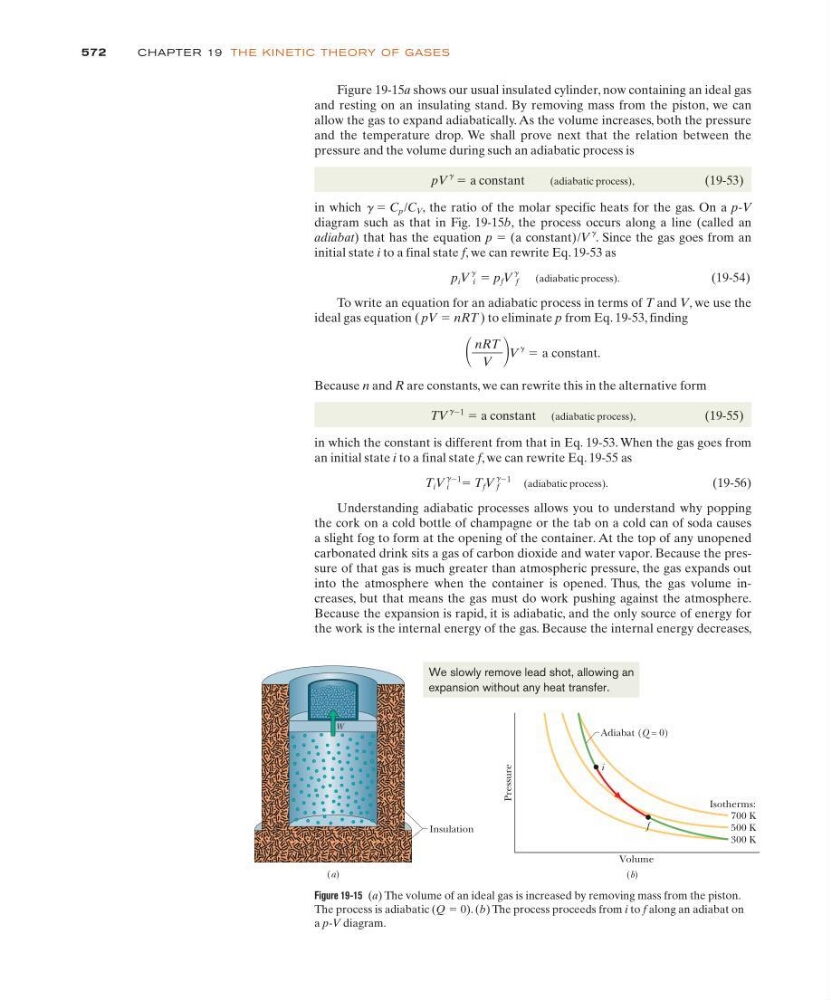
Figure 19-15 (a) The volume of an ideal gas is increased by removing mass from the piston.
The process is adiabatic (Q ϭ 0). (b) The process proceeds from i to f along an adiabat on
a p-V diagram.
Figure 19-15a shows our usual insulated cylinder, now containing an ideal gas
and resting on an insulating stand. By removing mass from the piston, we can
allow the gas to expand adiabatically. As the volume increases, both the pressure
and the temperature drop. We shall prove next that the relation between the
pressure and the volume during such an adiabatic process is
pV
g ϭ a constant
(adiabatic process),
(19-53)
in which g ϭ C p /C V , the ratio of the molar specific heats for the gas. On a p-V
diagram such as that in Fig. 19-15b, the process occurs along a line (called an
adiabat) that has the equation p (a constant)/V
g
. Since the gas goes from an
initial state i to a final state f, we can rewrite Eq. 19-53 as
p i V
g
i ϭ p f V
g
f
(adiabatic process).
(19-54)
To write an equation for an adiabatic process in terms of T and V, we use the
ideal gas equation ( pV ϭ nRT ) to eliminate p from Eq. 19-53, finding
Because n and R are constants, we can rewrite this in the alternative form
TV
gϪ1 ϭ a constant (adiabatic process),
(19-55)
in which the constant is different from that in Eq. 19-53. When the gas goes from
an initial state i to a final state f, we can rewrite Eq. 19-55 as
T i V
gϪ1
i ϭ T f V
gϪ1
f
(adiabatic process).
(19-56)
Understanding adiabatic processes allows you to understand why popping
the cork on a cold bottle of champagne or the tab on a cold can of soda causes
a slight fog to form at the opening of the container. At the top of any unopened
carbonated drink sits a gas of carbon dioxide and water vapor. Because the pressure of that gas is much greater than atmospheric pressure, the gas expands out
into the atmosphere when the container is opened. Thus, the gas volume increases, but that means the gas must do work pushing against the atmosphere.
Because the expansion is rapid, it is adiabatic, and the only source of energy for
the work is the internal energy of the gas. Because the internal energy decreases,
nRT
V V
␥ ϭ a constant.
ϭ
CHAPTE R 19 TH E KI N ETIC TH EORY OF GASES
Adiabat (Q = 0)
700 K
500 K
300 K
i
f
(a)
(b)
Volume
Pressure
W
Insulation
Isotherms:
We slowly remove lead shot, allowing an
expansion without any heat transfer.
Figure 19-15 (a) The volume of an ideal gas is increased by removing mass from the piston.
The process is adiabatic (Q ϭ 0). (b) The process proceeds from i to f along an adiabat on
a p-V diagram.
Figure 19-15a shows our usual insulated cylinder, now containing an ideal gas
and resting on an insulating stand. By removing mass from the piston, we can
allow the gas to expand adiabatically. As the volume increases, both the pressure
and the temperature drop. We shall prove next that the relation between the
pressure and the volume during such an adiabatic process is
pV
g ϭ a constant
(adiabatic process),
(19-53)
in which g ϭ C p /C V , the ratio of the molar specific heats for the gas. On a p-V
diagram such as that in Fig. 19-15b, the process occurs along a line (called an
adiabat) that has the equation p (a constant)/V
g
. Since the gas goes from an
initial state i to a final state f, we can rewrite Eq. 19-53 as
p i V
g
i ϭ p f V
g
f
(adiabatic process).
(19-54)
To write an equation for an adiabatic process in terms of T and V, we use the
ideal gas equation ( pV ϭ nRT ) to eliminate p from Eq. 19-53, finding
Because n and R are constants, we can rewrite this in the alternative form
TV
gϪ1 ϭ a constant (adiabatic process),
(19-55)
in which the constant is different from that in Eq. 19-53. When the gas goes from
an initial state i to a final state f, we can rewrite Eq. 19-55 as
T i V
gϪ1
i ϭ T f V
gϪ1
f
(adiabatic process).
(19-56)
Understanding adiabatic processes allows you to understand why popping
the cork on a cold bottle of champagne or the tab on a cold can of soda causes
a slight fog to form at the opening of the container. At the top of any unopened
carbonated drink sits a gas of carbon dioxide and water vapor. Because the pressure of that gas is much greater than atmospheric pressure, the gas expands out
into the atmosphere when the container is opened. Thus, the gas volume increases, but that means the gas must do work pushing against the atmosphere.
Because the expansion is rapid, it is adiabatic, and the only source of energy for
the work is the internal energy of the gas. Because the internal energy decreases,
nRT
V V
␥ ϭ a constant.
ϭ