

559
19-5 M EAN FREE PATH
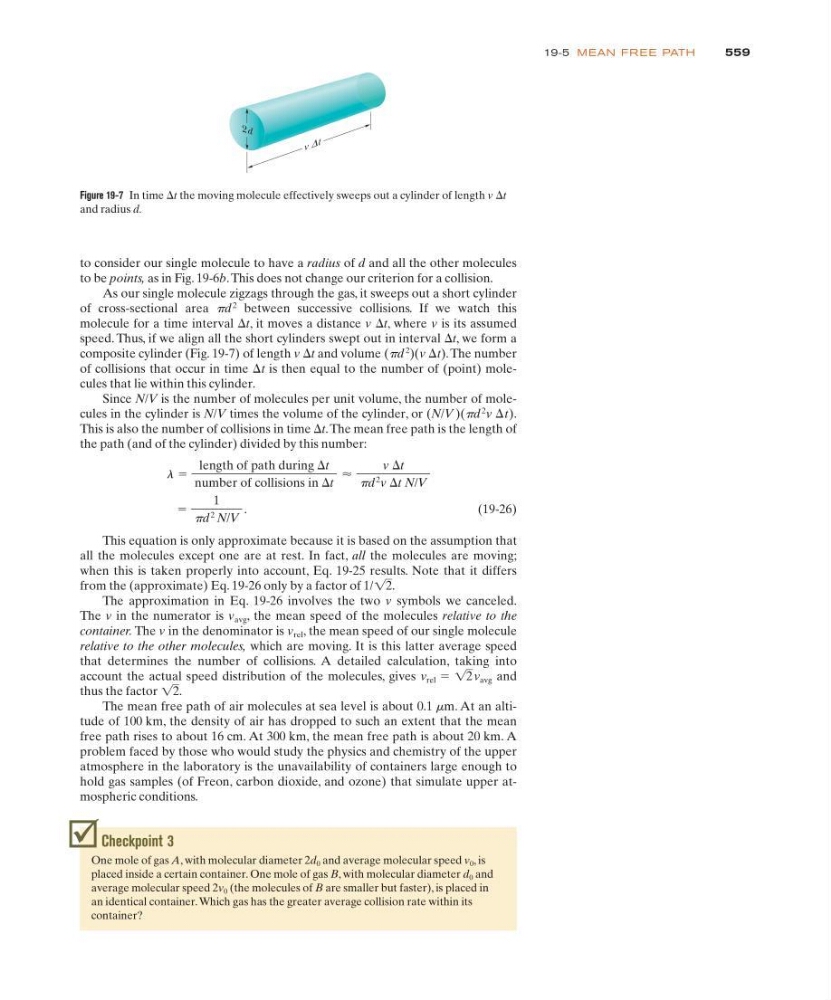
Figure 19-7 In time the moving molecule effectively sweeps out a cylinder of length v ⌬t
and radius d.
⌬t
2 d
v ∆ t
Checkpoint 3
One mole of gas A, with molecular diameter 2d 0 and average molecular speed v 0 , is
placed inside a certain container. One mole of gas B, with molecular diameter d 0 and
average molecular speed 2v 0 (the molecules of B are smaller but faster), is placed in
an identical container.Which gas has the greater average collision rate within its
container?
to consider our single molecule to have a radius of d and all the other molecules
to be points, as in Fig. 19-6b.This does not change our criterion for a collision.
As our single molecule zigzags through the gas, it sweeps out a short cylinder
of cross-sectional area pd
2
between successive collisions. If we watch this
molecule for a time interval ⌬t, it moves a distance v ⌬t, where v is its assumed
speed. Thus, if we align all the short cylinders swept out in interval ⌬t, we form a
composite cylinder (Fig. 19-7) of length v ⌬t and volume (pd
2
)(v ⌬t). The number
of collisions that occur in time ⌬t is then equal to the number of (point) molecules that lie within this cylinder.
Since N/V is the number of molecules per unit volume, the number of molecules in the cylinder is N/V times the volume of the cylinder, or (N/V )(pd
2
v ⌬t).
This is also the number of collisions in time ⌬t.The mean free path is the length of
the path (and of the cylinder) divided by this number:
(19-26)
This equation is only approximate because it is based on the assumption that
all the molecules except one are at rest. In fact, all the molecules are moving;
when this is taken properly into account, Eq. 19-25 results. Note that it differs
from the (approximate) Eq. 19-26 only by a factor of
.
The approximation in Eq. 19-26 involves the two v symbols we canceled.
The v in the numerator is v avg , the mean speed of the molecules relative to the
container. The v in the denominator is v rel , the mean speed of our single molecule
relative to the other molecules, which are moving. It is this latter average speed
that determines the number of collisions. A detailed calculation, taking into
account the actual speed distribution of the molecules, gives
and
thus the factor
.
The mean free path of air molecules at sea level is about 0.1 mm. At an altitude of 100 km, the density of air has dropped to such an extent that the mean
free path rises to about 16 cm. At 300 km, the mean free path is about 20 km. A
problem faced by those who would study the physics and chemistry of the upper
atmosphere in the laboratory is the unavailability of containers large enough to
hold gas samples (of Freon, carbon dioxide, and ozone) that simulate upper atmospheric conditions.
12
v rel ϭ 12 v avg
1/12
ϭ
1
pd
2
N/V
.
l ϭ
length of path during ⌬t
number of collisions in ⌬t
Ϸ
v ⌬t
pd
2
v ⌬t N/V
19-5 M EAN FREE PATH
Figure 19-7 In time the moving molecule effectively sweeps out a cylinder of length v ⌬t
and radius d.
⌬t
2 d
v ∆ t
Checkpoint 3
One mole of gas A, with molecular diameter 2d 0 and average molecular speed v 0 , is
placed inside a certain container. One mole of gas B, with molecular diameter d 0 and
average molecular speed 2v 0 (the molecules of B are smaller but faster), is placed in
an identical container.Which gas has the greater average collision rate within its
container?
to consider our single molecule to have a radius of d and all the other molecules
to be points, as in Fig. 19-6b.This does not change our criterion for a collision.
As our single molecule zigzags through the gas, it sweeps out a short cylinder
of cross-sectional area pd
2
between successive collisions. If we watch this
molecule for a time interval ⌬t, it moves a distance v ⌬t, where v is its assumed
speed. Thus, if we align all the short cylinders swept out in interval ⌬t, we form a
composite cylinder (Fig. 19-7) of length v ⌬t and volume (pd
2
)(v ⌬t). The number
of collisions that occur in time ⌬t is then equal to the number of (point) molecules that lie within this cylinder.
Since N/V is the number of molecules per unit volume, the number of molecules in the cylinder is N/V times the volume of the cylinder, or (N/V )(pd
2
v ⌬t).
This is also the number of collisions in time ⌬t.The mean free path is the length of
the path (and of the cylinder) divided by this number:
(19-26)
This equation is only approximate because it is based on the assumption that
all the molecules except one are at rest. In fact, all the molecules are moving;
when this is taken properly into account, Eq. 19-25 results. Note that it differs
from the (approximate) Eq. 19-26 only by a factor of
.
The approximation in Eq. 19-26 involves the two v symbols we canceled.
The v in the numerator is v avg , the mean speed of the molecules relative to the
container. The v in the denominator is v rel , the mean speed of our single molecule
relative to the other molecules, which are moving. It is this latter average speed
that determines the number of collisions. A detailed calculation, taking into
account the actual speed distribution of the molecules, gives
and
thus the factor
.
The mean free path of air molecules at sea level is about 0.1 mm. At an altitude of 100 km, the density of air has dropped to such an extent that the mean
free path rises to about 16 cm. At 300 km, the mean free path is about 20 km. A
problem faced by those who would study the physics and chemistry of the upper
atmosphere in the laboratory is the unavailability of containers large enough to
hold gas samples (of Freon, carbon dioxide, and ozone) that simulate upper atmospheric conditions.
12
v rel ϭ 12 v avg
1/12
ϭ
1
pd
2
N/V
.
l ϭ
length of path during ⌬t
number of collisions in ⌬t
Ϸ
v ⌬t
pd
2
v ⌬t N/V