

Mean Free Path
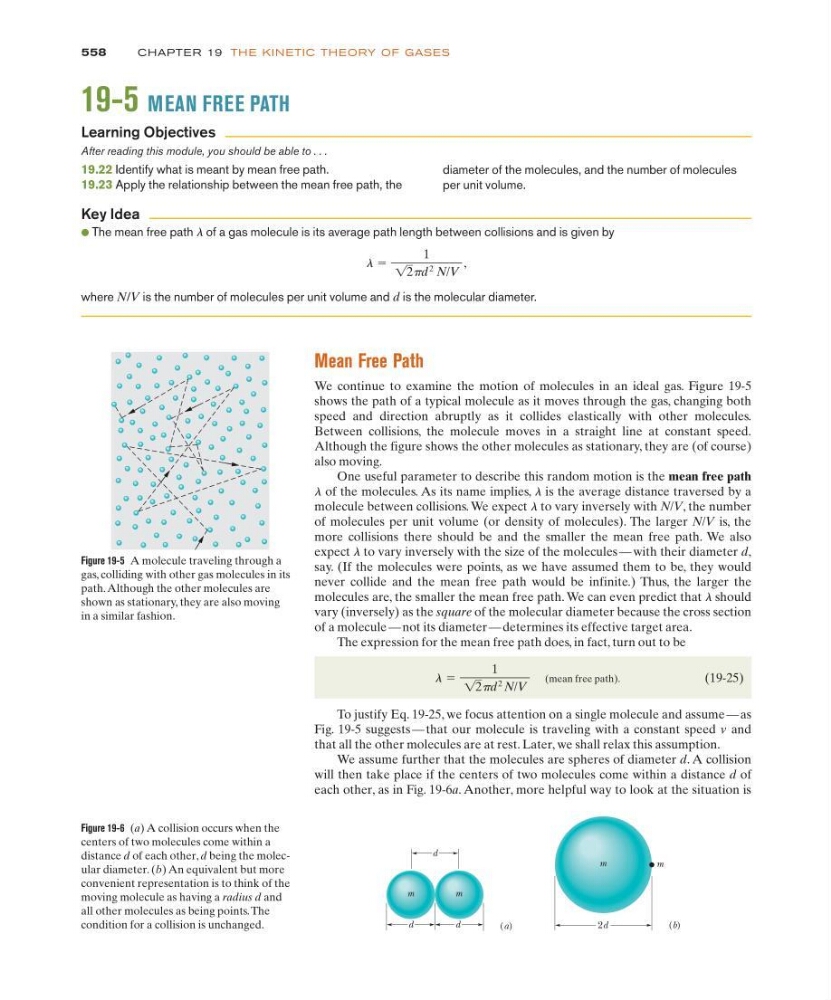
We continue to examine the motion of molecules in an ideal gas. Figure 19-5
shows the path of a typical molecule as it moves through the gas, changing both
speed and direction abruptly as it collides elastically with other molecules.
Between collisions, the molecule moves in a straight line at constant speed.
Although the figure shows the other molecules as stationary, they are (of course)
also moving.
One useful parameter to describe this random motion is the mean free path
l of the molecules. As its name implies, l is the average distance traversed by a
molecule between collisions. We expect l to vary inversely with N/V, the number
of molecules per unit volume (or density of molecules). The larger N/V is, the
more collisions there should be and the smaller the mean free path. We also
expect l to vary inversely with the size of the molecules — with their diameter d,
say. (If the molecules were points, as we have assumed them to be, they would
never collide and the mean free path would be infinite.) Thus, the larger the
molecules are, the smaller the mean free path. We can even predict that l should
vary (inversely) as the square of the molecular diameter because the cross section
of a molecule — not its diameter — determines its effective target area.
The expression for the mean free path does, in fact, turn out to be
(mean free path).
(19-25)
To justify Eq. 19-25, we focus attention on a single molecule and assume — as
Fig. 19-5 suggests — that our molecule is traveling with a constant speed v and
that all the other molecules are at rest. Later, we shall relax this assumption.
We assume further that the molecules are spheres of diameter d. A collision
will then take place if the centers of two molecules come within a distance d of
each other, as in Fig. 19-6a. Another, more helpful way to look at the situation is
l ϭ
1
12pd
2
N/V
558
CHAPTE R 19 TH E KI N ETIC TH EORY OF GASES
19-5 MEAN FREE PATH
After reading this module, you should be able to . . .
19.22 Identify what is meant by mean free path.
19.23 Apply the relationship between the mean free path, the
diameter of the molecules, and the number of molecules
per unit volume.
Learning Objectives
● The mean free path of a gas molecule is its average path length between collisions and is given by
where N/V is the number of molecules per unit volume and d is the molecular diameter.
l ϭ
1
12pd
2
N/V
,
l
Key Idea
Figure 19-5 A molecule traveling through a
gas, colliding with other gas molecules in its
path. Although the other molecules are
shown as stationary, they are also moving
in a similar fashion.
Figure 19-6 (a) A collision occurs when the
centers of two molecules come within a
distance d of each other, d being the molecular diameter. (b) An equivalent but more
convenient representation is to think of the
moving molecule as having a radius d and
all other molecules as being points. The
condition for a collision is unchanged.
(b)
2d
m
m
(a)
d
d
d
m
m
We continue to examine the motion of molecules in an ideal gas. Figure 19-5
shows the path of a typical molecule as it moves through the gas, changing both
speed and direction abruptly as it collides elastically with other molecules.
Between collisions, the molecule moves in a straight line at constant speed.
Although the figure shows the other molecules as stationary, they are (of course)
also moving.
One useful parameter to describe this random motion is the mean free path
l of the molecules. As its name implies, l is the average distance traversed by a
molecule between collisions. We expect l to vary inversely with N/V, the number
of molecules per unit volume (or density of molecules). The larger N/V is, the
more collisions there should be and the smaller the mean free path. We also
expect l to vary inversely with the size of the molecules — with their diameter d,
say. (If the molecules were points, as we have assumed them to be, they would
never collide and the mean free path would be infinite.) Thus, the larger the
molecules are, the smaller the mean free path. We can even predict that l should
vary (inversely) as the square of the molecular diameter because the cross section
of a molecule — not its diameter — determines its effective target area.
The expression for the mean free path does, in fact, turn out to be
(mean free path).
(19-25)
To justify Eq. 19-25, we focus attention on a single molecule and assume — as
Fig. 19-5 suggests — that our molecule is traveling with a constant speed v and
that all the other molecules are at rest. Later, we shall relax this assumption.
We assume further that the molecules are spheres of diameter d. A collision
will then take place if the centers of two molecules come within a distance d of
each other, as in Fig. 19-6a. Another, more helpful way to look at the situation is
l ϭ
1
12pd
2
N/V
558
CHAPTE R 19 TH E KI N ETIC TH EORY OF GASES
19-5 MEAN FREE PATH
After reading this module, you should be able to . . .
19.22 Identify what is meant by mean free path.
19.23 Apply the relationship between the mean free path, the
diameter of the molecules, and the number of molecules
per unit volume.
Learning Objectives
● The mean free path of a gas molecule is its average path length between collisions and is given by
where N/V is the number of molecules per unit volume and d is the molecular diameter.
l ϭ
1
12pd
2
N/V
,
l
Key Idea
Figure 19-5 A molecule traveling through a
gas, colliding with other gas molecules in its
path. Although the other molecules are
shown as stationary, they are also moving
in a similar fashion.
Figure 19-6 (a) A collision occurs when the
centers of two molecules come within a
distance d of each other, d being the molecular diameter. (b) An equivalent but more
convenient representation is to think of the
moving molecule as having a radius d and
all other molecules as being points. The
condition for a collision is unchanged.
(b)
2d
m
m
(a)
d
d
d
m
m