

The molecules of gas in the box are moving in all directions and with various
speeds, bumping into one another and bouncing from the walls of the box like
balls in a racquetball court. We ignore (for the time being) collisions of the molecules with one another and consider only elastic collisions with the walls.
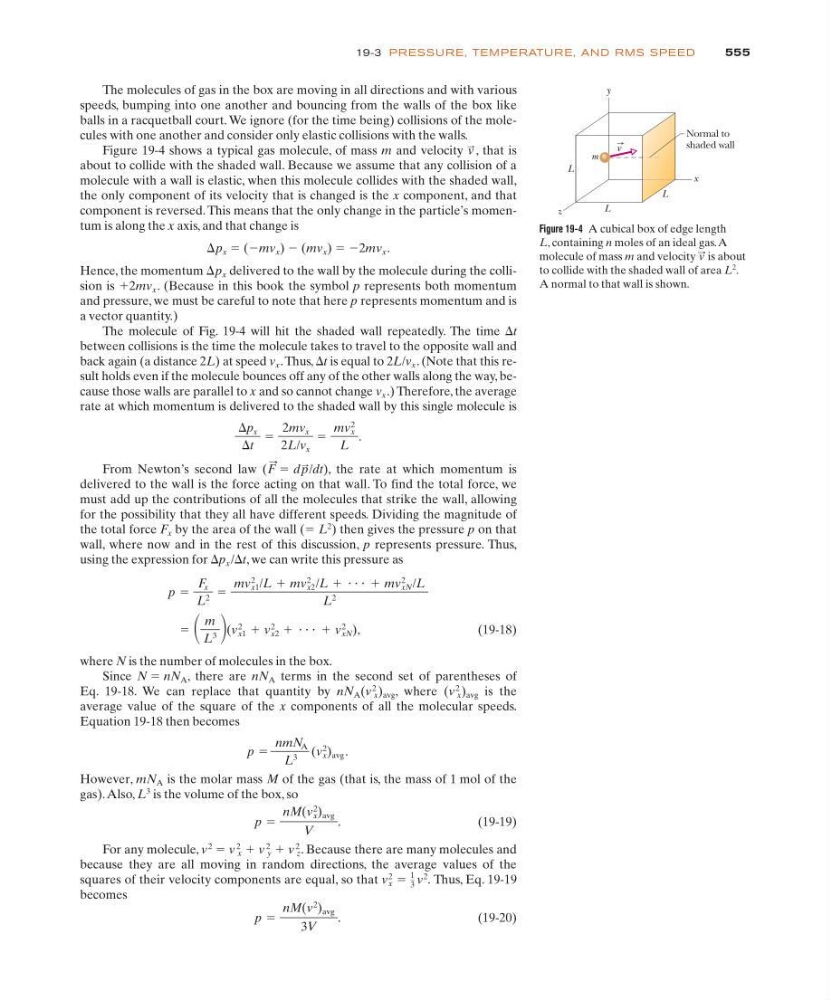
Figure 19-4 shows a typical gas molecule, of mass m and velocity , that is
about to collide with the shaded wall. Because we assume that any collision of a
molecule with a wall is elastic, when this molecule collides with the shaded wall,
the only component of its velocity that is changed is the x component, and that
component is reversed. This means that the only change in the particle’s momentum is along the x axis, and that change is
⌬p x ϭ (Ϫmv x ) Ϫ (mv x ) ϭ Ϫ2mv x .
Hence, the momentum ⌬p x delivered to the wall by the molecule during the collision is ϩ2mv x . (Because in this book the symbol p represents both momentum
and pressure, we must be careful to note that here p represents momentum and is
a vector quantity.)
The molecule of Fig. 19-4 will hit the shaded wall repeatedly. The time ⌬t
between collisions is the time the molecule takes to travel to the opposite wall and
back again (a distance 2L) at speed v x .Thus, ⌬t is equal to 2L/v x . (Note that this result holds even if the molecule bounces off any of the other walls along the way, because those walls are parallel to x and so cannot change v x .) Therefore, the average
rate at which momentum is delivered to the shaded wall by this single molecule is
.
From Newton’s second law
, the rate at which momentum is
delivered to the wall is the force acting on that wall. To find the total force, we
must add up the contributions of all the molecules that strike the wall, allowing
for the possibility that they all have different speeds. Dividing the magnitude of
the total force F x by the area of the wall (ϭ L
2
) then gives the pressure p on that
wall, where now and in the rest of this discussion, p represents pressure. Thus,
using the expression for ⌬p x /⌬t, we can write this pressure as
(19-18)
where N is the number of molecules in the box.
Since N ϭ nN A , there are nN A terms in the second set of parentheses of
Eq. 19-18. We can replace that quantity by nN A (v
2
x ) avg , where (v
2
x ) avg is the
average value of the square of the x components of all the molecular speeds.
Equation 19-18 then becomes
However, mN A is the molar mass M of the gas (that is, the mass of 1 mol of the
gas). Also, L
3
is the volume of the box, so
(19-19)
For any molecule, v
2 ϭ v
2
x ϩ v
2
y ϩ v
2
z . Because there are many molecules and
because they are all moving in random directions, the average values of the
squares of their velocity components are equal, so that
Thus, Eq. 19-19
becomes
(19-20)
p ϭ
nM(v
2
) avg
3V
.
v
2
x ϭ
1
3 v
2
.
p ϭ
nM(v
2
x ) avg
V
.
p ϭ
nmN A
L
3
(v
2
x ) avg .
ϭ
m
L
3 (v
2
x1 ϩ v
2
x2 ϩ и и и ϩ v
2
xN ),
p ϭ
F x
L
2
ϭ
mv
2
x1 /L ϩ mv
2
x2 /L ϩ и и и ϩ mv
2
xN /L
L
2
(F
: ϭ dp
:
/dt)
⌬p x
⌬t
ϭ
2mv x
2L/v x
ϭ
mv
2
x
L
v
:
555
19-3 PR ESSU R E, TE M PE RATU R E, AN D R M S SPE E D
Figure 19-4 A cubical box of edge length
L, containing n moles of an ideal gas. A
molecule of mass m and velocity is about
to collide with the shaded wall of area L
2
.
A normal to that wall is shown.
v
:
y
z
x
L
L
L
m
Normal to
shaded wall
v
speeds, bumping into one another and bouncing from the walls of the box like
balls in a racquetball court. We ignore (for the time being) collisions of the molecules with one another and consider only elastic collisions with the walls.
Figure 19-4 shows a typical gas molecule, of mass m and velocity , that is
about to collide with the shaded wall. Because we assume that any collision of a
molecule with a wall is elastic, when this molecule collides with the shaded wall,
the only component of its velocity that is changed is the x component, and that
component is reversed. This means that the only change in the particle’s momentum is along the x axis, and that change is
⌬p x ϭ (Ϫmv x ) Ϫ (mv x ) ϭ Ϫ2mv x .
Hence, the momentum ⌬p x delivered to the wall by the molecule during the collision is ϩ2mv x . (Because in this book the symbol p represents both momentum
and pressure, we must be careful to note that here p represents momentum and is
a vector quantity.)
The molecule of Fig. 19-4 will hit the shaded wall repeatedly. The time ⌬t
between collisions is the time the molecule takes to travel to the opposite wall and
back again (a distance 2L) at speed v x .Thus, ⌬t is equal to 2L/v x . (Note that this result holds even if the molecule bounces off any of the other walls along the way, because those walls are parallel to x and so cannot change v x .) Therefore, the average
rate at which momentum is delivered to the shaded wall by this single molecule is
.
From Newton’s second law
, the rate at which momentum is
delivered to the wall is the force acting on that wall. To find the total force, we
must add up the contributions of all the molecules that strike the wall, allowing
for the possibility that they all have different speeds. Dividing the magnitude of
the total force F x by the area of the wall (ϭ L
2
) then gives the pressure p on that
wall, where now and in the rest of this discussion, p represents pressure. Thus,
using the expression for ⌬p x /⌬t, we can write this pressure as
(19-18)
where N is the number of molecules in the box.
Since N ϭ nN A , there are nN A terms in the second set of parentheses of
Eq. 19-18. We can replace that quantity by nN A (v
2
x ) avg , where (v
2
x ) avg is the
average value of the square of the x components of all the molecular speeds.
Equation 19-18 then becomes
However, mN A is the molar mass M of the gas (that is, the mass of 1 mol of the
gas). Also, L
3
is the volume of the box, so
(19-19)
For any molecule, v
2 ϭ v
2
x ϩ v
2
y ϩ v
2
z . Because there are many molecules and
because they are all moving in random directions, the average values of the
squares of their velocity components are equal, so that
Thus, Eq. 19-19
becomes
(19-20)
p ϭ
nM(v
2
) avg
3V
.
v
2
x ϭ
1
3 v
2
.
p ϭ
nM(v
2
x ) avg
V
.
p ϭ
nmN A
L
3
(v
2
x ) avg .
ϭ
m
L
3 (v
2
x1 ϩ v
2
x2 ϩ и и и ϩ v
2
xN ),
p ϭ
F x
L
2
ϭ
mv
2
x1 /L ϩ mv
2
x2 /L ϩ и и и ϩ mv
2
xN /L
L
2
(F
: ϭ dp
:
/dt)
⌬p x
⌬t
ϭ
2mv x
2L/v x
ϭ
mv
2
x
L
v
:
555
19-3 PR ESSU R E, TE M PE RATU R E, AN D R M S SPE E D
Figure 19-4 A cubical box of edge length
L, containing n moles of an ideal gas. A
molecule of mass m and velocity is about
to collide with the shaded wall of area L
2
.
A normal to that wall is shown.
v
:
y
z
x
L
L
L
m
Normal to
shaded wall
v