

554
CHAPTE R 19 TH E KI N ETIC TH EORY OF GASES
You can show that if the expansion is now reversed,
with the gas undergoing an isothermal compression from
19 L to 12 L, the work done by the gas will be Ϫ1180 J. Thus,
an external force would have to do 1180 J of work on the
gas to compress it.
Sample Problem 19.02 Work by an ideal gas
One mole of oxygen (assume it to be an ideal gas) expands
at a constant temperature T of 310 K from an initial volume
V i of 12 L to a final volume V f of 19 L. How much work is
done by the gas during the expansion?
KEY IDEA
Generally we find the work by integrating the gas pressure
with respect to the gas volume, using Eq. 19-11. However,
because the gas here is ideal and the expansion is isothermal, that integration leads to Eq. 19-14.
Calculation: Therefore, we can write
ϭ 1180 J.
(Answer)
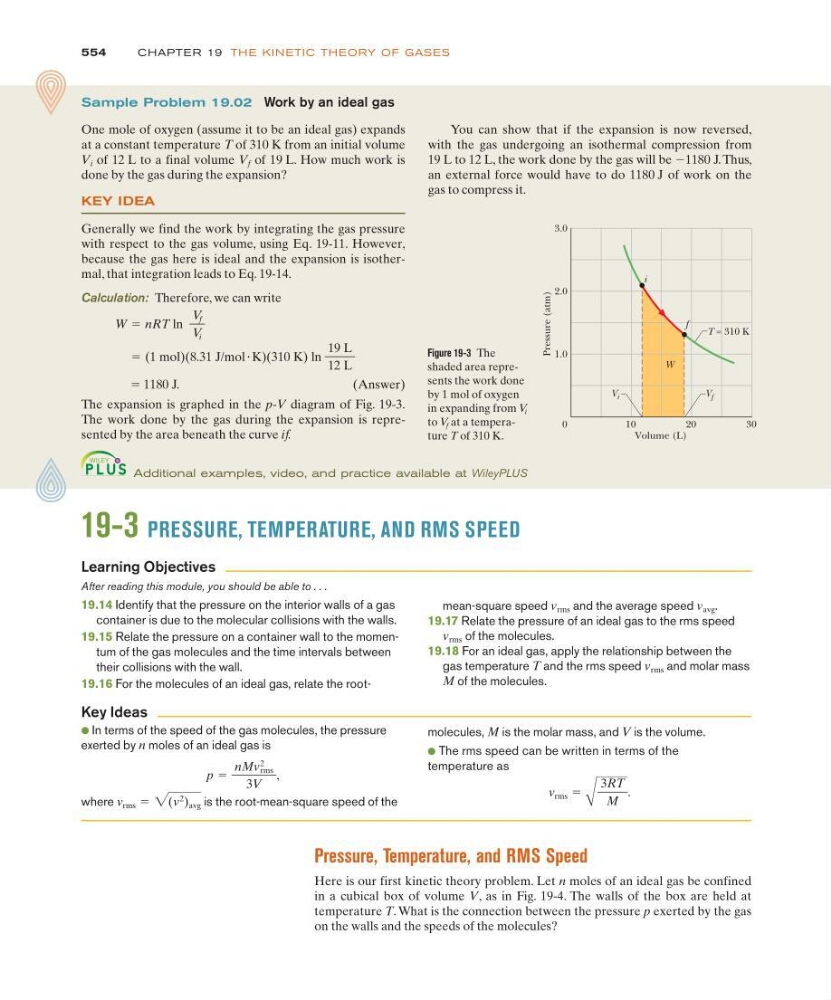
The expansion is graphed in the p-V diagram of Fig. 19-3.
The work done by the gas during the expansion is represented by the area beneath the curve if.
ϭ (1 mol)(8.31 J/molиK)(310 K) ln
19 L
12 L
W ϭ nRT ln
V f
V i
Additional examples, video, and practice available at WileyPLUS
3.0
2.0
1.0
10
20
30
0
Volume (L)
Pressure (atm)
W
V i
V f
T = 310 K
i
f
Figure 19-3 The
shaded area represents the work done
by 1 mol of oxygen
in expanding from V i
to V f at a temperature T of 310 K.
19-3 PRESSURE, TEMPERATURE, AND RMS SPEED
After reading this module, you should be able to . . .
19.14 Identify that the pressure on the interior walls of a gas
container is due to the molecular collisions with the walls.
19.15 Relate the pressure on a container wall to the momentum of the gas molecules and the time intervals between
their collisions with the wall.
19.16 For the molecules of an ideal gas, relate the rootmean-square speed v rms and the average speed v avg .
19.17 Relate the pressure of an ideal gas to the rms speed
v rms of the molecules.
19.18 For an ideal gas, apply the relationship between the
gas temperature T and the rms speed v rms and molar mass
M of the molecules.
Learning Objectives
● In terms of the speed of the gas molecules, the pressure
exerted by n moles of an ideal gas is
where
is the root-mean-square speed of the
v rms ϭ 2(v
2
) avg
p ϭ
nMv
2
rms
3V
,
molecules, M is the molar mass, and V is the volume.
● The rms speed can be written in terms of the
temperature as
v rms ϭ A
3RT
M
.
Key Ideas
Pressure, Temperature, and RMS Speed
Here is our first kinetic theory problem. Let n moles of an ideal gas be confined
in a cubical box of volume V, as in Fig. 19-4. The walls of the box are held at
temperature T. What is the connection between the pressure p exerted by the gas
on the walls and the speeds of the molecules?
CHAPTE R 19 TH E KI N ETIC TH EORY OF GASES
You can show that if the expansion is now reversed,
with the gas undergoing an isothermal compression from
19 L to 12 L, the work done by the gas will be Ϫ1180 J. Thus,
an external force would have to do 1180 J of work on the
gas to compress it.
Sample Problem 19.02 Work by an ideal gas
One mole of oxygen (assume it to be an ideal gas) expands
at a constant temperature T of 310 K from an initial volume
V i of 12 L to a final volume V f of 19 L. How much work is
done by the gas during the expansion?
KEY IDEA
Generally we find the work by integrating the gas pressure
with respect to the gas volume, using Eq. 19-11. However,
because the gas here is ideal and the expansion is isothermal, that integration leads to Eq. 19-14.
Calculation: Therefore, we can write
ϭ 1180 J.
(Answer)
The expansion is graphed in the p-V diagram of Fig. 19-3.
The work done by the gas during the expansion is represented by the area beneath the curve if.
ϭ (1 mol)(8.31 J/molиK)(310 K) ln
19 L
12 L
W ϭ nRT ln
V f
V i
Additional examples, video, and practice available at WileyPLUS
3.0
2.0
1.0
10
20
30
0
Volume (L)
Pressure (atm)
W
V i
V f
T = 310 K
i
f
Figure 19-3 The
shaded area represents the work done
by 1 mol of oxygen
in expanding from V i
to V f at a temperature T of 310 K.
19-3 PRESSURE, TEMPERATURE, AND RMS SPEED
After reading this module, you should be able to . . .
19.14 Identify that the pressure on the interior walls of a gas
container is due to the molecular collisions with the walls.
19.15 Relate the pressure on a container wall to the momentum of the gas molecules and the time intervals between
their collisions with the wall.
19.16 For the molecules of an ideal gas, relate the rootmean-square speed v rms and the average speed v avg .
19.17 Relate the pressure of an ideal gas to the rms speed
v rms of the molecules.
19.18 For an ideal gas, apply the relationship between the
gas temperature T and the rms speed v rms and molar mass
M of the molecules.
Learning Objectives
● In terms of the speed of the gas molecules, the pressure
exerted by n moles of an ideal gas is
where
is the root-mean-square speed of the
v rms ϭ 2(v
2
) avg
p ϭ
nMv
2
rms
3V
,
molecules, M is the molar mass, and V is the volume.
● The rms speed can be written in terms of the
temperature as
v rms ϭ A
3RT
M
.
Key Ideas
Pressure, Temperature, and RMS Speed
Here is our first kinetic theory problem. Let n moles of an ideal gas be confined
in a cubical box of volume V, as in Fig. 19-4. The walls of the box are held at
temperature T. What is the connection between the pressure p exerted by the gas
on the walls and the speeds of the molecules?