

547
PROB LE M S
84 (a) Calculate the rate at which body heat is conducted
through the clothing of a skier in a steady-state process, given the
following data: the body surface area is 1.8 m
2
, and the clothing is
1.0 cm thick; the skin surface temperature is 33 C and the outer
surface of the clothing is at 1.0 C; the thermal conductivity of the
clothing is 0.040 W/m иK. (b) If, after a fall, the skier’s clothes became soaked with water of thermal conductivity 0.60 W/m иK, by
how much is the rate of conduction multiplied?
85
A 2.50 kg lump of aluminum is heated to 92.0 C and then
dropped into 8.00 kg of water at 5.00 C. Assuming that the
lump – water system is thermally isolated, what is the system’s equilibrium temperature?
86 A glass window pane is exactly 20 cm by 30 cm at 10 C. By
how much has its area increased when its temperature is 40 C, assuming that it can expand freely?
87 A recruit can join the semi-secret “300 F” club at the
Amundsen – Scott South Pole Station only when the outside temperature is below Ϫ70 C. On such a day, the recruit first basks in a
hot sauna and then runs outside wearing only shoes. (This is, of
course, extremely dangerous, but the rite is effectively a protest
against the constant danger of the cold.)
Assume that upon stepping out of the sauna, the recruit’s skin
temperature is 102 F and the walls, ceiling, and floor of the sauna
room have a temperature of 30 C. Estimate the recruit’s surface
area, and take the skin emissivity to be 0.80. (a) What is the approximate net rate P net at which the recruit loses energy via thermal radiation exchanges with the room? Next, assume that when
outdoors, half the recruit’s surface area exchanges thermal radiation with the sky at a temperature of Ϫ25 C and the other half
exchanges thermal radiation with the snow and ground at a temperature of Ϫ80 C. What is the approximate net rate at which the
recruit loses energy via thermal radiation exchanges with (b) the
sky and (c) the snow and ground?
88 A steel rod at 25.0 C is bolted at both ends and then cooled.
At what temperature will it rupture? Use Table 12-1.
89 An athlete needs to lose weight and decides to do it by
“pumping iron.” (a) How many times must an 80.0 kg weight be
lifted a distance of 1.00 m in order to burn off 1.00 lb of fat, assuming that that much fat is equivalent to 3500 Cal? (b) If the weight is
lifted once every 2.00 s, how long does the task take?
90 Soon after Earth was formed, heat released by the decay of radioactive elements raised the average internal temperature from 300
to 3000 K, at about which value it remains today. Assuming an average coefficient of volume expansion of 3.0 ϫ 10
Ϫ5
K
Ϫ1
, by how much
has the radius of Earth increased since the planet was formed?
91 It is possible to melt ice by rubbing one block of it against
another. How much work, in joules, would you have to do to get
1.00 g of ice to melt?
92 A rectangular plate of glass initially has the dimensions 0.200 m
by 0.300 m. The coefficient of linear expansion for the glass is
9.00 ϫ 10
Ϫ6
/K. What is the change in the plate’s area if its temperature is increased by 20.0 K?
93 Suppose that you intercept 5.0 ϫ 10
Ϫ3
of the energy radiated
by a hot sphere that has a radius of 0.020 m, an emissivity of 0.80,
and a surface temperature of 500 K. How much energy do you intercept in 2.0 min?
94 A thermometer of mass 0.0550 kg and of specific heat
0.837 kJ/kg иK reads 15.0 C. It is then completely immersed in
Њ
Њ
Њ
Њ
Њ
Њ
Њ
Њ
Њ
Њ
Њ
SSM
Њ
Њ
0.300 kg of water, and it comes to the same final temperature as
the water. If the thermometer then reads 44.4 C, what was the temperature of the water before insertion of the thermometer?
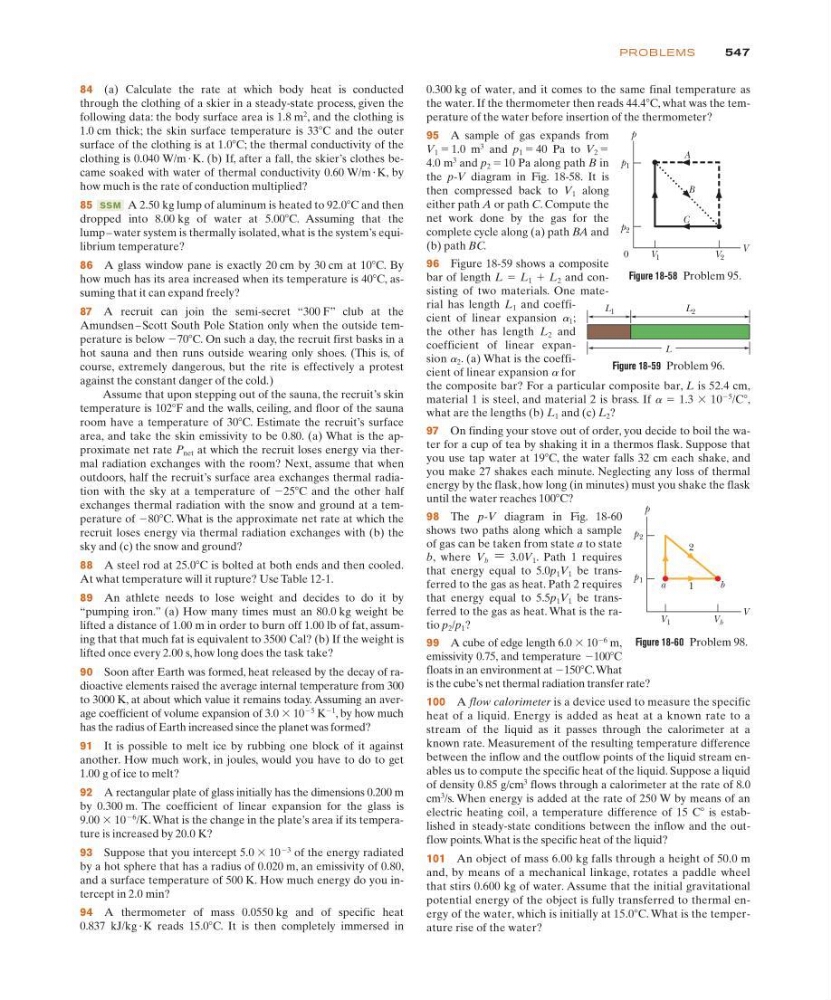
95 A sample of gas expands from
V 1 ϭ 1.0 m
3
and p 1 ϭ 40 Pa to V 2 ϭ
4.0 m
3
and p 2 ϭ 10 Pa along path B in
the p-V diagram in Fig. 18-58. It is
then compressed back to V 1 along
either path A or path C. Compute the
net work done by the gas for the
complete cycle along (a) path BA and
(b) path BC.
96 Figure 18-59 shows a composite
bar of length L ϭ L 1 ϩ L 2 and consisting of two materials. One material has length L 1 and coefficient of linear expansion a 1 ;
the other has length L 2 and
coefficient of linear expansion a 2 . (a) What is the coefficient of linear expansion a for
the composite bar? For a particular composite bar, L is 52.4 cm,
material 1 is steel, and material 2 is brass. If a ϭ 1.3 ϫ 10
Ϫ5
/CЊ,
what are the lengths (b) L 1 and (c) L 2 ?
97 On finding your stove out of order, you decide to boil the water for a cup of tea by shaking it in a thermos flask. Suppose that
you use tap water at 19ЊC, the water falls 32 cm each shake, and
you make 27 shakes each minute. Neglecting any loss of thermal
energy by the flask, how long (in minutes) must you shake the flask
until the water reaches 100ЊC?
98 The p-V diagram in Fig. 18-60
shows two paths along which a sample
of gas can be taken from state a to state
b, where V b
3.0V 1 . Path 1 requires
that energy equal to 5.0p 1 V 1 be transferred to the gas as heat. Path 2 requires
that energy equal to 5.5p 1 V 1 be transferred to the gas as heat. What is the ratio p 2 /p 1 ?
99 A cube of edge length 6.0 ϫ 10
Ϫ6
m,
emissivity 0.75, and temperature Ϫ100ЊC
floats in an environment at Ϫ150ЊC.What
is the cube’s net thermal radiation transfer rate?
100 A flow calorimeter is a device used to measure the specific
heat of a liquid. Energy is added as heat at a known rate to a
stream of the liquid as it passes through the calorimeter at a
known rate. Measurement of the resulting temperature difference
between the inflow and the outflow points of the liquid stream enables us to compute the specific heat of the liquid. Suppose a liquid
of density 0.85 g/cm
3
flows through a calorimeter at the rate of 8.0
cm
3
/s. When energy is added at the rate of 250 W by means of an
electric heating coil, a temperature difference of 15 CЊ is established in steady-state conditions between the inflow and the outflow points. What is the specific heat of the liquid?
101 An object of mass 6.00 kg falls through a height of 50.0 m
and, by means of a mechanical linkage, rotates a paddle wheel
that stirs 0.600 kg of water. Assume that the initial gravitational
potential energy of the object is fully transferred to thermal energy of the water, which is initially at 15.0 C. What is the temperature rise of the water?
Њ
ϭ
Њ
p 1
p
p 2
V 1
V 2
V
C
B
A
0
Figure 18-58 Problem 95.
L
L 1
L 2
Figure 18-59 Problem 96.
p
V
p 2
p 1
V 1
V b
2
1
a
b
Figure 18-60 Problem 98.
PROB LE M S
84 (a) Calculate the rate at which body heat is conducted
through the clothing of a skier in a steady-state process, given the
following data: the body surface area is 1.8 m
2
, and the clothing is
1.0 cm thick; the skin surface temperature is 33 C and the outer
surface of the clothing is at 1.0 C; the thermal conductivity of the
clothing is 0.040 W/m иK. (b) If, after a fall, the skier’s clothes became soaked with water of thermal conductivity 0.60 W/m иK, by
how much is the rate of conduction multiplied?
85
A 2.50 kg lump of aluminum is heated to 92.0 C and then
dropped into 8.00 kg of water at 5.00 C. Assuming that the
lump – water system is thermally isolated, what is the system’s equilibrium temperature?
86 A glass window pane is exactly 20 cm by 30 cm at 10 C. By
how much has its area increased when its temperature is 40 C, assuming that it can expand freely?
87 A recruit can join the semi-secret “300 F” club at the
Amundsen – Scott South Pole Station only when the outside temperature is below Ϫ70 C. On such a day, the recruit first basks in a
hot sauna and then runs outside wearing only shoes. (This is, of
course, extremely dangerous, but the rite is effectively a protest
against the constant danger of the cold.)
Assume that upon stepping out of the sauna, the recruit’s skin
temperature is 102 F and the walls, ceiling, and floor of the sauna
room have a temperature of 30 C. Estimate the recruit’s surface
area, and take the skin emissivity to be 0.80. (a) What is the approximate net rate P net at which the recruit loses energy via thermal radiation exchanges with the room? Next, assume that when
outdoors, half the recruit’s surface area exchanges thermal radiation with the sky at a temperature of Ϫ25 C and the other half
exchanges thermal radiation with the snow and ground at a temperature of Ϫ80 C. What is the approximate net rate at which the
recruit loses energy via thermal radiation exchanges with (b) the
sky and (c) the snow and ground?
88 A steel rod at 25.0 C is bolted at both ends and then cooled.
At what temperature will it rupture? Use Table 12-1.
89 An athlete needs to lose weight and decides to do it by
“pumping iron.” (a) How many times must an 80.0 kg weight be
lifted a distance of 1.00 m in order to burn off 1.00 lb of fat, assuming that that much fat is equivalent to 3500 Cal? (b) If the weight is
lifted once every 2.00 s, how long does the task take?
90 Soon after Earth was formed, heat released by the decay of radioactive elements raised the average internal temperature from 300
to 3000 K, at about which value it remains today. Assuming an average coefficient of volume expansion of 3.0 ϫ 10
Ϫ5
K
Ϫ1
, by how much
has the radius of Earth increased since the planet was formed?
91 It is possible to melt ice by rubbing one block of it against
another. How much work, in joules, would you have to do to get
1.00 g of ice to melt?
92 A rectangular plate of glass initially has the dimensions 0.200 m
by 0.300 m. The coefficient of linear expansion for the glass is
9.00 ϫ 10
Ϫ6
/K. What is the change in the plate’s area if its temperature is increased by 20.0 K?
93 Suppose that you intercept 5.0 ϫ 10
Ϫ3
of the energy radiated
by a hot sphere that has a radius of 0.020 m, an emissivity of 0.80,
and a surface temperature of 500 K. How much energy do you intercept in 2.0 min?
94 A thermometer of mass 0.0550 kg and of specific heat
0.837 kJ/kg иK reads 15.0 C. It is then completely immersed in
Њ
Њ
Њ
Њ
Њ
Њ
Њ
Њ
Њ
Њ
Њ
SSM
Њ
Њ
0.300 kg of water, and it comes to the same final temperature as
the water. If the thermometer then reads 44.4 C, what was the temperature of the water before insertion of the thermometer?
95 A sample of gas expands from
V 1 ϭ 1.0 m
3
and p 1 ϭ 40 Pa to V 2 ϭ
4.0 m
3
and p 2 ϭ 10 Pa along path B in
the p-V diagram in Fig. 18-58. It is
then compressed back to V 1 along
either path A or path C. Compute the
net work done by the gas for the
complete cycle along (a) path BA and
(b) path BC.
96 Figure 18-59 shows a composite
bar of length L ϭ L 1 ϩ L 2 and consisting of two materials. One material has length L 1 and coefficient of linear expansion a 1 ;
the other has length L 2 and
coefficient of linear expansion a 2 . (a) What is the coefficient of linear expansion a for
the composite bar? For a particular composite bar, L is 52.4 cm,
material 1 is steel, and material 2 is brass. If a ϭ 1.3 ϫ 10
Ϫ5
/CЊ,
what are the lengths (b) L 1 and (c) L 2 ?
97 On finding your stove out of order, you decide to boil the water for a cup of tea by shaking it in a thermos flask. Suppose that
you use tap water at 19ЊC, the water falls 32 cm each shake, and
you make 27 shakes each minute. Neglecting any loss of thermal
energy by the flask, how long (in minutes) must you shake the flask
until the water reaches 100ЊC?
98 The p-V diagram in Fig. 18-60
shows two paths along which a sample
of gas can be taken from state a to state
b, where V b
3.0V 1 . Path 1 requires
that energy equal to 5.0p 1 V 1 be transferred to the gas as heat. Path 2 requires
that energy equal to 5.5p 1 V 1 be transferred to the gas as heat. What is the ratio p 2 /p 1 ?
99 A cube of edge length 6.0 ϫ 10
Ϫ6
m,
emissivity 0.75, and temperature Ϫ100ЊC
floats in an environment at Ϫ150ЊC.What
is the cube’s net thermal radiation transfer rate?
100 A flow calorimeter is a device used to measure the specific
heat of a liquid. Energy is added as heat at a known rate to a
stream of the liquid as it passes through the calorimeter at a
known rate. Measurement of the resulting temperature difference
between the inflow and the outflow points of the liquid stream enables us to compute the specific heat of the liquid. Suppose a liquid
of density 0.85 g/cm
3
flows through a calorimeter at the rate of 8.0
cm
3
/s. When energy is added at the rate of 250 W by means of an
electric heating coil, a temperature difference of 15 CЊ is established in steady-state conditions between the inflow and the outflow points. What is the specific heat of the liquid?
101 An object of mass 6.00 kg falls through a height of 50.0 m
and, by means of a mechanical linkage, rotates a paddle wheel
that stirs 0.600 kg of water. Assume that the initial gravitational
potential energy of the object is fully transferred to thermal energy of the water, which is initially at 15.0 C. What is the temperature rise of the water?
Њ
ϭ
Њ
p 1
p
p 2
V 1
V 2
V
C
B
A
0
Figure 18-58 Problem 95.
L
L 1
L 2
Figure 18-59 Problem 96.
p
V
p 2
p 1
V 1
V b
2
1
a
b
Figure 18-60 Problem 98.