

546
CHAPTE R 18 TE M PE RATU R E, H EAT, AN D TH E FI RST L AW OF TH E R M ODYNAM ICS
there? The thermal conductivity of ice is 0.400 W/mиK, and the
density of liquid water is 1000 kg/m
3
.
79
A sample of gas expands from an initial pressure and
volume of 10 Pa and 1.0 m
3
to a final volume of 2.0 m
3
. During the
expansion, the pressure and volume are related by the equation
p ϭ aV
2
, where a ϭ 10 N/m
8
. Determine the work done by the gas
during this expansion.
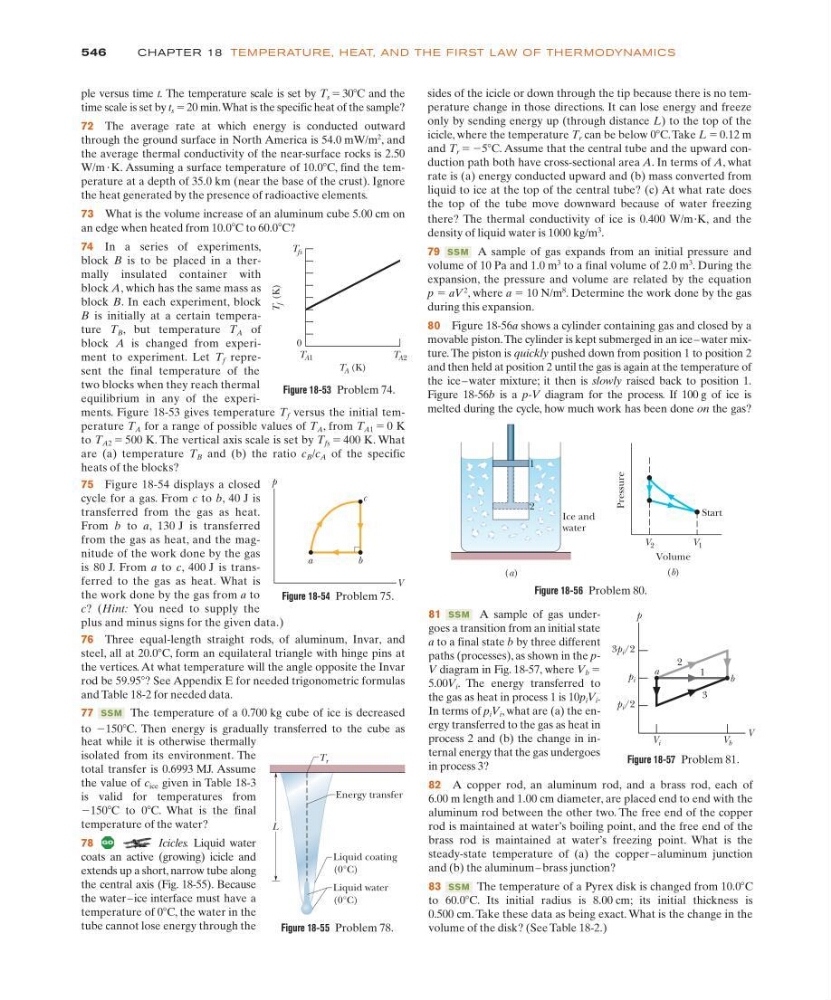
80 Figure 18-56a shows a cylinder containing gas and closed by a
movable piston.The cylinder is kept submerged in an ice – water mixture. The piston is quickly pushed down from position 1 to position 2
and then held at position 2 until the gas is again at the temperature of
the ice – water mixture; it then is slowly raised back to position 1.
Figure 18-56b is a p-V diagram for the process. If 100 g of ice is
melted during the cycle, how much work has been done on the gas?
SSM
ple versus time t. The temperature scale is set by T s ϭ 30 C and the
time scale is set by t s ϭ 20 min.What is the specific heat of the sample?
72 The average rate at which energy is conducted outward
through the ground surface in North America is 54.0 mW/m
2
, and
the average thermal conductivity of the near-surface rocks is 2.50
W/m иK. Assuming a surface temperature of 10.0 C, find the temperature at a depth of 35.0 km (near the base of the crust). Ignore
the heat generated by the presence of radioactive elements.
73 What is the volume increase of an aluminum cube 5.00 cm on
an edge when heated from 10.0 C to 60.0 C?
74 In a series of experiments,
block B is to be placed in a thermally insulated container with
block A, which has the same mass as
block B. In each experiment, block
B is initially at a certain temperature T B , but temperature T A of
block A is changed from experiment to experiment. Let T f represent the final temperature of the
two blocks when they reach thermal
equilibrium in any of the experiments. Figure 18-53 gives temperature T f versus the initial temperature T A for a range of possible values of T A , from T A1 ϭ 0 K
to T A2 ϭ 500 K. The vertical axis scale is set by T fs ϭ 400 K. What
are (a) temperature T B and (b) the ratio c B /c A of the specific
heats of the blocks?
75 Figure 18-54 displays a closed
cycle for a gas. From c to b, 40 J is
transferred from the gas as heat.
From b to a, 130 J is transferred
from the gas as heat, and the magnitude of the work done by the gas
is 80 J. From a to c, 400 J is transferred to the gas as heat. What is
the work done by the gas from a to
c? (Hint: You need to supply the
plus and minus signs for the given data.)
76 Three equal-length straight rods, of aluminum, Invar, and
steel, all at 20.0 C, form an equilateral triangle with hinge pins at
the vertices. At what temperature will the angle opposite the Invar
rod be 59.95 ? See Appendix E for needed trigonometric formulas
and Table 18-2 for needed data.
Њ
Њ
Њ
Њ
Њ
Њ
sides of the icicle or down through the tip because there is no temperature change in those directions. It can lose energy and freeze
only by sending energy up (through distance L) to the top of the
icicle, where the temperature T r can be below 0 C. Take L ϭ 0.12 m
and T r ϭ Ϫ5 C. Assume that the central tube and the upward conduction path both have cross-sectional area A. In terms of A, what
rate is (a) energy conducted upward and (b) mass converted from
liquid to ice at the top of the central tube? (c) At what rate does
the top of the tube move downward because of water freezing
Њ
Њ
Figure 18-53 Problem 74.
T fs
0
T A1
T A (K)
T A2
T
f (K)
c
p
V
b
a
Figure 18-54 Problem 75.
Ice and
water
(a)
V 1
V 2
Volume
Pressure
Start
(b)
1
2
Figure 18-56 Problem 80.
77
The temperature of a 0.700 kg cube of ice is decreased
SSM
81
A sample of gas undergoes a transition from an initial state
a to a final state b by three different
paths (processes), as shown in the pV diagram in Fig. 18-57, where V b ϭ
5.00V i . The energy transferred to
the gas as heat in process 1 is 10p i V i .
In terms of p i V i , what are (a) the energy transferred to the gas as heat in
process 2 and (b) the change in internal energy that the gas undergoes
in process 3?
82 A copper rod, an aluminum rod, and a brass rod, each of
6.00 m length and 1.00 cm diameter, are placed end to end with the
aluminum rod between the other two. The free end of the copper
rod is maintained at water’s boiling point, and the free end of the
brass rod is maintained at water’s freezing point. What is the
steady-state temperature of (a) the copper – aluminum junction
and (b) the aluminum – brass junction?
83
The temperature of a Pyrex disk is changed from 10.0 C
to 60.0 C. Its initial radius is 8.00 cm; its initial thickness is
0.500 cm. Take these data as being exact. What is the change in the
volume of the disk? (See Table 18-2.)
Њ
Њ
SSM
SSM
p i /2
p i
3p i /2
V i
V b
V
a
b
2
1
3
p
Figure 18-57 Problem 81.
Energy transfer
Liquid coating
(0°C)
Liquid water
(0°C)
T r
L
Figure 18-55 Problem 78.
to Ϫ150 C. Then energy is gradually transferred to the cube as
Њ
heat while it is otherwise thermally
isolated from its environment. The
total transfer is 0.6993 MJ. Assume
the value of c ice given in Table 18-3
is valid for temperatures from
Ϫ150 C to 0 C. What is the final
temperature of the water?
78
Icicles. Liquid water
coats an active (growing) icicle and
extends up a short, narrow tube along
the central axis (Fig. 18-55). Because
the water – ice interface must have a
temperature of 0 C, the water in the
tube cannot lose energy through the
Њ
Њ
Њ
CHAPTE R 18 TE M PE RATU R E, H EAT, AN D TH E FI RST L AW OF TH E R M ODYNAM ICS
there? The thermal conductivity of ice is 0.400 W/mиK, and the
density of liquid water is 1000 kg/m
3
.
79
A sample of gas expands from an initial pressure and
volume of 10 Pa and 1.0 m
3
to a final volume of 2.0 m
3
. During the
expansion, the pressure and volume are related by the equation
p ϭ aV
2
, where a ϭ 10 N/m
8
. Determine the work done by the gas
during this expansion.
80 Figure 18-56a shows a cylinder containing gas and closed by a
movable piston.The cylinder is kept submerged in an ice – water mixture. The piston is quickly pushed down from position 1 to position 2
and then held at position 2 until the gas is again at the temperature of
the ice – water mixture; it then is slowly raised back to position 1.
Figure 18-56b is a p-V diagram for the process. If 100 g of ice is
melted during the cycle, how much work has been done on the gas?
SSM
ple versus time t. The temperature scale is set by T s ϭ 30 C and the
time scale is set by t s ϭ 20 min.What is the specific heat of the sample?
72 The average rate at which energy is conducted outward
through the ground surface in North America is 54.0 mW/m
2
, and
the average thermal conductivity of the near-surface rocks is 2.50
W/m иK. Assuming a surface temperature of 10.0 C, find the temperature at a depth of 35.0 km (near the base of the crust). Ignore
the heat generated by the presence of radioactive elements.
73 What is the volume increase of an aluminum cube 5.00 cm on
an edge when heated from 10.0 C to 60.0 C?
74 In a series of experiments,
block B is to be placed in a thermally insulated container with
block A, which has the same mass as
block B. In each experiment, block
B is initially at a certain temperature T B , but temperature T A of
block A is changed from experiment to experiment. Let T f represent the final temperature of the
two blocks when they reach thermal
equilibrium in any of the experiments. Figure 18-53 gives temperature T f versus the initial temperature T A for a range of possible values of T A , from T A1 ϭ 0 K
to T A2 ϭ 500 K. The vertical axis scale is set by T fs ϭ 400 K. What
are (a) temperature T B and (b) the ratio c B /c A of the specific
heats of the blocks?
75 Figure 18-54 displays a closed
cycle for a gas. From c to b, 40 J is
transferred from the gas as heat.
From b to a, 130 J is transferred
from the gas as heat, and the magnitude of the work done by the gas
is 80 J. From a to c, 400 J is transferred to the gas as heat. What is
the work done by the gas from a to
c? (Hint: You need to supply the
plus and minus signs for the given data.)
76 Three equal-length straight rods, of aluminum, Invar, and
steel, all at 20.0 C, form an equilateral triangle with hinge pins at
the vertices. At what temperature will the angle opposite the Invar
rod be 59.95 ? See Appendix E for needed trigonometric formulas
and Table 18-2 for needed data.
Њ
Њ
Њ
Њ
Њ
Њ
sides of the icicle or down through the tip because there is no temperature change in those directions. It can lose energy and freeze
only by sending energy up (through distance L) to the top of the
icicle, where the temperature T r can be below 0 C. Take L ϭ 0.12 m
and T r ϭ Ϫ5 C. Assume that the central tube and the upward conduction path both have cross-sectional area A. In terms of A, what
rate is (a) energy conducted upward and (b) mass converted from
liquid to ice at the top of the central tube? (c) At what rate does
the top of the tube move downward because of water freezing
Њ
Њ
Figure 18-53 Problem 74.
T fs
0
T A1
T A (K)
T A2
T
f (K)
c
p
V
b
a
Figure 18-54 Problem 75.
Ice and
water
(a)
V 1
V 2
Volume
Pressure
Start
(b)
1
2
Figure 18-56 Problem 80.
77
The temperature of a 0.700 kg cube of ice is decreased
SSM
81
A sample of gas undergoes a transition from an initial state
a to a final state b by three different
paths (processes), as shown in the pV diagram in Fig. 18-57, where V b ϭ
5.00V i . The energy transferred to
the gas as heat in process 1 is 10p i V i .
In terms of p i V i , what are (a) the energy transferred to the gas as heat in
process 2 and (b) the change in internal energy that the gas undergoes
in process 3?
82 A copper rod, an aluminum rod, and a brass rod, each of
6.00 m length and 1.00 cm diameter, are placed end to end with the
aluminum rod between the other two. The free end of the copper
rod is maintained at water’s boiling point, and the free end of the
brass rod is maintained at water’s freezing point. What is the
steady-state temperature of (a) the copper – aluminum junction
and (b) the aluminum – brass junction?
83
The temperature of a Pyrex disk is changed from 10.0 C
to 60.0 C. Its initial radius is 8.00 cm; its initial thickness is
0.500 cm. Take these data as being exact. What is the change in the
volume of the disk? (See Table 18-2.)
Њ
Њ
SSM
SSM
p i /2
p i
3p i /2
V i
V b
V
a
b
2
1
3
p
Figure 18-57 Problem 81.
Energy transfer
Liquid coating
(0°C)
Liquid water
(0°C)
T r
L
Figure 18-55 Problem 78.
to Ϫ150 C. Then energy is gradually transferred to the cube as
Њ
heat while it is otherwise thermally
isolated from its environment. The
total transfer is 0.6993 MJ. Assume
the value of c ice given in Table 18-3
is valid for temperatures from
Ϫ150 C to 0 C. What is the final
temperature of the water?
78
Icicles. Liquid water
coats an active (growing) icicle and
extends up a short, narrow tube along
the central axis (Fig. 18-55). Because
the water – ice interface must have a
temperature of 0 C, the water in the
tube cannot lose energy through the
Њ
Њ
Њ