

496
CHAPTE R 17 WAVES—I I
17-6 BEATS
After reading this module, you should be able to . . .
17.28 Explain how beats are produced.
17.29 Add the displacement equations for two sound
waves of the same amplitude and slightly different angular frequencies to find the displacement equation of the
resultant wave and identify the time-varying amplitude.
17.30 Apply the relationship between the beat frequency
and the frequencies of two sound waves that have the
same amplitude when the frequencies (or, equivalently,
the angular frequencies) differ by a small amount.
Learning Objectives
● Beats arise when two waves having slightly different frequencies, f 1 and f 2 , are detected together. The beat frequency is
f beat ϭ f 1 Ϫ f 2 .
Key Idea
Additional examples, video, and practice available at WileyPLUS
1
1
3
3
5
1
3
5
1
3
2
4
6
5
0.50
0
1.5
1.0
2.0
3.0
2.5
7 9 11 13 15 17 19 21 23
n A
kHz
n B
n C
n D
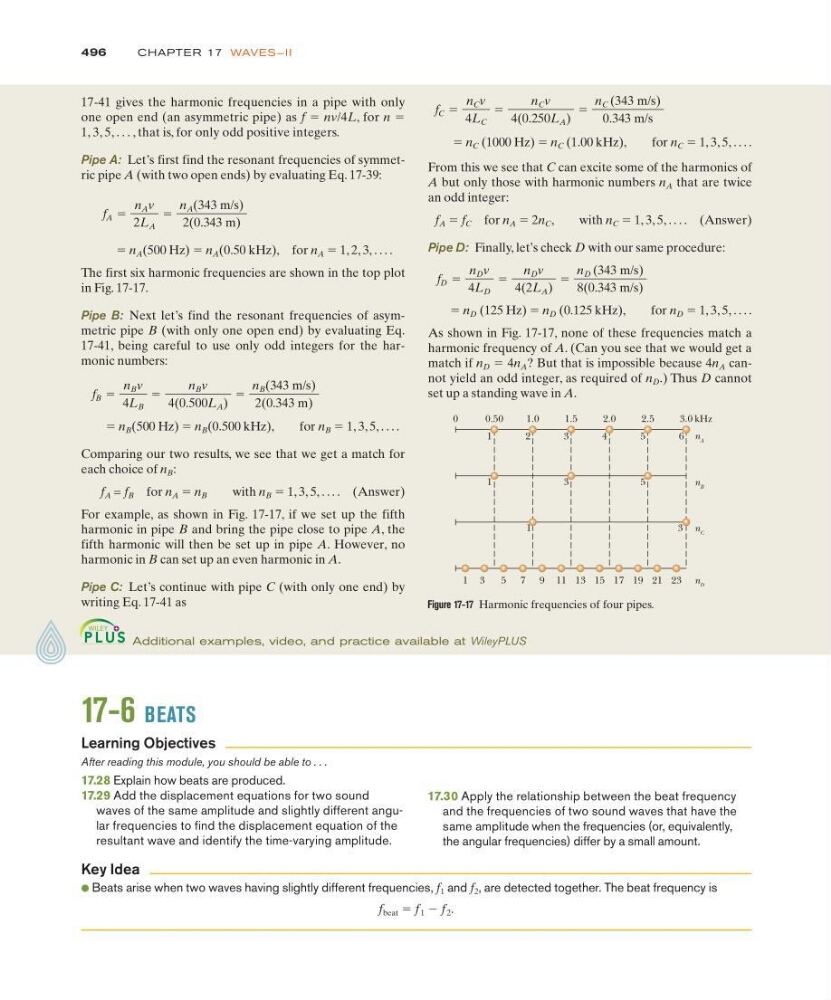
Figure 17-17 Harmonic frequencies of four pipes.
17-41 gives the harmonic frequencies in a pipe with only
one open end (an asymmetric pipe) as f ϭ nv/4L, for n ϭ
1, 3, 5, . . . , that is, for only odd positive integers.
Pipe A: Let’s first find the resonant frequencies of symmetric pipe A (with two open ends) by evaluating Eq. 17-39:
ϭ n A (500 Hz) ϭ n A (0.50 kHz), for n A ϭ 1, 2, 3, . . . .
The first six harmonic frequencies are shown in the top plot
in Fig. 17-17.
Pipe B: Next let’s find the resonant frequencies of asymmetric pipe B (with only one open end) by evaluating Eq.
17-41, being careful to use only odd integers for the harmonic numbers:
ϭ n B (500 Hz) ϭ n B (0.500 kHz),
for n B ϭ 1, 3, 5, . . . .
Comparing our two results, we see that we get a match for
each choice of n B :
f A = f B for n A ϭ n B
with n B ϭ 1, 3, 5, . . . . (Answer)
For example, as shown in Fig. 17-17, if we set up the fifth
harmonic in pipe B and bring the pipe close to pipe A, the
fifth harmonic will then be set up in pipe A. However, no
harmonic in B can set up an even harmonic in A.
Pipe C: Let’s continue with pipe C (with only one end) by
writing Eq. 17-41 as
f B ϭ
n B v
4L B
ϭ
n B v
4(0.500L A )
ϭ
n B (343 m/s)
2(0.343 m)
f A ϭ
n A v
2L A
ϭ
n A (343 m/s)
2(0.343 m)
ϭ n C (1000 Hz) ϭ n C (1.00 kHz),
for n C ϭ 1, 3, 5, . . . .
From this we see that C can excite some of the harmonics of
A but only those with harmonic numbers n A that are twice
an odd integer:
f A ϭ f C for n A ϭ 2n C ,
with n C ϭ 1, 3, 5, . . . . (Answer)
Pipe D: Finally, let’s check D with our same procedure:
ϭ n D (125 Hz) ϭ n D (0.125 kHz),
for n D ϭ 1, 3, 5, . . . .
As shown in Fig. 17-17, none of these frequencies match a
harmonic frequency of A. (Can you see that we would get a
match if n D ϭ 4n A ? But that is impossible because 4n A cannot yield an odd integer, as required of n D .) Thus D cannot
set up a standing wave in A.
f D ϭ
n D v
4L D
ϭ
n D v
4(2L A )
ϭ
n D (343 m/s)
8(0.343 m/s)
f C ϭ
n C v
4L C
ϭ
n C v
4(0.250L A )
ϭ
n C (343 m/s)
0.343 m/s
CHAPTE R 17 WAVES—I I
17-6 BEATS
After reading this module, you should be able to . . .
17.28 Explain how beats are produced.
17.29 Add the displacement equations for two sound
waves of the same amplitude and slightly different angular frequencies to find the displacement equation of the
resultant wave and identify the time-varying amplitude.
17.30 Apply the relationship between the beat frequency
and the frequencies of two sound waves that have the
same amplitude when the frequencies (or, equivalently,
the angular frequencies) differ by a small amount.
Learning Objectives
● Beats arise when two waves having slightly different frequencies, f 1 and f 2 , are detected together. The beat frequency is
f beat ϭ f 1 Ϫ f 2 .
Key Idea
Additional examples, video, and practice available at WileyPLUS
1
1
3
3
5
1
3
5
1
3
2
4
6
5
0.50
0
1.5
1.0
2.0
3.0
2.5
7 9 11 13 15 17 19 21 23
n A
kHz
n B
n C
n D
Figure 17-17 Harmonic frequencies of four pipes.
17-41 gives the harmonic frequencies in a pipe with only
one open end (an asymmetric pipe) as f ϭ nv/4L, for n ϭ
1, 3, 5, . . . , that is, for only odd positive integers.
Pipe A: Let’s first find the resonant frequencies of symmetric pipe A (with two open ends) by evaluating Eq. 17-39:
ϭ n A (500 Hz) ϭ n A (0.50 kHz), for n A ϭ 1, 2, 3, . . . .
The first six harmonic frequencies are shown in the top plot
in Fig. 17-17.
Pipe B: Next let’s find the resonant frequencies of asymmetric pipe B (with only one open end) by evaluating Eq.
17-41, being careful to use only odd integers for the harmonic numbers:
ϭ n B (500 Hz) ϭ n B (0.500 kHz),
for n B ϭ 1, 3, 5, . . . .
Comparing our two results, we see that we get a match for
each choice of n B :
f A = f B for n A ϭ n B
with n B ϭ 1, 3, 5, . . . . (Answer)
For example, as shown in Fig. 17-17, if we set up the fifth
harmonic in pipe B and bring the pipe close to pipe A, the
fifth harmonic will then be set up in pipe A. However, no
harmonic in B can set up an even harmonic in A.
Pipe C: Let’s continue with pipe C (with only one end) by
writing Eq. 17-41 as
f B ϭ
n B v
4L B
ϭ
n B v
4(0.500L A )
ϭ
n B (343 m/s)
2(0.343 m)
f A ϭ
n A v
2L A
ϭ
n A (343 m/s)
2(0.343 m)
ϭ n C (1000 Hz) ϭ n C (1.00 kHz),
for n C ϭ 1, 3, 5, . . . .
From this we see that C can excite some of the harmonics of
A but only those with harmonic numbers n A that are twice
an odd integer:
f A ϭ f C for n A ϭ 2n C ,
with n C ϭ 1, 3, 5, . . . . (Answer)
Pipe D: Finally, let’s check D with our same procedure:
ϭ n D (125 Hz) ϭ n D (0.125 kHz),
for n D ϭ 1, 3, 5, . . . .
As shown in Fig. 17-17, none of these frequencies match a
harmonic frequency of A. (Can you see that we would get a
match if n D ϭ 4n A ? But that is impossible because 4n A cannot yield an odd integer, as required of n D .) Thus D cannot
set up a standing wave in A.
f D ϭ
n D v
4L D
ϭ
n D v
4(2L A )
ϭ
n D (343 m/s)
8(0.343 m/s)
f C ϭ
n C v
4L C
ϭ
n C v
4(0.250L A )
ϭ
n C (343 m/s)
0.343 m/s