

464
CHAPTE R 16 WAVES—I
where yЈ m is the amplitude of the resultant wave and b is its phase constant. To
find the values of yЈ m and b, we would have to sum the two combining waves, as
we did to obtain Eq. 16-51. To do this on a phasor diagram, we vectorially add the
two phasors at any instant during their rotation, as in Fig. 16-15f where phasor y m2
has been shifted to the head of phasor y m1 . The magnitude of the vector sum
equals the amplitude yЈ m in Eq. 16-57. The angle between the vector sum and the
phasor for y 1 equals the phase constant b in Eq. 16-57.
Note that, in contrast to the method of Module 16-5:
We can use phasors to combine waves even if their amplitudes are different.
we shall sum them by components. (They are called horizontal and vertical components, because the symbols x and
y are already used for the waves themselves.) For the horizontal components we have
yЈ mh ϭ y m1 cos 0 ϩ y m2 cos p/3
ϭ 4.0 mm ϩ (3.0 mm) cos p/3 ϭ 5.50 mm.
For the vertical components we have
yЈ mv ϭ y m1 sin 0 ϩ y m2 sin p/3
ϭ 0 ϩ (3.0 mm) sin p/3 ϭ 2.60 mm.
Thus, the resultant wave has an amplitude of
ϭ 6.1 mm
(Answer)
and a phase constant of
(Answer)
From Fig. 16-16b, phase constant b is a positive angle relative to phasor 1. Thus, the resultant wave lags wave 1 in their
travel by phase constant b ϭ ϩ0.44 rad. From Eq. 16-57, we
can write the resultant wave as
yЈ(x, t) ϭ (6.1 mm) sin(kx Ϫ vt ϩ 0.44 rad).
(Answer)
b ϭ tan
Ϫ1
2.60 mm
5.50 mm
ϭ 0.44 rad.
yЈ m ϭ 2(5.50 mm)
2 ϩ (2.60 mm)
2
Sample Problem 16.05 Interference of two waves, same direction, phasors, any amplitudes
Two sinusoidal waves y 1 (x, t) and y 2 (x, t) have the same
wavelength and travel together in the same direction along
a string. Their amplitudes are y m1 ϭ 4.0 mm and y m2 ϭ 3.0
mm, and their phase constants are 0 and p/3 rad, respectively. What are the amplitude yЈ m and phase constant b of
the resultant wave? Write the resultant wave in the form of
Eq. 16-57.
KEY IDEAS
(1) The two waves have a number of properties in common: Because they travel along the same string, they must
have the same speed v, as set by the tension and linear
density of the string according to Eq. 16-26. With the
same wavelength l, they have the same angular wave
number k (ϭ 2p/l). Also, because they have the same
wave number k and speed v, they must have the same angular frequency v (ϭ kv).
(2) The waves (call them waves 1 and 2) can be represented by phasors rotating at the same angular speed v
about an origin. Because the phase constant for wave 2 is
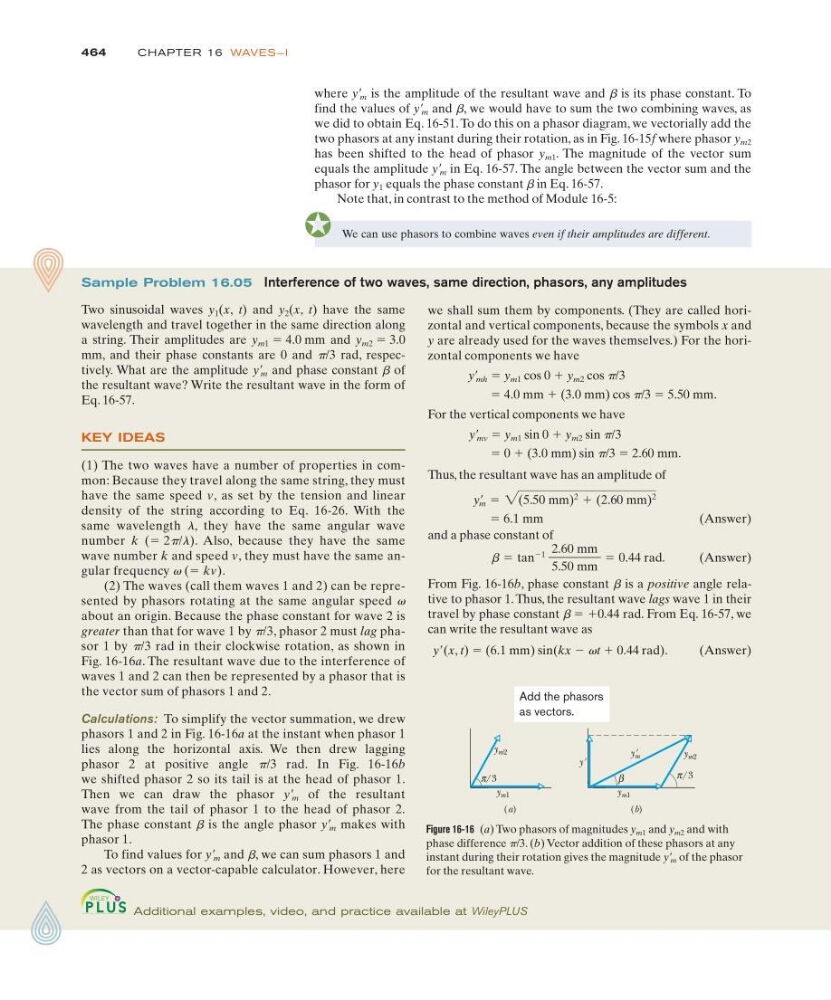
greater than that for wave 1 by p/3, phasor 2 must lag phasor 1 by p/3 rad in their clockwise rotation, as shown in
Fig. 16-16a. The resultant wave due to the interference of
waves 1 and 2 can then be represented by a phasor that is
the vector sum of phasors 1 and 2.
Calculations: To simplify the vector summation, we drew
phasors 1 and 2 in Fig. 16-16a at the instant when phasor 1
lies along the horizontal axis. We then drew lagging
phasor 2 at positive angle p/3 rad. In Fig. 16-16b
we shifted phasor 2 so its tail is at the head of phasor 1.
Then we can draw the phasor yЈ m of the resultant
wave from the tail of phasor 1 to the head of phasor 2.
The phase constant b is the angle phasor yЈ m makes with
phasor 1.
To find values for yЈ m and b, we can sum phasors 1 and
2 as vectors on a vector-capable calculator. However, here
Figure 16-16 (a) Two phasors of magnitudes y m1 and y m2 and with
phase difference p/3. (b) Vector addition of these phasors at any
instant during their rotation gives the magnitude yЈ m of the phasor
for the resultant wave.
π /3
y m2
y m1
β
π
y m2
/3
y m1
y' m
y'
(a)
( b)
Add the phasors
as vectors.
Additional examples, video, and practice available at WileyPLUS
CHAPTE R 16 WAVES—I
where yЈ m is the amplitude of the resultant wave and b is its phase constant. To
find the values of yЈ m and b, we would have to sum the two combining waves, as
we did to obtain Eq. 16-51. To do this on a phasor diagram, we vectorially add the
two phasors at any instant during their rotation, as in Fig. 16-15f where phasor y m2
has been shifted to the head of phasor y m1 . The magnitude of the vector sum
equals the amplitude yЈ m in Eq. 16-57. The angle between the vector sum and the
phasor for y 1 equals the phase constant b in Eq. 16-57.
Note that, in contrast to the method of Module 16-5:
We can use phasors to combine waves even if their amplitudes are different.
we shall sum them by components. (They are called horizontal and vertical components, because the symbols x and
y are already used for the waves themselves.) For the horizontal components we have
yЈ mh ϭ y m1 cos 0 ϩ y m2 cos p/3
ϭ 4.0 mm ϩ (3.0 mm) cos p/3 ϭ 5.50 mm.
For the vertical components we have
yЈ mv ϭ y m1 sin 0 ϩ y m2 sin p/3
ϭ 0 ϩ (3.0 mm) sin p/3 ϭ 2.60 mm.
Thus, the resultant wave has an amplitude of
ϭ 6.1 mm
(Answer)
and a phase constant of
(Answer)
From Fig. 16-16b, phase constant b is a positive angle relative to phasor 1. Thus, the resultant wave lags wave 1 in their
travel by phase constant b ϭ ϩ0.44 rad. From Eq. 16-57, we
can write the resultant wave as
yЈ(x, t) ϭ (6.1 mm) sin(kx Ϫ vt ϩ 0.44 rad).
(Answer)
b ϭ tan
Ϫ1
2.60 mm
5.50 mm
ϭ 0.44 rad.
yЈ m ϭ 2(5.50 mm)
2 ϩ (2.60 mm)
2
Sample Problem 16.05 Interference of two waves, same direction, phasors, any amplitudes
Two sinusoidal waves y 1 (x, t) and y 2 (x, t) have the same
wavelength and travel together in the same direction along
a string. Their amplitudes are y m1 ϭ 4.0 mm and y m2 ϭ 3.0
mm, and their phase constants are 0 and p/3 rad, respectively. What are the amplitude yЈ m and phase constant b of
the resultant wave? Write the resultant wave in the form of
Eq. 16-57.
KEY IDEAS
(1) The two waves have a number of properties in common: Because they travel along the same string, they must
have the same speed v, as set by the tension and linear
density of the string according to Eq. 16-26. With the
same wavelength l, they have the same angular wave
number k (ϭ 2p/l). Also, because they have the same
wave number k and speed v, they must have the same angular frequency v (ϭ kv).
(2) The waves (call them waves 1 and 2) can be represented by phasors rotating at the same angular speed v
about an origin. Because the phase constant for wave 2 is
greater than that for wave 1 by p/3, phasor 2 must lag phasor 1 by p/3 rad in their clockwise rotation, as shown in
Fig. 16-16a. The resultant wave due to the interference of
waves 1 and 2 can then be represented by a phasor that is
the vector sum of phasors 1 and 2.
Calculations: To simplify the vector summation, we drew
phasors 1 and 2 in Fig. 16-16a at the instant when phasor 1
lies along the horizontal axis. We then drew lagging
phasor 2 at positive angle p/3 rad. In Fig. 16-16b
we shifted phasor 2 so its tail is at the head of phasor 1.
Then we can draw the phasor yЈ m of the resultant
wave from the tail of phasor 1 to the head of phasor 2.
The phase constant b is the angle phasor yЈ m makes with
phasor 1.
To find values for yЈ m and b, we can sum phasors 1 and
2 as vectors on a vector-capable calculator. However, here
Figure 16-16 (a) Two phasors of magnitudes y m1 and y m2 and with
phase difference p/3. (b) Vector addition of these phasors at any
instant during their rotation gives the magnitude yЈ m of the phasor
for the resultant wave.
π /3
y m2
y m1
β
π
y m2
/3
y m1
y' m
y'
(a)
( b)
Add the phasors
as vectors.
Additional examples, video, and practice available at WileyPLUS