

463
16-6 PHASORS
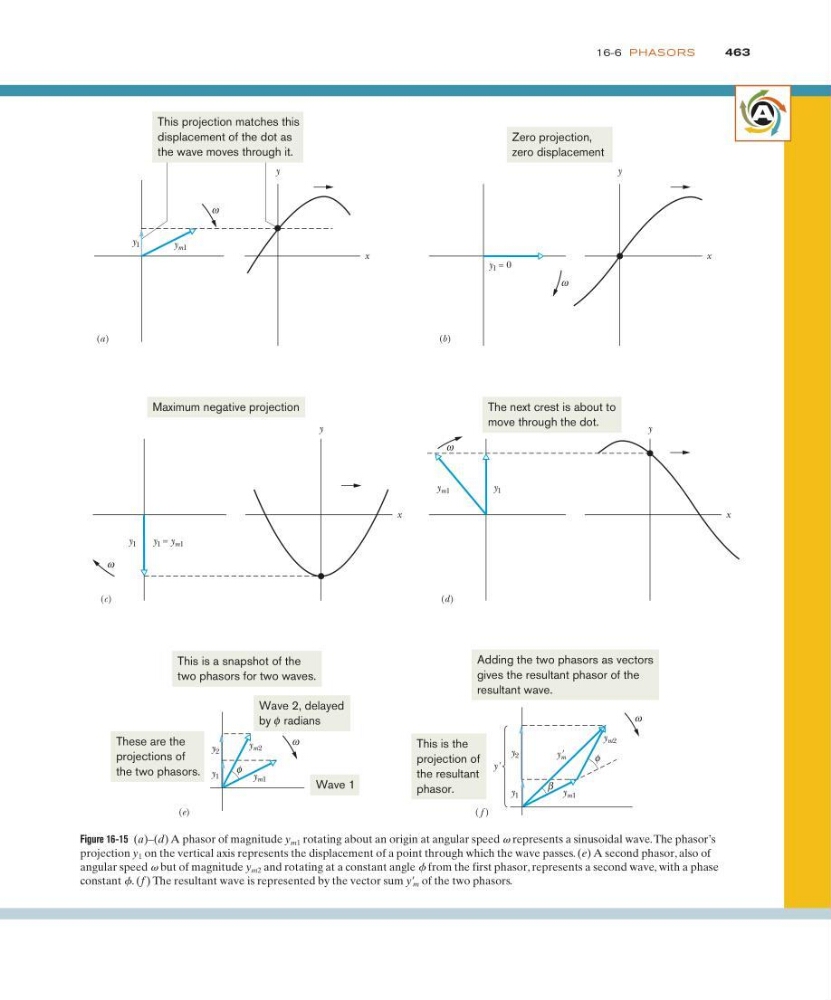
Figure 16-15 (a)–(d) A phasor of magnitude y m1 rotating about an origin at angular speed v represents a sinusoidal wave. The phasor’s
projection y 1 on the vertical axis represents the displacement of a point through which the wave passes. (e) A second phasor, also of
angular speed v but of magnitude y m2 and rotating at a constant angle f from the first phasor, represents a second wave, with a phase
constant f. (f ) The resultant wave is represented by the vector sum yЈ m of the two phasors.
φ
φ
y 1
y
x
y m1
ω
ω
ω
y 1
y m1
y 2
y m2
y 1
y m1
y 2
y'
y m2
y' m
β
(a)
(e)
( f )
y 1 = 0
y
x
ω
(b)
y 1 = y m1
y 1
x
y
ω
(c)
y m1
y 1
x
y
ω
(d)
Zero projection,
zero displacement
Maximum negative projection
The next crest is about to
move through the dot.
This is a snapshot of the
two phasors for two waves.
These are the
projections of
the two phasors.
Wave 1
This is the
projection of
the resultant
phasor.
Adding the two phasors as vectors
gives the resultant phasor of the
resultant wave.
Wave 2, delayed
by radians
φ
This projection matches this
displacement of the dot as
the wave moves through it.
A
16-6 PHASORS
Figure 16-15 (a)–(d) A phasor of magnitude y m1 rotating about an origin at angular speed v represents a sinusoidal wave. The phasor’s
projection y 1 on the vertical axis represents the displacement of a point through which the wave passes. (e) A second phasor, also of
angular speed v but of magnitude y m2 and rotating at a constant angle f from the first phasor, represents a second wave, with a phase
constant f. (f ) The resultant wave is represented by the vector sum yЈ m of the two phasors.
φ
φ
y 1
y
x
y m1
ω
ω
ω
y 1
y m1
y 2
y m2
y 1
y m1
y 2
y'
y m2
y' m
β
(a)
(e)
( f )
y 1 = 0
y
x
ω
(b)
y 1 = y m1
y 1
x
y
ω
(c)
y m1
y 1
x
y
ω
(d)
Zero projection,
zero displacement
Maximum negative projection
The next crest is about to
move through the dot.
This is a snapshot of the
two phasors for two waves.
These are the
projections of
the two phasors.
Wave 1
This is the
projection of
the resultant
phasor.
Adding the two phasors as vectors
gives the resultant phasor of the
resultant wave.
Wave 2, delayed
by radians
φ
This projection matches this
displacement of the dot as
the wave moves through it.
A