

443
PROB LE M S
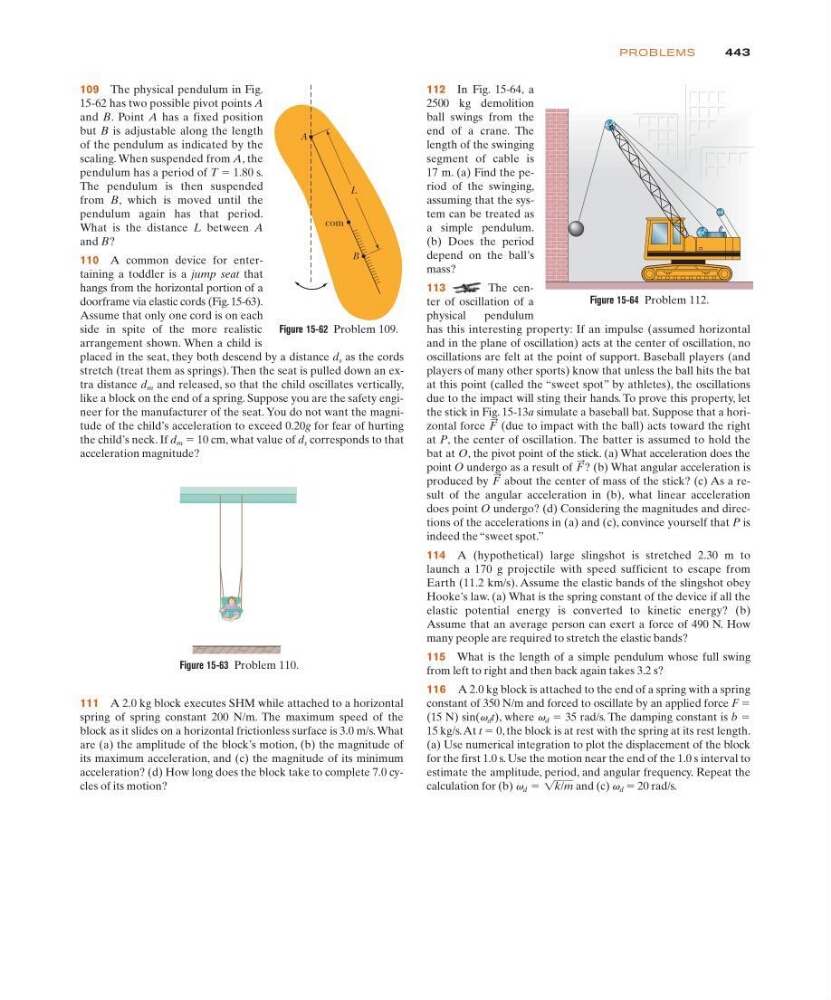
109 The physical pendulum in Fig.
15-62 has two possible pivot points A
and B. Point A has a fixed position
but B is adjustable along the length
of the pendulum as indicated by the
scaling. When suspended from A, the
pendulum has a period of T ϭ 1.80 s.
The pendulum is then suspended
from B, which is moved until the
pendulum again has that period.
What is the distance L between A
and B?
110 A common device for entertaining a toddler is a jump seat that
hangs from the horizontal portion of a
doorframe via elastic cords (Fig. 15-63).
Assume that only one cord is on each
side in spite of the more realistic
arrangement shown. When a child is
placed in the seat, they both descend by a distance d s as the cords
stretch (treat them as springs). Then the seat is pulled down an extra distance d m and released, so that the child oscillates vertically,
like a block on the end of a spring. Suppose you are the safety engineer for the manufacturer of the seat. You do not want the magnitude of the child’s acceleration to exceed 0.20g for fear of hurting
the child’s neck. If d m ϭ 10 cm, what value of d s corresponds to that
acceleration magnitude?
112 In Fig. 15-64, a
2500 kg demolition
ball swings from the
end of a crane. The
length of the swinging
segment of cable is
17 m. (a) Find the period of the swinging,
assuming that the system can be treated as
a simple pendulum.
(b) Does the period
depend on the ball’s
mass?
113
The center of oscillation of a
physical
pendulum
has this interesting property: If an impulse (assumed horizontal
and in the plane of oscillation) acts at the center of oscillation, no
oscillations are felt at the point of support. Baseball players (and
players of many other sports) know that unless the ball hits the bat
at this point (called the “sweet spot” by athletes), the oscillations
due to the impact will sting their hands. To prove this property, let
the stick in Fig. 15-13a simulate a baseball bat. Suppose that a horizontal force (due to impact with the ball) acts toward the right
at P, the center of oscillation. The batter is assumed to hold the
bat at O, the pivot point of the stick. (a) What acceleration does the
point O undergo as a result of ? (b) What angular acceleration is
produced by about the center of mass of the stick? (c) As a result of the angular acceleration in (b), what linear acceleration
does point O undergo? (d) Considering the magnitudes and directions of the accelerations in (a) and (c), convince yourself that P is
indeed the “sweet spot.”
114 A (hypothetical) large slingshot is stretched 2.30 m to
launch a 170 g projectile with speed sufficient to escape from
Earth (11.2 km/s). Assume the elastic bands of the slingshot obey
Hooke’s law. (a) What is the spring constant of the device if all the
elastic potential energy is converted to kinetic energy? (b)
Assume that an average person can exert a force of 490 N. How
many people are required to stretch the elastic bands?
115 What is the length of a simple pendulum whose full swing
from left to right and then back again takes 3.2 s?
116 A 2.0 kg block is attached to the end of a spring with a spring
constant of 350 N/m and forced to oscillate by an applied force F ϭ
(15 N) sin(v d t), where v d ϭ 35 rad/s. The damping constant is b ϭ
15 kg/s. At t ϭ 0, the block is at rest with the spring at its rest length.
(a) Use numerical integration to plot the displacement of the block
for the first 1.0 s. Use the motion near the end of the 1.0 s interval to
estimate the amplitude, period, and angular frequency. Repeat the
calculation for (b)
and (c) v d ϭ 20 rad/s.
v d ϭ 1k/m
F
:
F
:
F
:
Figure 15-63 Problem 110.
Figure 15-64 Problem 112.
L
com
B
A
Figure 15-62 Problem 109.
111 A 2.0 kg block executes SHM while attached to a horizontal
spring of spring constant 200 N/m. The maximum speed of the
block as it slides on a horizontal frictionless surface is 3.0 m/s. What
are (a) the amplitude of the block’s motion, (b) the magnitude of
its maximum acceleration, and (c) the magnitude of its minimum
acceleration? (d) How long does the block take to complete 7.0 cycles of its motion?
PROB LE M S
109 The physical pendulum in Fig.
15-62 has two possible pivot points A
and B. Point A has a fixed position
but B is adjustable along the length
of the pendulum as indicated by the
scaling. When suspended from A, the
pendulum has a period of T ϭ 1.80 s.
The pendulum is then suspended
from B, which is moved until the
pendulum again has that period.
What is the distance L between A
and B?
110 A common device for entertaining a toddler is a jump seat that
hangs from the horizontal portion of a
doorframe via elastic cords (Fig. 15-63).
Assume that only one cord is on each
side in spite of the more realistic
arrangement shown. When a child is
placed in the seat, they both descend by a distance d s as the cords
stretch (treat them as springs). Then the seat is pulled down an extra distance d m and released, so that the child oscillates vertically,
like a block on the end of a spring. Suppose you are the safety engineer for the manufacturer of the seat. You do not want the magnitude of the child’s acceleration to exceed 0.20g for fear of hurting
the child’s neck. If d m ϭ 10 cm, what value of d s corresponds to that
acceleration magnitude?
112 In Fig. 15-64, a
2500 kg demolition
ball swings from the
end of a crane. The
length of the swinging
segment of cable is
17 m. (a) Find the period of the swinging,
assuming that the system can be treated as
a simple pendulum.
(b) Does the period
depend on the ball’s
mass?
113
The center of oscillation of a
physical
pendulum
has this interesting property: If an impulse (assumed horizontal
and in the plane of oscillation) acts at the center of oscillation, no
oscillations are felt at the point of support. Baseball players (and
players of many other sports) know that unless the ball hits the bat
at this point (called the “sweet spot” by athletes), the oscillations
due to the impact will sting their hands. To prove this property, let
the stick in Fig. 15-13a simulate a baseball bat. Suppose that a horizontal force (due to impact with the ball) acts toward the right
at P, the center of oscillation. The batter is assumed to hold the
bat at O, the pivot point of the stick. (a) What acceleration does the
point O undergo as a result of ? (b) What angular acceleration is
produced by about the center of mass of the stick? (c) As a result of the angular acceleration in (b), what linear acceleration
does point O undergo? (d) Considering the magnitudes and directions of the accelerations in (a) and (c), convince yourself that P is
indeed the “sweet spot.”
114 A (hypothetical) large slingshot is stretched 2.30 m to
launch a 170 g projectile with speed sufficient to escape from
Earth (11.2 km/s). Assume the elastic bands of the slingshot obey
Hooke’s law. (a) What is the spring constant of the device if all the
elastic potential energy is converted to kinetic energy? (b)
Assume that an average person can exert a force of 490 N. How
many people are required to stretch the elastic bands?
115 What is the length of a simple pendulum whose full swing
from left to right and then back again takes 3.2 s?
116 A 2.0 kg block is attached to the end of a spring with a spring
constant of 350 N/m and forced to oscillate by an applied force F ϭ
(15 N) sin(v d t), where v d ϭ 35 rad/s. The damping constant is b ϭ
15 kg/s. At t ϭ 0, the block is at rest with the spring at its rest length.
(a) Use numerical integration to plot the displacement of the block
for the first 1.0 s. Use the motion near the end of the 1.0 s interval to
estimate the amplitude, period, and angular frequency. Repeat the
calculation for (b)
and (c) v d ϭ 20 rad/s.
v d ϭ 1k/m
F
:
F
:
F
:
Figure 15-63 Problem 110.
Figure 15-64 Problem 112.
L
com
B
A
Figure 15-62 Problem 109.
111 A 2.0 kg block executes SHM while attached to a horizontal
spring of spring constant 200 N/m. The maximum speed of the
block as it slides on a horizontal frictionless surface is 3.0 m/s. What
are (a) the amplitude of the block’s motion, (b) the magnitude of
its maximum acceleration, and (c) the magnitude of its minimum
acceleration? (d) How long does the block take to complete 7.0 cycles of its motion?