

face is attached to a horizontal spring with k ϭ 480 N/m. Let x be
the displacement of the block from the position at which the spring
is unstretched. At t ϭ 0 the block passes through x ϭ 0 with a
speed of 5.2 m/s in the positive x direction. What are the (a) frequency and (b) amplitude of the block’s motion? (c) Write an expression for x as a function of time.
102 A simple harmonic oscillator consists of an 0.80 kg block attached to a spring (k ϭ 200 N/m). The block slides on a horizontal
frictionless surface about the equilibrium point x ϭ 0 with a total
mechanical energy of 4.0 J. (a) What is the amplitude of the oscillation? (b) How many oscillations does the block complete in 10 s?
(c) What is the maximum kinetic energy attained by the block? (d)
What is the speed of the block at x ϭ 0.15 m?
103 A block sliding on a horizontal frictionless surface is
attached to a horizontal spring with a spring constant of 600 N/m.
The block executes SHM about its equilibrium position with a period of 0.40 s and an amplitude of 0.20 m. As the block slides
through its equilibrium position, a 0.50 kg putty wad is dropped
442
CHAPTE R 15 OSCI LL ATIONS
needed to rotate the disk about its center (and thus twist the
wire) versus the rotation angle u. The vertical axis scale is set by
t s ϭ 4.0 ϫ 10
Ϫ3
N иm. The disk is rotated to u ϭ 0.200 rad and then
released. Figure 15-58b shows the resulting oscillation in terms of
angular position u versus time t. The horizontal axis scale is set by
t s ϭ 0.40 s. (a) What is the rotational inertia of the disk about
its center? (b) What is the maximum angular speed du/dt of the
disk? (Caution: Do not confuse the (constant) angular frequency
of the SHM with the (varying) angular speed of the rotating disk,
even though they usually have the same symbol v. Hint: The potential energy U of a torsion pendulum is equal to ku
2
, analogous
to U ϭ kx
2
for a spring.)
98 When a 20 N can is hung from the bottom of a vertical spring, it
causes the spring to stretch 20 cm. (a) What is the spring constant? (b)
This spring is now placed horizontally on a frictionless table. One end
of it is held fixed, and the other end is attached to a 5.0 N can.The can is
then moved (stretching the spring) and released from rest. What is the
period of the resulting oscillation?
99 For a simple pendulum, find the angular amplitude u m at
which the restoring torque required for simple harmonic motion
deviates from the actual restoring torque by 1.0%. (See
“Trigonometric Expansions” in Appendix E.)
100 In Fig. 15-59, a solid cylinder
attached to a horizontal spring (k ϭ
3.00 N/m) rolls without slipping
along a horizontal surface. If the system is released from rest when the
spring is stretched by 0.250 m, find
(a) the translational kinetic energy
and (b) the rotational kinetic energy of the cylinder as it passes
through the equilibrium position. (c) Show that under these conditions the cylinder’s center of mass executes simple harmonic motion with period
T ϭ 2p
where M is the cylinder mass. (Hint: Find the time derivative of the
total mechanical energy.)
101
A 1.2 kg block sliding on a horizontal frictionless surSSM
A
3M
2k
,
1
2
1
2
vertically onto the block. If the putty wad sticks to the block, determine (a) the new period of the motion and (b) the new amplitude of the motion.
104 A damped harmonic oscillator consists of a block (m ϭ
2.00 kg), a spring (k ϭ 10.0 N/m), and a damping force (F ϭ Ϫbv).
Initially, it oscillates with an amplitude of 25.0 cm; because of
the damping, the amplitude falls to three-fourths of this initial
value at the completion of four oscillations. (a) What is the
value of b? (b) How much energy has been “lost” during these
four oscillations?
105 A block weighing 10.0 N is attached to the lower end of a
vertical spring (k ϭ 200.0 N/m), the other end of which is attached
to a ceiling. The block oscillates vertically and has a kinetic energy
of 2.00 J as it passes through the point at which the spring is
unstretched. (a) What is the period of the oscillation? (b) Use the
law of conservation of energy to determine the maximum distance
the block moves both above and below the point at which the
spring is unstretched. (These are not necessarily the same.)
(c) What is the amplitude of the oscillation? (d) What is the maximum kinetic energy of the block as it oscillates?
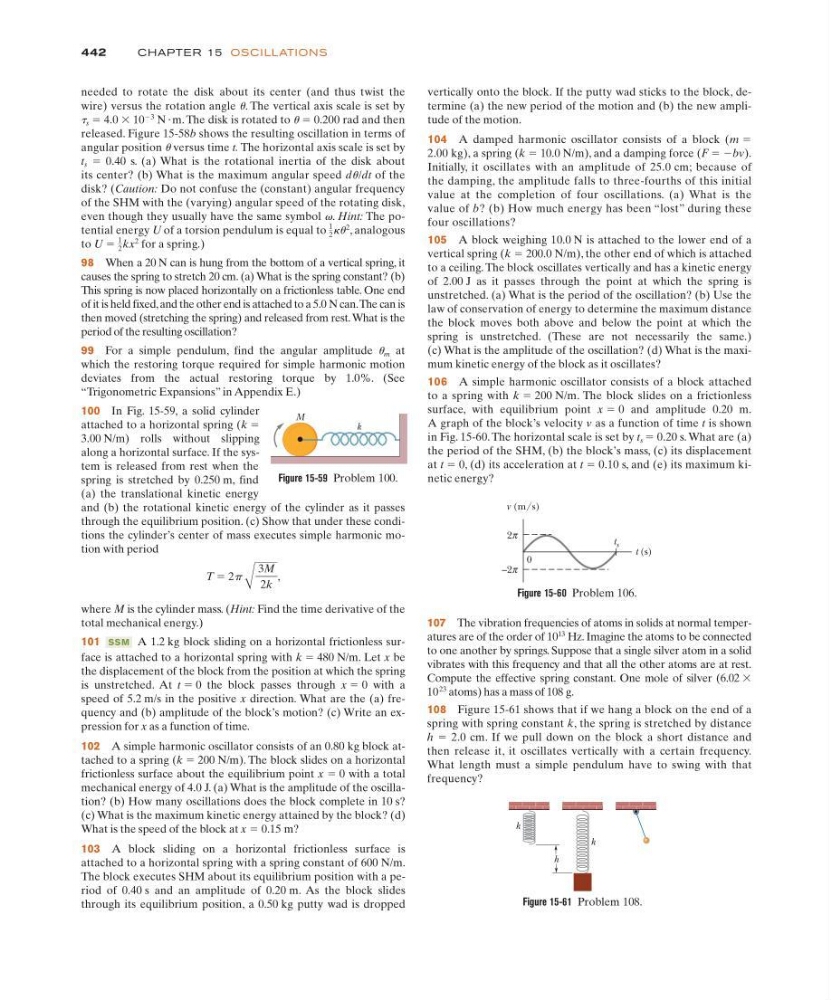
106 A simple harmonic oscillator consists of a block attached
to a spring with k ϭ 200 N/m. The block slides on a frictionless
surface, with equilibrium point x ϭ 0 and amplitude 0.20 m.
A graph of the block’s velocity v as a function of time t is shown
in Fig. 15-60. The horizontal scale is set by t s ϭ 0.20 s. What are (a)
the period of the SHM, (b) the block’s mass, (c) its displacement
at t ϭ 0, (d) its acceleration at t ϭ 0.10 s, and (e) its maximum kinetic energy?
M
k
Figure 15-59 Problem 100.
v (m/s)
2
0
π
–2π
t (s)
t s
Figure 15-60 Problem 106.
h
k
k
Figure 15-61 Problem 108.
107 The vibration frequencies of atoms in solids at normal temperatures are of the order of 10
13
Hz. Imagine the atoms to be connected
to one another by springs. Suppose that a single silver atom in a solid
vibrates with this frequency and that all the other atoms are at rest.
Compute the effective spring constant. One mole of silver (6.02 ϫ
10
23
atoms) has a mass of 108 g.
108 Figure 15-61 shows that if we hang a block on the end of a
spring with spring constant k, the spring is stretched by distance
h ϭ 2.0 cm. If we pull down on the block a short distance and
then release it, it oscillates vertically with a certain frequency.
What length must a simple pendulum have to swing with that
frequency?
the displacement of the block from the position at which the spring
is unstretched. At t ϭ 0 the block passes through x ϭ 0 with a
speed of 5.2 m/s in the positive x direction. What are the (a) frequency and (b) amplitude of the block’s motion? (c) Write an expression for x as a function of time.
102 A simple harmonic oscillator consists of an 0.80 kg block attached to a spring (k ϭ 200 N/m). The block slides on a horizontal
frictionless surface about the equilibrium point x ϭ 0 with a total
mechanical energy of 4.0 J. (a) What is the amplitude of the oscillation? (b) How many oscillations does the block complete in 10 s?
(c) What is the maximum kinetic energy attained by the block? (d)
What is the speed of the block at x ϭ 0.15 m?
103 A block sliding on a horizontal frictionless surface is
attached to a horizontal spring with a spring constant of 600 N/m.
The block executes SHM about its equilibrium position with a period of 0.40 s and an amplitude of 0.20 m. As the block slides
through its equilibrium position, a 0.50 kg putty wad is dropped
442
CHAPTE R 15 OSCI LL ATIONS
needed to rotate the disk about its center (and thus twist the
wire) versus the rotation angle u. The vertical axis scale is set by
t s ϭ 4.0 ϫ 10
Ϫ3
N иm. The disk is rotated to u ϭ 0.200 rad and then
released. Figure 15-58b shows the resulting oscillation in terms of
angular position u versus time t. The horizontal axis scale is set by
t s ϭ 0.40 s. (a) What is the rotational inertia of the disk about
its center? (b) What is the maximum angular speed du/dt of the
disk? (Caution: Do not confuse the (constant) angular frequency
of the SHM with the (varying) angular speed of the rotating disk,
even though they usually have the same symbol v. Hint: The potential energy U of a torsion pendulum is equal to ku
2
, analogous
to U ϭ kx
2
for a spring.)
98 When a 20 N can is hung from the bottom of a vertical spring, it
causes the spring to stretch 20 cm. (a) What is the spring constant? (b)
This spring is now placed horizontally on a frictionless table. One end
of it is held fixed, and the other end is attached to a 5.0 N can.The can is
then moved (stretching the spring) and released from rest. What is the
period of the resulting oscillation?
99 For a simple pendulum, find the angular amplitude u m at
which the restoring torque required for simple harmonic motion
deviates from the actual restoring torque by 1.0%. (See
“Trigonometric Expansions” in Appendix E.)
100 In Fig. 15-59, a solid cylinder
attached to a horizontal spring (k ϭ
3.00 N/m) rolls without slipping
along a horizontal surface. If the system is released from rest when the
spring is stretched by 0.250 m, find
(a) the translational kinetic energy
and (b) the rotational kinetic energy of the cylinder as it passes
through the equilibrium position. (c) Show that under these conditions the cylinder’s center of mass executes simple harmonic motion with period
T ϭ 2p
where M is the cylinder mass. (Hint: Find the time derivative of the
total mechanical energy.)
101
A 1.2 kg block sliding on a horizontal frictionless surSSM
A
3M
2k
,
1
2
1
2
vertically onto the block. If the putty wad sticks to the block, determine (a) the new period of the motion and (b) the new amplitude of the motion.
104 A damped harmonic oscillator consists of a block (m ϭ
2.00 kg), a spring (k ϭ 10.0 N/m), and a damping force (F ϭ Ϫbv).
Initially, it oscillates with an amplitude of 25.0 cm; because of
the damping, the amplitude falls to three-fourths of this initial
value at the completion of four oscillations. (a) What is the
value of b? (b) How much energy has been “lost” during these
four oscillations?
105 A block weighing 10.0 N is attached to the lower end of a
vertical spring (k ϭ 200.0 N/m), the other end of which is attached
to a ceiling. The block oscillates vertically and has a kinetic energy
of 2.00 J as it passes through the point at which the spring is
unstretched. (a) What is the period of the oscillation? (b) Use the
law of conservation of energy to determine the maximum distance
the block moves both above and below the point at which the
spring is unstretched. (These are not necessarily the same.)
(c) What is the amplitude of the oscillation? (d) What is the maximum kinetic energy of the block as it oscillates?
106 A simple harmonic oscillator consists of a block attached
to a spring with k ϭ 200 N/m. The block slides on a frictionless
surface, with equilibrium point x ϭ 0 and amplitude 0.20 m.
A graph of the block’s velocity v as a function of time t is shown
in Fig. 15-60. The horizontal scale is set by t s ϭ 0.20 s. What are (a)
the period of the SHM, (b) the block’s mass, (c) its displacement
at t ϭ 0, (d) its acceleration at t ϭ 0.10 s, and (e) its maximum kinetic energy?
M
k
Figure 15-59 Problem 100.
v (m/s)
2
0
π
–2π
t (s)
t s
Figure 15-60 Problem 106.
h
k
k
Figure 15-61 Problem 108.
107 The vibration frequencies of atoms in solids at normal temperatures are of the order of 10
13
Hz. Imagine the atoms to be connected
to one another by springs. Suppose that a single silver atom in a solid
vibrates with this frequency and that all the other atoms are at rest.
Compute the effective spring constant. One mole of silver (6.02 ϫ
10
23
atoms) has a mass of 108 g.
108 Figure 15-61 shows that if we hang a block on the end of a
spring with spring constant k, the spring is stretched by distance
h ϭ 2.0 cm. If we pull down on the block a short distance and
then release it, it oscillates vertically with a certain frequency.
What length must a simple pendulum have to swing with that
frequency?