

415
15-1 SI M PLE HAR M ON IC M OTION
0
+ x m
–x m
t = 0
t = T/4
t = T/2
t = 3T/4
t = T
0
+ x m
–x m
(a)
(c)
x
x m
0
Displacement
Time (t)
(d)
–x m
0
+ x m
–x m
t = 0
t = T/4
t = T/2
t = 3T/4
t = T
T
0
+ x m
–x m
(b)
v
v
v
v
0
x m
–x m
0
T/2
T
x
x m
0
Displacement
Time (t)
(e)
–x m
A particle oscillates left
and right in simple
harmonic motion.
Rotating the figure reveals
that the motion forms a
cosine function.
This is a graph of the motion,
with the period T indicated.
The speed is zero at
extreme points.
The speed is greatest
at x = 0.
The speed
is zero at the
extreme points.
The speed is greatest
at the midpoint.
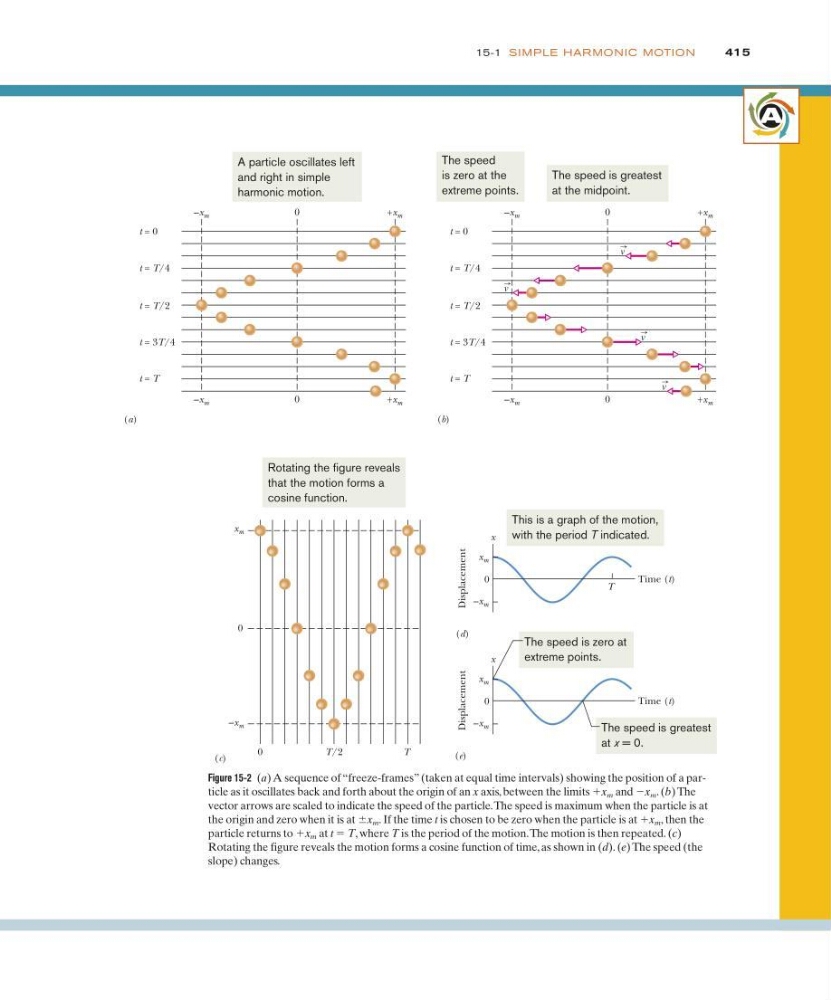
Figure 15-2 (a) A sequence of “freeze-frames” (taken at equal time intervals) showing the position of a particle as it oscillates back and forth about the origin of an x axis, between the limits ϩx m and Ϫx m . (b) The
vector arrows are scaled to indicate the speed of the particle.The speed is maximum when the particle is at
the origin and zero when it is at Ϯx m . If the time t is chosen to be zero when the particle is at ϩx m , then the
particle returns to ϩx m at t ϭ T, where T is the period of the motion.The motion is then repeated. (c)
Rotating the figure reveals the motion forms a cosine function of time, as shown in (d). (e) The speed (the
slope) changes.
A
15-1 SI M PLE HAR M ON IC M OTION
0
+ x m
–x m
t = 0
t = T/4
t = T/2
t = 3T/4
t = T
0
+ x m
–x m
(a)
(c)
x
x m
0
Displacement
Time (t)
(d)
–x m
0
+ x m
–x m
t = 0
t = T/4
t = T/2
t = 3T/4
t = T
T
0
+ x m
–x m
(b)
v
v
v
v
0
x m
–x m
0
T/2
T
x
x m
0
Displacement
Time (t)
(e)
–x m
A particle oscillates left
and right in simple
harmonic motion.
Rotating the figure reveals
that the motion forms a
cosine function.
This is a graph of the motion,
with the period T indicated.
The speed is zero at
extreme points.
The speed is greatest
at x = 0.
The speed
is zero at the
extreme points.
The speed is greatest
at the midpoint.
Figure 15-2 (a) A sequence of “freeze-frames” (taken at equal time intervals) showing the position of a particle as it oscillates back and forth about the origin of an x axis, between the limits ϩx m and Ϫx m . (b) The
vector arrows are scaled to indicate the speed of the particle.The speed is maximum when the particle is at
the origin and zero when it is at Ϯx m . If the time t is chosen to be zero when the particle is at ϩx m , then the
particle returns to ϩx m at t ϭ T, where T is the period of the motion.The motion is then repeated. (c)
Rotating the figure reveals the motion forms a cosine function of time, as shown in (d). (e) The speed (the
slope) changes.
A