

404
CHAPTE R 14 FLU I DS
KEY IDEAS
(1) Because the fluid flowing through the wide section of
pipe must entirely pass through the narrow section, the volume flow rate R V must be the same in the two sections. Thus,
from Eq. 14-24,
R V ϭ v 1 A 1 ϭ v 2 A 2 .
( 1 4 - 3 5 )
However, with two unknown speeds, we cannot evaluate this
equation for R V . (2) Because the flow is smooth, we can apply Bernoulli’s equation. From Eq. 14-28, we can write
,
( 1 4 - 3 6 )
where subscripts 1 and 2 refer to the wide and narrow
sections of pipe, respectively, and y is their common elevation. This equation hardly seems to help because it does not
contain the desired R V and it contains the unknown speeds
v 1 and v 2 .
Calculations: There is a neat way to make Eq. 14-36 work for
us: First, we can use Eq. 14-35 and the fact that A 2 ϭ A 1 /2 to write
and
.
(14-37)
v 2 ϭ
R V
A 2
ϭ
2R V
A 1
v 1 ϭ
R V
A 1
p 1 ϩ
1
2 rv
2
1 ϩ rgy ϭ p 2 ϩ
1
2 rv
2
2 ϩ rgy
Sample Problem 14.07 Bernoulli principle for a leaky water tank
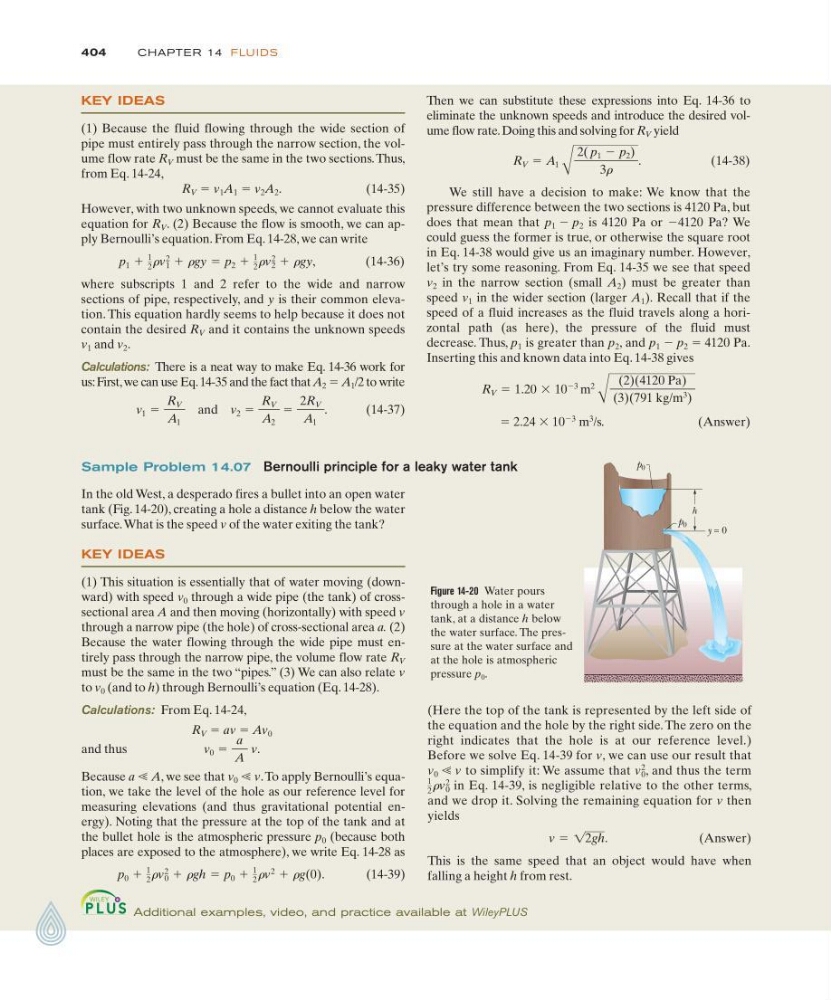
In the old West, a desperado fires a bullet into an open water
tank (Fig. 14-20), creating a hole a distance h below the water
surface.What is the speed v of the water exiting the tank?
KEY IDEAS
(1) This situation is essentially that of water moving (downward) with speed v 0 through a wide pipe (the tank) of crosssectional area A and then moving (horizontally) with speed v
through a narrow pipe (the hole) of cross-sectional area a. (2)
Because the water flowing through the wide pipe must entirely pass through the narrow pipe, the volume flow rate R V
must be the same in the two “pipes.” (3) We can also relate v
to v 0 (and to h) through Bernoulli’s equation (Eq. 14-28).
Calculations: From Eq. 14-24,
R V ϭ av ϭ Av 0
and thus
Because a A, we see that v 0 v.To apply Bernoulli’s equation, we take the level of the hole as our reference level for
measuring elevations (and thus gravitational potential energy). Noting that the pressure at the top of the tank and at
the bullet hole is the atmospheric pressure p 0 (because both
places are exposed to the atmosphere), we write Eq. 14-28 as
(14-39)
p 0 ϩ
1
2 rv
2
0 ϩ rgh ϭ p 0 ϩ
1
2 rv
2 ϩ rg(0).
Ӷ
Ӷ
v 0 ϭ
a
A
v.
h
p 0
y = 0
p 0
Figure 14-20 Water pours
through a hole in a water
tank, at a distance h below
the water surface. The pressure at the water surface and
at the hole is atmospheric
pressure p 0 .
(Here the top of the tank is represented by the left side of
the equation and the hole by the right side. The zero on the
right indicates that the hole is at our reference level.)
Before we solve Eq. 14-39 for v, we can use our result that
v 0 v to simplify it: We assume that , and thus the term
in Eq. 14-39, is negligible relative to the other terms,
and we drop it. Solving the remaining equation for v then
yields
(Answer)
This is the same speed that an object would have when
falling a height h from rest.
v ϭ 12gh.
1
2 rv
2
0
v
2
0
Ӷ
Additional examples, video, and practice available at WileyPLUS
Then we can substitute these expressions into Eq. 14-36 to
eliminate the unknown speeds and introduce the desired volume flow rate. Doing this and solving for R V yield
.
( 1 4 - 3 8 )
We still have a decision to make: We know that the
pressure difference between the two sections is 4120 Pa, but
does that mean that p 1 Ϫ p 2 is 4120 Pa or Ϫ4120 Pa? We
could guess the former is true, or otherwise the square root
in Eq. 14-38 would give us an imaginary number. However,
let’s try some reasoning. From Eq. 14-35 we see that speed
v 2 in the narrow section (small A 2 ) must be greater than
speed v 1 in the wider section (larger A 1 ). Recall that if the
speed of a fluid increases as the fluid travels along a horizontal path (as here), the pressure of the fluid must
decrease. Thus, p 1 is greater than p 2 , and p 1 Ϫ p 2 ϭ 4120 Pa.
Inserting this and known data into Eq. 14-38 gives
ϭ 2.24 ϫ 10
Ϫ3
m
3
/s.
(Answer)
R V ϭ 1.20 ϫ 10
Ϫ3
m
2
A
(2)(4120 Pa)
(3)(791 kg/m
3
)
R V ϭ A 1 A
2( p 1 Ϫ p 2 )
3r
CHAPTE R 14 FLU I DS
KEY IDEAS
(1) Because the fluid flowing through the wide section of
pipe must entirely pass through the narrow section, the volume flow rate R V must be the same in the two sections. Thus,
from Eq. 14-24,
R V ϭ v 1 A 1 ϭ v 2 A 2 .
( 1 4 - 3 5 )
However, with two unknown speeds, we cannot evaluate this
equation for R V . (2) Because the flow is smooth, we can apply Bernoulli’s equation. From Eq. 14-28, we can write
,
( 1 4 - 3 6 )
where subscripts 1 and 2 refer to the wide and narrow
sections of pipe, respectively, and y is their common elevation. This equation hardly seems to help because it does not
contain the desired R V and it contains the unknown speeds
v 1 and v 2 .
Calculations: There is a neat way to make Eq. 14-36 work for
us: First, we can use Eq. 14-35 and the fact that A 2 ϭ A 1 /2 to write
and
.
(14-37)
v 2 ϭ
R V
A 2
ϭ
2R V
A 1
v 1 ϭ
R V
A 1
p 1 ϩ
1
2 rv
2
1 ϩ rgy ϭ p 2 ϩ
1
2 rv
2
2 ϩ rgy
Sample Problem 14.07 Bernoulli principle for a leaky water tank
In the old West, a desperado fires a bullet into an open water
tank (Fig. 14-20), creating a hole a distance h below the water
surface.What is the speed v of the water exiting the tank?
KEY IDEAS
(1) This situation is essentially that of water moving (downward) with speed v 0 through a wide pipe (the tank) of crosssectional area A and then moving (horizontally) with speed v
through a narrow pipe (the hole) of cross-sectional area a. (2)
Because the water flowing through the wide pipe must entirely pass through the narrow pipe, the volume flow rate R V
must be the same in the two “pipes.” (3) We can also relate v
to v 0 (and to h) through Bernoulli’s equation (Eq. 14-28).
Calculations: From Eq. 14-24,
R V ϭ av ϭ Av 0
and thus
Because a A, we see that v 0 v.To apply Bernoulli’s equation, we take the level of the hole as our reference level for
measuring elevations (and thus gravitational potential energy). Noting that the pressure at the top of the tank and at
the bullet hole is the atmospheric pressure p 0 (because both
places are exposed to the atmosphere), we write Eq. 14-28 as
(14-39)
p 0 ϩ
1
2 rv
2
0 ϩ rgh ϭ p 0 ϩ
1
2 rv
2 ϩ rg(0).
Ӷ
Ӷ
v 0 ϭ
a
A
v.
h
p 0
y = 0
p 0
Figure 14-20 Water pours
through a hole in a water
tank, at a distance h below
the water surface. The pressure at the water surface and
at the hole is atmospheric
pressure p 0 .
(Here the top of the tank is represented by the left side of
the equation and the hole by the right side. The zero on the
right indicates that the hole is at our reference level.)
Before we solve Eq. 14-39 for v, we can use our result that
v 0 v to simplify it: We assume that , and thus the term
in Eq. 14-39, is negligible relative to the other terms,
and we drop it. Solving the remaining equation for v then
yields
(Answer)
This is the same speed that an object would have when
falling a height h from rest.
v ϭ 12gh.
1
2 rv
2
0
v
2
0
Ӷ
Additional examples, video, and practice available at WileyPLUS
Then we can substitute these expressions into Eq. 14-36 to
eliminate the unknown speeds and introduce the desired volume flow rate. Doing this and solving for R V yield
.
( 1 4 - 3 8 )
We still have a decision to make: We know that the
pressure difference between the two sections is 4120 Pa, but
does that mean that p 1 Ϫ p 2 is 4120 Pa or Ϫ4120 Pa? We
could guess the former is true, or otherwise the square root
in Eq. 14-38 would give us an imaginary number. However,
let’s try some reasoning. From Eq. 14-35 we see that speed
v 2 in the narrow section (small A 2 ) must be greater than
speed v 1 in the wider section (larger A 1 ). Recall that if the
speed of a fluid increases as the fluid travels along a horizontal path (as here), the pressure of the fluid must
decrease. Thus, p 1 is greater than p 2 , and p 1 Ϫ p 2 ϭ 4120 Pa.
Inserting this and known data into Eq. 14-38 gives
ϭ 2.24 ϫ 10
Ϫ3
m
3
/s.
(Answer)
R V ϭ 1.20 ϫ 10
Ϫ3
m
2
A
(2)(4120 Pa)
(3)(791 kg/m
3
)
R V ϭ A 1 A
2( p 1 Ϫ p 2 )
3r