

403
14-7 BERNOULLI’S EQUATION
First, we apply energy conservation in the form of the work – kinetic energy
theorem,
W ϭ ⌬K,
( 1 4 - 3 1 )
which tells us that the change in the kinetic energy of our system must equal the
net work done on the system. The change in kinetic energy results from the
change in speed between the ends of the tube and is
,
( 1 4 - 3 2 )
in which ⌬m (ϭ r ⌬V) is the mass of the fluid that enters at the input end and
leaves at the output end during a small time interval ⌬t.
The work done on the system arises from two sources. The work W g done by
the gravitational force
on the fluid of mass ⌬m during the vertical lift of
the mass from the input level to the output level is
W g ϭ Ϫ⌬m g(y 2 Ϫ y 1 )
ϭ Ϫrg ⌬V(y 2 Ϫ y 1 ).
(14-33)
This work is negative because the upward displacement and the downward gravitational force have opposite directions.
Work must also be done on the system (at the input end) to push the entering
fluid into the tube and by the system (at the output end) to push forward the fluid
that is located ahead of the emerging fluid. In general, the work done by a force
of magnitude F, acting on a fluid sample contained in a tube of area A to move
the fluid through a distance ⌬x, is
F ⌬x ϭ ( pA)(⌬x) ϭ p(A ⌬x) ϭ p ⌬V.
The work done on the system is then p 1 ⌬V, and the work done by the system
is Ϫp 2 ⌬V.Their sum W p is
W p ϭ Ϫp 2 ⌬V ϩ p 1 ⌬V
ϭ Ϫ( p 2 Ϫ p 1 ) ⌬V.
( 1 4 - 3 4 )
The work – kinetic energy theorem of Eq. 14-31 now becomes
W ϭ W g ϩ W p ϭ ⌬K.
Substituting from Eqs. 14-32, 14-33, and 14-34 yields
.
This, after a slight rearrangement, matches Eq. 14-28, which we set out to prove.
Ϫrg ⌬V(y 2 Ϫ y 1 ) Ϫ ⌬V(p 2 Ϫ p 1 ) ϭ
1
2 r ⌬V(v
2
2 Ϫ v
2
1 )
(⌬m g
:
)
ϭ
1
2 r ⌬V(v
2
2 Ϫ v
2
1 )
⌬K ϭ
1
2 ⌬m v
2
2 Ϫ
1
2 ⌬m v
2
1
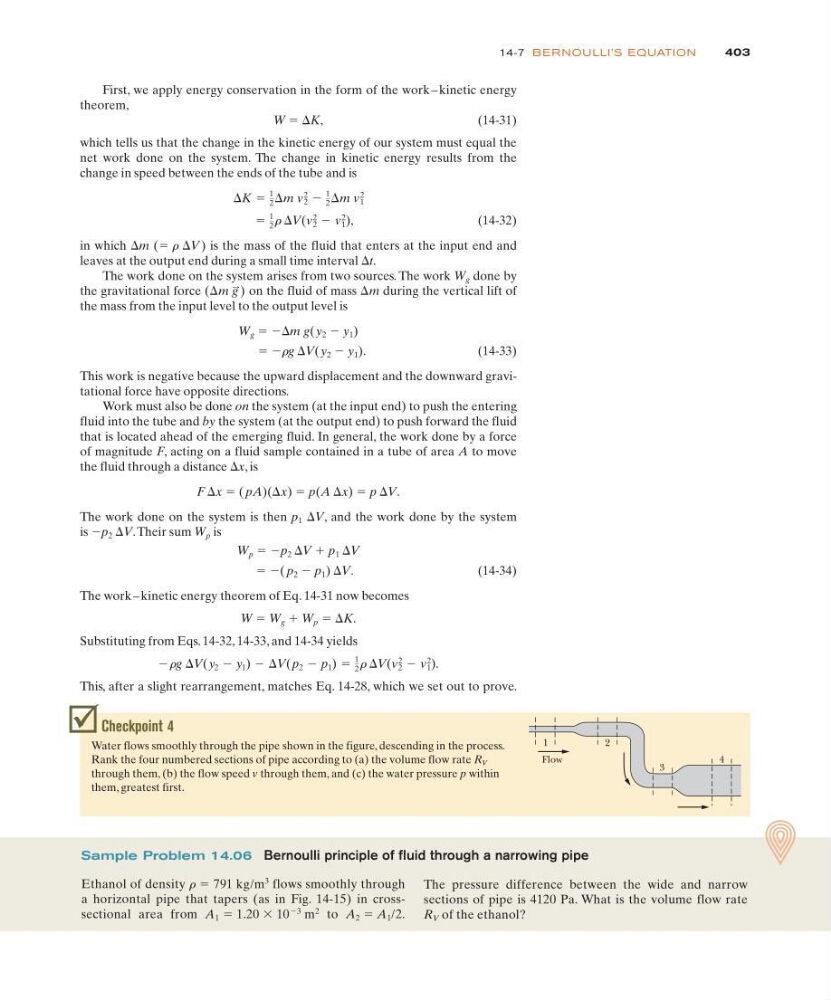
Checkpoint 4
Water flows smoothly through the pipe shown in the figure, descending in the process.
Rank the four numbered sections of pipe according to (a) the volume flow rate R V
through them, (b) the flow speed v through them, and (c) the water pressure p within
them, greatest first.
1
Flow
2
3
4
Sample Problem 14.06 Bernoulli principle of fluid through a narrowing pipe
Ethanol of density r 791 kg/m
3
flows smoothly through
a horizontal pipe that tapers (as in Fig. 14-15) in crosssectional area from A 1 ϭ 1.20 ϫ 10
Ϫ3
m
2
to A 2 ϭ A 1 /2.
ϭ
The pressure difference between the wide and narrow
sections of pipe is 4120 Pa. What is the volume flow rate
R V of the ethanol?
14-7 BERNOULLI’S EQUATION
First, we apply energy conservation in the form of the work – kinetic energy
theorem,
W ϭ ⌬K,
( 1 4 - 3 1 )
which tells us that the change in the kinetic energy of our system must equal the
net work done on the system. The change in kinetic energy results from the
change in speed between the ends of the tube and is
,
( 1 4 - 3 2 )
in which ⌬m (ϭ r ⌬V) is the mass of the fluid that enters at the input end and
leaves at the output end during a small time interval ⌬t.
The work done on the system arises from two sources. The work W g done by
the gravitational force
on the fluid of mass ⌬m during the vertical lift of
the mass from the input level to the output level is
W g ϭ Ϫ⌬m g(y 2 Ϫ y 1 )
ϭ Ϫrg ⌬V(y 2 Ϫ y 1 ).
(14-33)
This work is negative because the upward displacement and the downward gravitational force have opposite directions.
Work must also be done on the system (at the input end) to push the entering
fluid into the tube and by the system (at the output end) to push forward the fluid
that is located ahead of the emerging fluid. In general, the work done by a force
of magnitude F, acting on a fluid sample contained in a tube of area A to move
the fluid through a distance ⌬x, is
F ⌬x ϭ ( pA)(⌬x) ϭ p(A ⌬x) ϭ p ⌬V.
The work done on the system is then p 1 ⌬V, and the work done by the system
is Ϫp 2 ⌬V.Their sum W p is
W p ϭ Ϫp 2 ⌬V ϩ p 1 ⌬V
ϭ Ϫ( p 2 Ϫ p 1 ) ⌬V.
( 1 4 - 3 4 )
The work – kinetic energy theorem of Eq. 14-31 now becomes
W ϭ W g ϩ W p ϭ ⌬K.
Substituting from Eqs. 14-32, 14-33, and 14-34 yields
.
This, after a slight rearrangement, matches Eq. 14-28, which we set out to prove.
Ϫrg ⌬V(y 2 Ϫ y 1 ) Ϫ ⌬V(p 2 Ϫ p 1 ) ϭ
1
2 r ⌬V(v
2
2 Ϫ v
2
1 )
(⌬m g
:
)
ϭ
1
2 r ⌬V(v
2
2 Ϫ v
2
1 )
⌬K ϭ
1
2 ⌬m v
2
2 Ϫ
1
2 ⌬m v
2
1
Checkpoint 4
Water flows smoothly through the pipe shown in the figure, descending in the process.
Rank the four numbered sections of pipe according to (a) the volume flow rate R V
through them, (b) the flow speed v through them, and (c) the water pressure p within
them, greatest first.
1
Flow
2
3
4
Sample Problem 14.06 Bernoulli principle of fluid through a narrowing pipe
Ethanol of density r 791 kg/m
3
flows smoothly through
a horizontal pipe that tapers (as in Fig. 14-15) in crosssectional area from A 1 ϭ 1.20 ϫ 10
Ϫ3
m
2
to A 2 ϭ A 1 /2.
ϭ
The pressure difference between the wide and narrow
sections of pipe is 4120 Pa. What is the volume flow rate
R V of the ethanol?