

the area), we can write Eq. 14-3 as
(pressure of uniform force on flat area),
(14-4)
where F is the magnitude of the normal force on area A.
We find by experiment that at a given point in a fluid at rest, the pressure p
defined by Eq. 14-4 has the same value no matter how the pressure sensor is
oriented. Pressure is a scalar, having no directional properties. It is true that
the force acting on the piston of our pressure sensor is a vector quantity, but
Eq. 14-4 involves only the magnitude of that force, a scalar quantity.
The SI unit of pressure is the newton per square meter, which is given a special name, the pascal (Pa). In metric countries, tire pressure gauges are calibrated
in kilopascals. The pascal is related to some other common (non-SI) pressure
units as follows:
1 atm ϭ 1.01 ϫ 10
5
Pa ϭ 760 torr ϭ 14.7 lb/in.
2
.
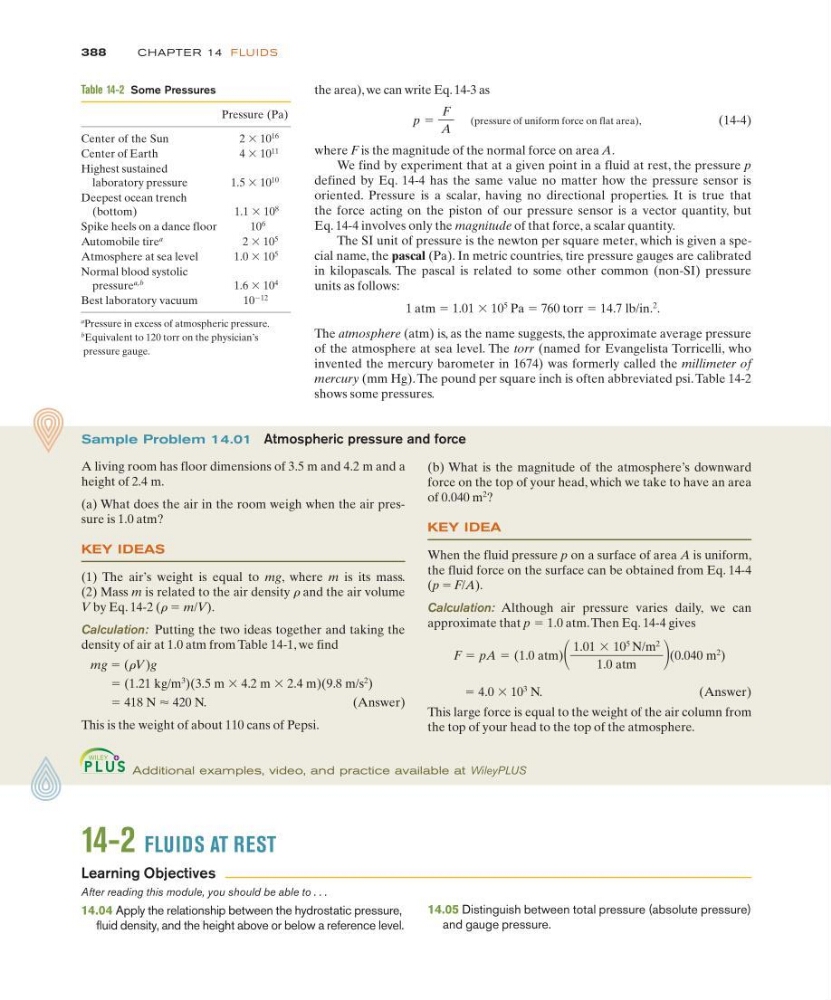
The atmosphere (atm) is, as the name suggests, the approximate average pressure
of the atmosphere at sea level. The torr (named for Evangelista Torricelli, who
invented the mercury barometer in 1674) was formerly called the millimeter of
mercury (mm Hg). The pound per square inch is often abbreviated psi. Table 14-2
shows some pressures.
p ϭ
F
A
388
CHAPTE R 14 FLU I DS
Table 14-2 Some Pressures
Pressure (Pa)
Center of the Sun
2 ϫ 10
16
Center of Earth
4 ϫ 10
11
Highest sustained
laboratory pressure
1.5 ϫ 10
10
Deepest ocean trench
(bottom)
1.1 ϫ 10
8
Spike heels on a dance floor
10
6
Automobile tire
a
2 ϫ 10
5
Atmosphere at sea level
1.0 ϫ 10
5
Normal blood systolic
pressure
a,b
1.6 ϫ 10
4
Best laboratory vacuum
10
Ϫ12
a Pressure in excess of atmospheric pressure.
b
Equivalent to 120 torr on the physician’s
pressure gauge.
Sample Problem 14.01 Atmospheric pressure and force
A living room has floor dimensions of 3.5 m and 4.2 m and a
height of 2.4 m.
(a) What does the air in the room weigh when the air pressure is 1.0 atm?
KEY IDEAS
(1) The air’s weight is equal to mg, where m is its mass.
(2) Mass m is related to the air density r and the air volume
V by Eq. 14-2 (r ϭ m/V).
Calculation: Putting the two ideas together and taking the
density of air at 1.0 atm from Table 14-1, we find
mg ϭ (rV)g
ϭ (1.21 kg/m
3
)(3.5 m ϫ 4.2 m ϫ 2.4 m)(9.8 m/s
2
)
ϭ 418 N Ϸ 420 N.
(Answer)
This is the weight of about 110 cans of Pepsi.
Additional examples, video, and practice available at WileyPLUS
14-2 FLUIDS AT REST
After reading this module, you should be able to . . .
14.04 Apply the relationship between the hydrostatic pressure,
fluid density, and the height above or below a reference level.
14.05 Distinguish between total pressure (absolute pressure)
and gauge pressure.
Learning Objectives
(b) What is the magnitude of the atmosphere’s downward
force on the top of your head, which we take to have an area
of 0.040 m
2
?
KEY IDEA
When the fluid pressure p on a surface of area A is uniform,
the fluid force on the surface can be obtained from Eq. 14-4
(p ϭ F/A).
Calculation: Although air pressure varies daily, we can
approximate that p ϭ 1.0 atm. Then Eq. 14-4 gives
ϭ 4.0 ϫ 10
3
N.
(Answer)
This large force is equal to the weight of the air column from
the top of your head to the top of the atmosphere.
F ϭ pA ϭ (1.0 atm)
1.01 ϫ 10
5
N/m
2
1.0 atm
(0.040 m
2
)
(pressure of uniform force on flat area),
(14-4)
where F is the magnitude of the normal force on area A.
We find by experiment that at a given point in a fluid at rest, the pressure p
defined by Eq. 14-4 has the same value no matter how the pressure sensor is
oriented. Pressure is a scalar, having no directional properties. It is true that
the force acting on the piston of our pressure sensor is a vector quantity, but
Eq. 14-4 involves only the magnitude of that force, a scalar quantity.
The SI unit of pressure is the newton per square meter, which is given a special name, the pascal (Pa). In metric countries, tire pressure gauges are calibrated
in kilopascals. The pascal is related to some other common (non-SI) pressure
units as follows:
1 atm ϭ 1.01 ϫ 10
5
Pa ϭ 760 torr ϭ 14.7 lb/in.
2
.
The atmosphere (atm) is, as the name suggests, the approximate average pressure
of the atmosphere at sea level. The torr (named for Evangelista Torricelli, who
invented the mercury barometer in 1674) was formerly called the millimeter of
mercury (mm Hg). The pound per square inch is often abbreviated psi. Table 14-2
shows some pressures.
p ϭ
F
A
388
CHAPTE R 14 FLU I DS
Table 14-2 Some Pressures
Pressure (Pa)
Center of the Sun
2 ϫ 10
16
Center of Earth
4 ϫ 10
11
Highest sustained
laboratory pressure
1.5 ϫ 10
10
Deepest ocean trench
(bottom)
1.1 ϫ 10
8
Spike heels on a dance floor
10
6
Automobile tire
a
2 ϫ 10
5
Atmosphere at sea level
1.0 ϫ 10
5
Normal blood systolic
pressure
a,b
1.6 ϫ 10
4
Best laboratory vacuum
10
Ϫ12
a Pressure in excess of atmospheric pressure.
b
Equivalent to 120 torr on the physician’s
pressure gauge.
Sample Problem 14.01 Atmospheric pressure and force
A living room has floor dimensions of 3.5 m and 4.2 m and a
height of 2.4 m.
(a) What does the air in the room weigh when the air pressure is 1.0 atm?
KEY IDEAS
(1) The air’s weight is equal to mg, where m is its mass.
(2) Mass m is related to the air density r and the air volume
V by Eq. 14-2 (r ϭ m/V).
Calculation: Putting the two ideas together and taking the
density of air at 1.0 atm from Table 14-1, we find
mg ϭ (rV)g
ϭ (1.21 kg/m
3
)(3.5 m ϫ 4.2 m ϫ 2.4 m)(9.8 m/s
2
)
ϭ 418 N Ϸ 420 N.
(Answer)
This is the weight of about 110 cans of Pepsi.
Additional examples, video, and practice available at WileyPLUS
14-2 FLUIDS AT REST
After reading this module, you should be able to . . .
14.04 Apply the relationship between the hydrostatic pressure,
fluid density, and the height above or below a reference level.
14.05 Distinguish between total pressure (absolute pressure)
and gauge pressure.
Learning Objectives
(b) What is the magnitude of the atmosphere’s downward
force on the top of your head, which we take to have an area
of 0.040 m
2
?
KEY IDEA
When the fluid pressure p on a surface of area A is uniform,
the fluid force on the surface can be obtained from Eq. 14-4
(p ϭ F/A).
Calculation: Although air pressure varies daily, we can
approximate that p ϭ 1.0 atm. Then Eq. 14-4 gives
ϭ 4.0 ϫ 10
3
N.
(Answer)
This large force is equal to the weight of the air column from
the top of your head to the top of the atmosphere.
F ϭ pA ϭ (1.0 atm)
1.01 ϫ 10
5
N/m
2
1.0 atm
(0.040 m
2
)