

387
14-1 FLU I DS, DE NSITY, AN D PR ESSU R E
withstand a shearing stress. It can, however, exert a force in the direction perpendicular to its surface.) Some materials, such as pitch, take a long time to conform
to the boundaries of a container, but they do so eventually; thus, we classify even
those materials as fluids.
You may wonder why we lump liquids and gases together and call them fluids.
After all (you may say), liquid water is as different from steam as it is from ice.
Actually, it is not. Ice, like other crystalline solids, has its constituent atoms organized in a fairly rigid three-dimensional array called a crystalline lattice. In neither
steam nor liquid water, however, is there any such orderly long-range arrangement.
Density and Pressure
When we discuss rigid bodies, we are concerned with particular lumps of matter,
such as wooden blocks, baseballs, or metal rods. Physical quantities that we find
useful, and in whose terms we express Newton’s laws, are mass and force. We
might speak, for example, of a 3.6 kg block acted on by a 25 N force.
With fluids, we are more interested in the extended substance and in properties
that can vary from point to point in that substance. It is more useful to speak of
density and pressure than of mass and force.
Density
To find the density r of a fluid at any point, we isolate a small volume element ⌬V
around that point and measure the mass ⌬m of the fluid contained within that
element. The density is then
(14-1)
In theory, the density at any point in a fluid is the limit of this ratio as the volume
element ⌬V at that point is made smaller and smaller. In practice, we assume that
a fluid sample is large relative to atomic dimensions and thus is “smooth” (with
uniform density), rather than “lumpy” with atoms. This assumption allows us to
write the density in terms of the mass m and volume V of the sample:
(uniform density).
(14-2)
Density is a scalar property; its SI unit is the kilogram per cubic meter.
Table 14-1 shows the densities of some substances and the average densities of
some objects. Note that the density of a gas (see Air in the table) varies considerably with pressure, but the density of a liquid (see Water) does not; that is,
gases are readily compressible but liquids are not.
Pressure
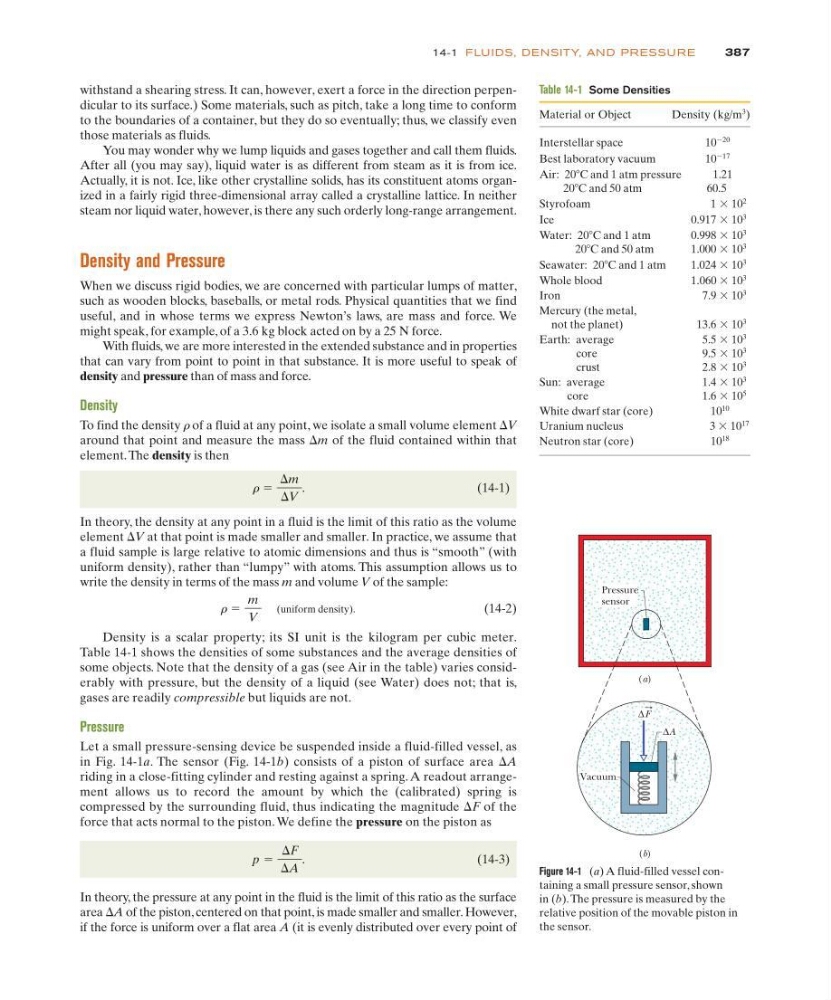
Let a small pressure-sensing device be suspended inside a fluid-filled vessel, as
in Fig. 14-1a. The sensor (Fig. 14-1b) consists of a piston of surface area ⌬A
riding in a close-fitting cylinder and resting against a spring. A readout arrangement allows us to record the amount by which the (calibrated) spring is
compressed by the surrounding fluid, thus indicating the magnitude ⌬F of the
force that acts normal to the piston. We define the pressure on the piston as
(14-3)
In theory, the pressure at any point in the fluid is the limit of this ratio as the surface
area ⌬A of the piston, centered on that point, is made smaller and smaller. However,
if the force is uniform over a flat area A (it is evenly distributed over every point of
p ϭ
⌬F
⌬A
.
r ϭ
m
V
r ϭ
⌬m
⌬V
.
Table 14-1 Some Densities
Material or Object
Density (kg/m
3
)
Interstellar space
10
Ϫ20
Best laboratory vacuum
10
Ϫ17
Air: 20ЊC and 1 atm pressure
1.21
20ЊC and 50 atm
60.5
Styrofoam
1 ϫ 10
2
Ice
0.917 ϫ 10
3
Water: 20ЊC and 1 atm
0.998 ϫ 10
3
20ЊC and 50 atm
1.000 ϫ 10
3
Seawater: 20ЊC and 1 atm
1.024 ϫ 10
3
Whole blood
1.060 ϫ 10
3
Iron
7.9 ϫ 10
3
Mercury (the metal,
not the planet)
13.6 ϫ 10
3
Earth: average
5.5 ϫ 10
3
core
9.5 ϫ 10
3
crust
2.8 ϫ 10
3
Sun: average
1.4 ϫ 10
3
core
1.6 ϫ 10
5
White dwarf star (core)
10
10
Uranium nucleus
3 ϫ 10
17
Neutron star (core)
10
18
Figure 14-1 (a) A fluid-filled vessel containing a small pressure sensor, shown
in (b). The pressure is measured by the
relative position of the movable piston in
the sensor.
(a)
(b)
Pressure
sensor
Vacuum
∆
∆A
F
14-1 FLU I DS, DE NSITY, AN D PR ESSU R E
withstand a shearing stress. It can, however, exert a force in the direction perpendicular to its surface.) Some materials, such as pitch, take a long time to conform
to the boundaries of a container, but they do so eventually; thus, we classify even
those materials as fluids.
You may wonder why we lump liquids and gases together and call them fluids.
After all (you may say), liquid water is as different from steam as it is from ice.
Actually, it is not. Ice, like other crystalline solids, has its constituent atoms organized in a fairly rigid three-dimensional array called a crystalline lattice. In neither
steam nor liquid water, however, is there any such orderly long-range arrangement.
Density and Pressure
When we discuss rigid bodies, we are concerned with particular lumps of matter,
such as wooden blocks, baseballs, or metal rods. Physical quantities that we find
useful, and in whose terms we express Newton’s laws, are mass and force. We
might speak, for example, of a 3.6 kg block acted on by a 25 N force.
With fluids, we are more interested in the extended substance and in properties
that can vary from point to point in that substance. It is more useful to speak of
density and pressure than of mass and force.
Density
To find the density r of a fluid at any point, we isolate a small volume element ⌬V
around that point and measure the mass ⌬m of the fluid contained within that
element. The density is then
(14-1)
In theory, the density at any point in a fluid is the limit of this ratio as the volume
element ⌬V at that point is made smaller and smaller. In practice, we assume that
a fluid sample is large relative to atomic dimensions and thus is “smooth” (with
uniform density), rather than “lumpy” with atoms. This assumption allows us to
write the density in terms of the mass m and volume V of the sample:
(uniform density).
(14-2)
Density is a scalar property; its SI unit is the kilogram per cubic meter.
Table 14-1 shows the densities of some substances and the average densities of
some objects. Note that the density of a gas (see Air in the table) varies considerably with pressure, but the density of a liquid (see Water) does not; that is,
gases are readily compressible but liquids are not.
Pressure
Let a small pressure-sensing device be suspended inside a fluid-filled vessel, as
in Fig. 14-1a. The sensor (Fig. 14-1b) consists of a piston of surface area ⌬A
riding in a close-fitting cylinder and resting against a spring. A readout arrangement allows us to record the amount by which the (calibrated) spring is
compressed by the surrounding fluid, thus indicating the magnitude ⌬F of the
force that acts normal to the piston. We define the pressure on the piston as
(14-3)
In theory, the pressure at any point in the fluid is the limit of this ratio as the surface
area ⌬A of the piston, centered on that point, is made smaller and smaller. However,
if the force is uniform over a flat area A (it is evenly distributed over every point of
p ϭ
⌬F
⌬A
.
r ϭ
m
V
r ϭ
⌬m
⌬V
.
Table 14-1 Some Densities
Material or Object
Density (kg/m
3
)
Interstellar space
10
Ϫ20
Best laboratory vacuum
10
Ϫ17
Air: 20ЊC and 1 atm pressure
1.21
20ЊC and 50 atm
60.5
Styrofoam
1 ϫ 10
2
Ice
0.917 ϫ 10
3
Water: 20ЊC and 1 atm
0.998 ϫ 10
3
20ЊC and 50 atm
1.000 ϫ 10
3
Seawater: 20ЊC and 1 atm
1.024 ϫ 10
3
Whole blood
1.060 ϫ 10
3
Iron
7.9 ϫ 10
3
Mercury (the metal,
not the planet)
13.6 ϫ 10
3
Earth: average
5.5 ϫ 10
3
core
9.5 ϫ 10
3
crust
2.8 ϫ 10
3
Sun: average
1.4 ϫ 10
3
core
1.6 ϫ 10
5
White dwarf star (core)
10
10
Uranium nucleus
3 ϫ 10
17
Neutron star (core)
10
18
Figure 14-1 (a) A fluid-filled vessel containing a small pressure sensor, shown
in (b). The pressure is measured by the
relative position of the movable piston in
the sensor.
(a)
(b)
Pressure
sensor
Vacuum
∆
∆A
F