

341
12-3 ELASTICITY
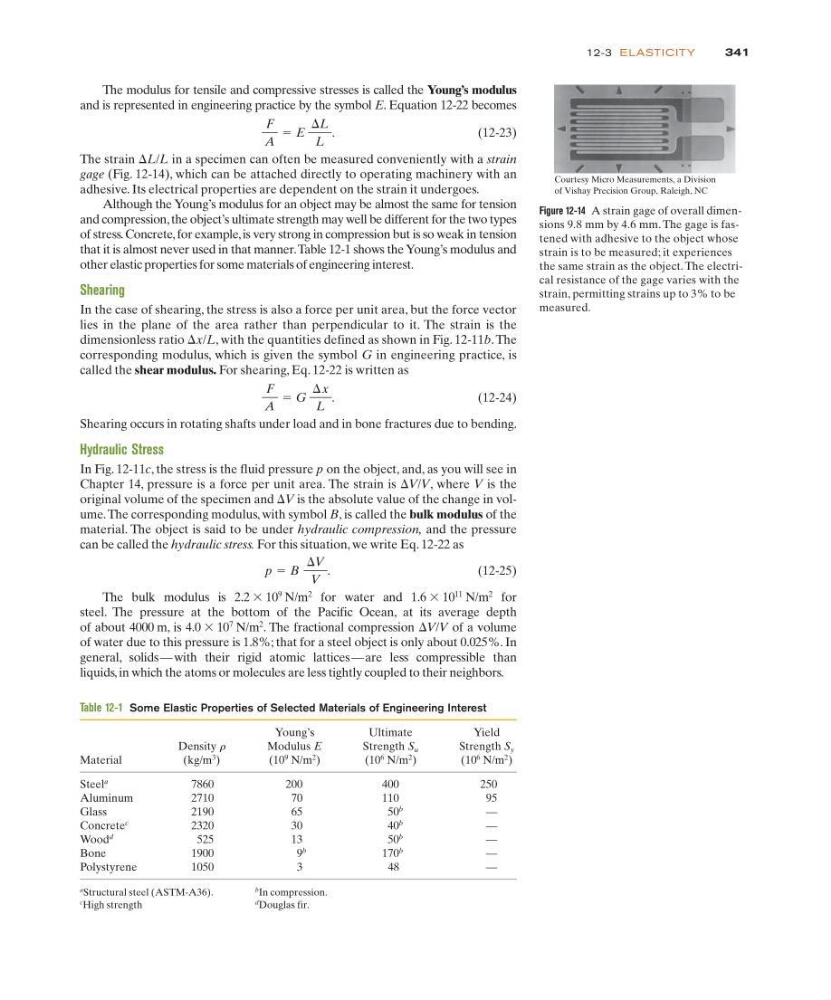
Figure 12-14 A strain gage of overall dimensions 9.8 mm by 4.6 mm. The gage is fastened with adhesive to the object whose
strain is to be measured; it experiences
the same strain as the object. The electrical resistance of the gage varies with the
strain, permitting strains up to 3% to be
measured.
Courtesy Micro Measurements, a Division
of Vishay Precision Group, Raleigh, NC
Table 12-1 Some Elastic Properties of Selected Materials of Engineering Interest
Young’s
Ultimate
Yield
Density r
Modulus E
Strength S u
Strength S y
Material
(kg/m
3
)
(10
9
N/m
2
)
(10
6
N/m
2
)
(10
6
N/m
2
)
Steel
a
7860
200
400
250
Aluminum
2710
70
110
95
Glass
2190
65
50
b
—
Concrete
c
2320
30
40
b
—
Wood
d
525
13
50
b
—
Bone
1900
9
b
170
b
—
Polystyrene
1050
3
48
—
a Structural steel (ASTM-A36).
b
In compression.
c
High strength
d
Douglas fir.
The modulus for tensile and compressive stresses is called the Young’s modulus
and is represented in engineering practice by the symbol E. Equation 12-22 becomes
(12-23)
The strain ⌬L/L in a specimen can often be measured conveniently with a strain
gage (Fig. 12-14), which can be attached directly to operating machinery with an
adhesive. Its electrical properties are dependent on the strain it undergoes.
Although the Young’s modulus for an object may be almost the same for tension
and compression, the object’s ultimate strength may well be different for the two types
of stress. Concrete, for example, is very strong in compression but is so weak in tension
that it is almost never used in that manner.Table 12-1 shows the Young’s modulus and
other elastic properties for some materials of engineering interest.
Shearing
In the case of shearing, the stress is also a force per unit area, but the force vector
lies in the plane of the area rather than perpendicular to it. The strain is the
dimensionless ratio ⌬x/L, with the quantities defined as shown in Fig. 12-11b. The
corresponding modulus, which is given the symbol G in engineering practice, is
called the shear modulus. For shearing, Eq. 12-22 is written as
(12-24)
Shearing occurs in rotating shafts under load and in bone fractures due to bending.
Hydraulic Stress
In Fig. 12-11c, the stress is the fluid pressure p on the object, and, as you will see in
Chapter 14, pressure is a force per unit area. The strain is ⌬V/V, where V is the
original volume of the specimen and ⌬V is the absolute value of the change in volume. The corresponding modulus, with symbol B, is called the bulk modulus of the
material. The object is said to be under hydraulic compression, and the pressure
can be called the hydraulic stress. For this situation, we write Eq. 12-22 as
(12-25)
The bulk modulus is 2.2 ϫ 10
9
N/m
2
for water and 1.6 ϫ 10
11
N/m
2
for
steel. The pressure at the bottom of the Pacific Ocean, at its average depth
of about 4000 m, is 4.0 ϫ 10
7
N/m
2
. The fractional compression ⌬V/V of a volume
of water due to this pressure is 1.8%; that for a steel object is only about 0.025%. In
general, solids — with their rigid atomic lattices — are less compressible than
liquids, in which the atoms or molecules are less tightly coupled to their neighbors.
p ϭ B
⌬V
V
.
F
A
ϭ G
⌬ x
L
.
F
A
ϭ E
⌬L
L
.
12-3 ELASTICITY
Figure 12-14 A strain gage of overall dimensions 9.8 mm by 4.6 mm. The gage is fastened with adhesive to the object whose
strain is to be measured; it experiences
the same strain as the object. The electrical resistance of the gage varies with the
strain, permitting strains up to 3% to be
measured.
Courtesy Micro Measurements, a Division
of Vishay Precision Group, Raleigh, NC
Table 12-1 Some Elastic Properties of Selected Materials of Engineering Interest
Young’s
Ultimate
Yield
Density r
Modulus E
Strength S u
Strength S y
Material
(kg/m
3
)
(10
9
N/m
2
)
(10
6
N/m
2
)
(10
6
N/m
2
)
Steel
a
7860
200
400
250
Aluminum
2710
70
110
95
Glass
2190
65
50
b
—
Concrete
c
2320
30
40
b
—
Wood
d
525
13
50
b
—
Bone
1900
9
b
170
b
—
Polystyrene
1050
3
48
—
a Structural steel (ASTM-A36).
b
In compression.
c
High strength
d
Douglas fir.
The modulus for tensile and compressive stresses is called the Young’s modulus
and is represented in engineering practice by the symbol E. Equation 12-22 becomes
(12-23)
The strain ⌬L/L in a specimen can often be measured conveniently with a strain
gage (Fig. 12-14), which can be attached directly to operating machinery with an
adhesive. Its electrical properties are dependent on the strain it undergoes.
Although the Young’s modulus for an object may be almost the same for tension
and compression, the object’s ultimate strength may well be different for the two types
of stress. Concrete, for example, is very strong in compression but is so weak in tension
that it is almost never used in that manner.Table 12-1 shows the Young’s modulus and
other elastic properties for some materials of engineering interest.
Shearing
In the case of shearing, the stress is also a force per unit area, but the force vector
lies in the plane of the area rather than perpendicular to it. The strain is the
dimensionless ratio ⌬x/L, with the quantities defined as shown in Fig. 12-11b. The
corresponding modulus, which is given the symbol G in engineering practice, is
called the shear modulus. For shearing, Eq. 12-22 is written as
(12-24)
Shearing occurs in rotating shafts under load and in bone fractures due to bending.
Hydraulic Stress
In Fig. 12-11c, the stress is the fluid pressure p on the object, and, as you will see in
Chapter 14, pressure is a force per unit area. The strain is ⌬V/V, where V is the
original volume of the specimen and ⌬V is the absolute value of the change in volume. The corresponding modulus, with symbol B, is called the bulk modulus of the
material. The object is said to be under hydraulic compression, and the pressure
can be called the hydraulic stress. For this situation, we write Eq. 12-22 as
(12-25)
The bulk modulus is 2.2 ϫ 10
9
N/m
2
for water and 1.6 ϫ 10
11
N/m
2
for
steel. The pressure at the bottom of the Pacific Ocean, at its average depth
of about 4000 m, is 4.0 ϫ 10
7
N/m
2
. The fractional compression ⌬V/V of a volume
of water due to this pressure is 1.8%; that for a steel object is only about 0.025%. In
general, solids — with their rigid atomic lattices — are less compressible than
liquids, in which the atoms or molecules are less tightly coupled to their neighbors.
p ϭ B
⌬V
V
.
F
A
ϭ G
⌬ x
L
.
F
A
ϭ E
⌬L
L
.