

would deform just like the tires of a car. Its legs would all touch the floor,
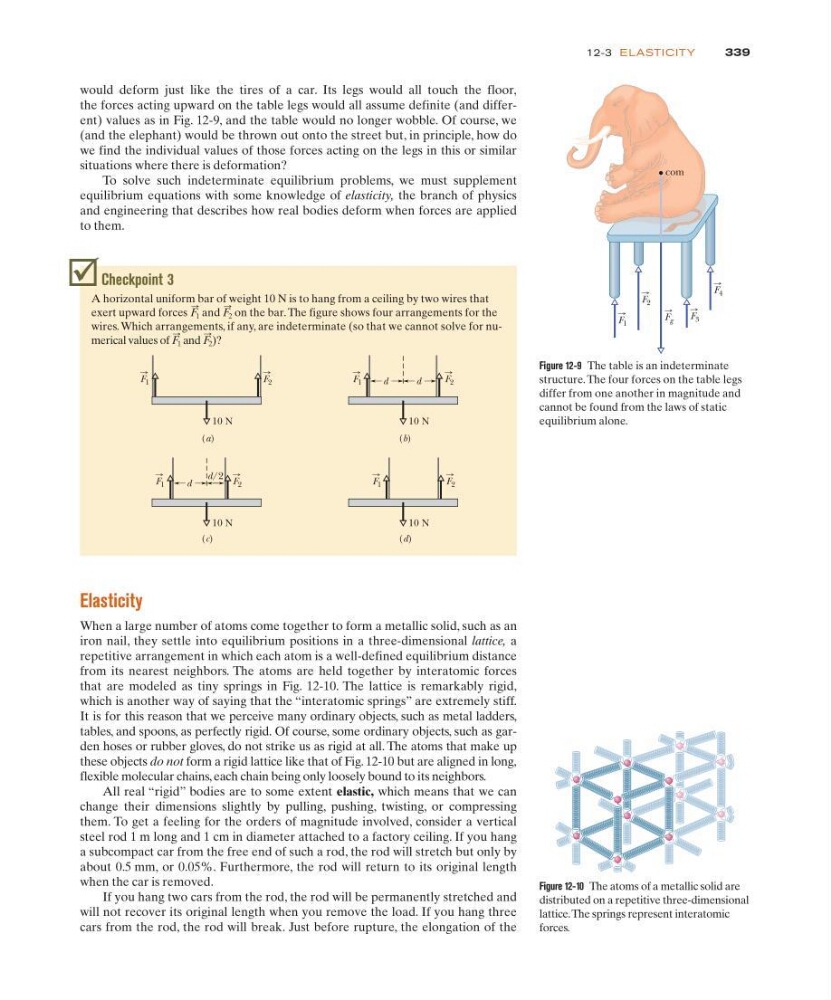
the forces acting upward on the table legs would all assume definite (and different) values as in Fig. 12-9, and the table would no longer wobble. Of course, we
(and the elephant) would be thrown out onto the street but, in principle, how do
we find the individual values of those forces acting on the legs in this or similar
situations where there is deformation?
To solve such indeterminate equilibrium problems, we must supplement
equilibrium equations with some knowledge of elasticity, the branch of physics
and engineering that describes how real bodies deform when forces are applied
to them.
339
12-3 ELASTICITY
Checkpoint 3
A horizontal uniform bar of weight 10 N is to hang from a ceiling by two wires that
exert upward forces and on the bar. The figure shows four arrangements for the
wires. Which arrangements, if any, are indeterminate (so that we cannot solve for numerical values of and )?
F
:
2
F
:
1
F
:
2
F
:
1
10 N
10 N
10 N
10 N
d
d
d
d/2
(a)
( b)
(c)
( d)
F 1
F 1
F 1
F 2
F 2
F 2
F 2
F 1
com
F g
F 1
F 2
F 3
F 4
Figure 12-9 The table is an indeterminate
structure. The four forces on the table legs
differ from one another in magnitude and
cannot be found from the laws of static
equilibrium alone.
Elasticity
When a large number of atoms come together to form a metallic solid, such as an
iron nail, they settle into equilibrium positions in a three-dimensional lattice, a
repetitive arrangement in which each atom is a well-defined equilibrium distance
from its nearest neighbors. The atoms are held together by interatomic forces
that are modeled as tiny springs in Fig. 12-10. The lattice is remarkably rigid,
which is another way of saying that the “interatomic springs” are extremely stiff.
It is for this reason that we perceive many ordinary objects, such as metal ladders,
tables, and spoons, as perfectly rigid. Of course, some ordinary objects, such as garden hoses or rubber gloves, do not strike us as rigid at all. The atoms that make up
these objects do not form a rigid lattice like that of Fig. 12-10 but are aligned in long,
flexible molecular chains, each chain being only loosely bound to its neighbors.
All real “rigid” bodies are to some extent elastic, which means that we can
change their dimensions slightly by pulling, pushing, twisting, or compressing
them. To get a feeling for the orders of magnitude involved, consider a vertical
steel rod 1 m long and 1 cm in diameter attached to a factory ceiling. If you hang
a subcompact car from the free end of such a rod, the rod will stretch but only by
about 0.5 mm, or 0.05%. Furthermore, the rod will return to its original length
when the car is removed.
If you hang two cars from the rod, the rod will be permanently stretched and
will not recover its original length when you remove the load. If you hang three
cars from the rod, the rod will break. Just before rupture, the elongation of the
Figure 12-10 The atoms of a metallic solid are
distributed on a repetitive three-dimensional
lattice.The springs represent interatomic
forces.
the forces acting upward on the table legs would all assume definite (and different) values as in Fig. 12-9, and the table would no longer wobble. Of course, we
(and the elephant) would be thrown out onto the street but, in principle, how do
we find the individual values of those forces acting on the legs in this or similar
situations where there is deformation?
To solve such indeterminate equilibrium problems, we must supplement
equilibrium equations with some knowledge of elasticity, the branch of physics
and engineering that describes how real bodies deform when forces are applied
to them.
339
12-3 ELASTICITY
Checkpoint 3
A horizontal uniform bar of weight 10 N is to hang from a ceiling by two wires that
exert upward forces and on the bar. The figure shows four arrangements for the
wires. Which arrangements, if any, are indeterminate (so that we cannot solve for numerical values of and )?
F
:
2
F
:
1
F
:
2
F
:
1
10 N
10 N
10 N
10 N
d
d
d
d/2
(a)
( b)
(c)
( d)
F 1
F 1
F 1
F 2
F 2
F 2
F 2
F 1
com
F g
F 1
F 2
F 3
F 4
Figure 12-9 The table is an indeterminate
structure. The four forces on the table legs
differ from one another in magnitude and
cannot be found from the laws of static
equilibrium alone.
Elasticity
When a large number of atoms come together to form a metallic solid, such as an
iron nail, they settle into equilibrium positions in a three-dimensional lattice, a
repetitive arrangement in which each atom is a well-defined equilibrium distance
from its nearest neighbors. The atoms are held together by interatomic forces
that are modeled as tiny springs in Fig. 12-10. The lattice is remarkably rigid,
which is another way of saying that the “interatomic springs” are extremely stiff.
It is for this reason that we perceive many ordinary objects, such as metal ladders,
tables, and spoons, as perfectly rigid. Of course, some ordinary objects, such as garden hoses or rubber gloves, do not strike us as rigid at all. The atoms that make up
these objects do not form a rigid lattice like that of Fig. 12-10 but are aligned in long,
flexible molecular chains, each chain being only loosely bound to its neighbors.
All real “rigid” bodies are to some extent elastic, which means that we can
change their dimensions slightly by pulling, pushing, twisting, or compressing
them. To get a feeling for the orders of magnitude involved, consider a vertical
steel rod 1 m long and 1 cm in diameter attached to a factory ceiling. If you hang
a subcompact car from the free end of such a rod, the rod will stretch but only by
about 0.5 mm, or 0.05%. Furthermore, the rod will return to its original length
when the car is removed.
If you hang two cars from the rod, the rod will be permanently stretched and
will not recover its original length when you remove the load. If you hang three
cars from the rod, the rod will break. Just before rupture, the elongation of the
Figure 12-10 The atoms of a metallic solid are
distributed on a repetitive three-dimensional
lattice.The springs represent interatomic
forces.