

337
12-2 SOM E EXAM PLES OF STATIC EQU I LI B R I U M
which gives us
Dividing this new result for the normal force at the right by
the original result and then substituting for d, we obtain
Substituting the values of h ϭ 60 m, R ϭ 9.8 m, and u ϭ 5.5Њ
leads to
Thus, our simple model predicts that, although the tilt is
modest, the normal force on the tower’s southern wall has
increased by about 30%. One danger to the tower is that the
force may cause the southern wall to buckle and explode
outward. The cause of the leaning is the compressible soil
beneath the tower, which worsened with each rainfall.
Recently engineers have stabilized the tower and partially
reversed the leaning by installing a drainage system.
FЈ NR
F NR
ϭ 1.29.
FЈ NR
F NR
ϭ
R ϩ d
R
ϭ 1 ϩ
d
R
ϭ 1 ϩ
0.5h tan u
R
.
FЈ NR ϭ
(R ϩ d)
2R
mg.
Sample Problem 12.04 Balancing the leaning Tower of Pisa
Let’s assume that the Tower of Pisa is a uniform hollow
cylinder of radius R ϭ 9.8 m and height h ϭ 60 m. The
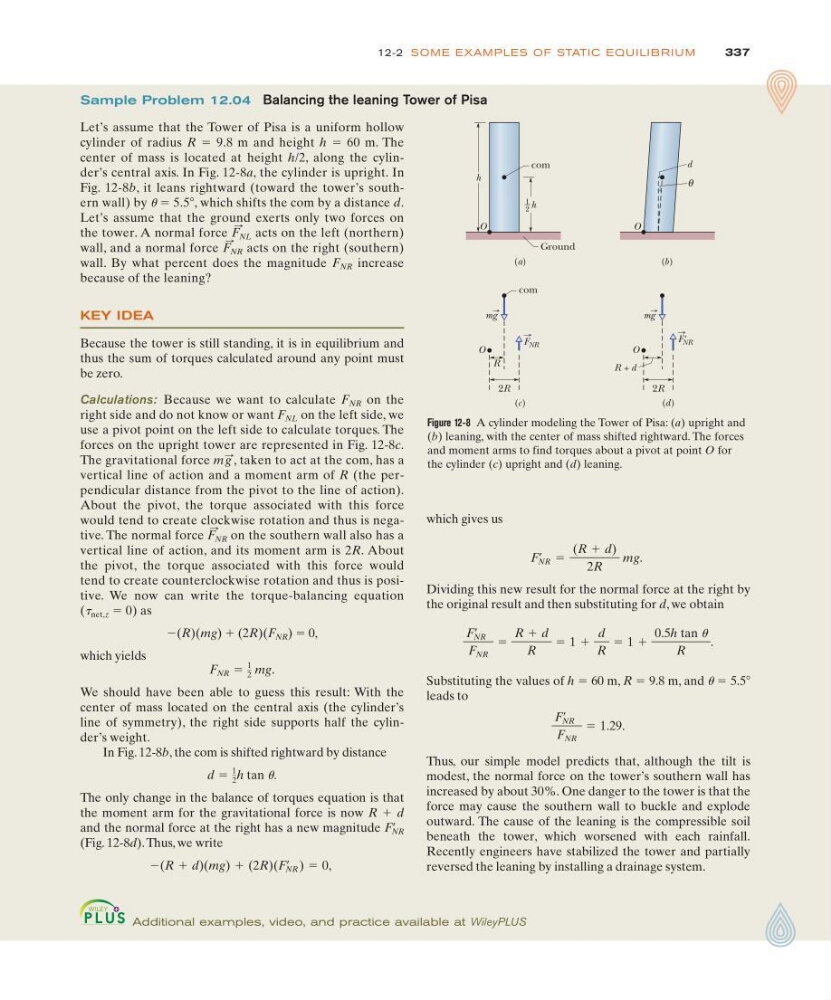
center of mass is located at height h/2, along the cylinder’s central axis. In Fig. 12-8a, the cylinder is upright. In
Fig. 12-8b, it leans rightward (toward the tower’s southern wall) by u ϭ 5.5Њ, which shifts the com by a distance d.
Let’s assume that the ground exerts only two forces on
the tower. A normal force
acts on the left (northern)
wall, and a normal force
acts on the right (southern)
wall. By what percent does the magnitude F NR increase
because of the leaning?
KEY IDEA
Because the tower is still standing, it is in equilibrium and
thus the sum of torques calculated around any point must
be zero.
Calculations: Because we want to calculate F NR on the
right side and do not know or want F NL on the left side, we
use a pivot point on the left side to calculate torques. The
forces on the upright tower are represented in Fig. 12-8c.
The gravitational force
, taken to act at the com, has a
vertical line of action and a moment arm of R (the perpendicular distance from the pivot to the line of action).
About the pivot, the torque associated with this force
would tend to create clockwise rotation and thus is negative. The normal force
on the southern wall also has a
vertical line of action, and its moment arm is 2R. About
the pivot, the torque associated with this force would
tend to create counterclockwise rotation and thus is positive. We now can write the torque-balancing equation
(t net,z ϭ 0) as
Ϫ(R)(mg) ϩ (2R)(F NR ) ϭ 0,
which yields
We should have been able to guess this result: With the
center of mass located on the central axis (the cylinder’s
line of symmetry), the right side supports half the cylinder’s weight.
In Fig. 12-8b, the com is shifted rightward by distance
The only change in the balance of torques equation is that
the moment arm for the gravitational force is now R ϩ d
and the normal force at the right has a new magnitude
(Fig. 12-8d). Thus, we write
Ϫ(R ϩ d)(mg) ϩ (2R)(FЈ NR ) ϭ 0,
FЈ NR
d ϭ
1
2 h tan u.
F NR ϭ
1
2 mg.
F NR
:
mg
:
F NR
:
F NL
:
Figure 12-8 A cylinder modeling the Tower of Pisa: (a) upright and
(b) leaning, with the center of mass shifted rightward. The forces
and moment arms to find torques about a pivot at point O for
the cylinder (c) upright and (d) leaning.
Additional examples, video, and practice available at WileyPLUS
com
1
__
2
com
Ground
O
O
h
h
(a)
(c)
d
θ
O
(b)
2R
R
F NR
mg
O
(d)
2R
R + d
F NR ‘
mg
12-2 SOM E EXAM PLES OF STATIC EQU I LI B R I U M
which gives us
Dividing this new result for the normal force at the right by
the original result and then substituting for d, we obtain
Substituting the values of h ϭ 60 m, R ϭ 9.8 m, and u ϭ 5.5Њ
leads to
Thus, our simple model predicts that, although the tilt is
modest, the normal force on the tower’s southern wall has
increased by about 30%. One danger to the tower is that the
force may cause the southern wall to buckle and explode
outward. The cause of the leaning is the compressible soil
beneath the tower, which worsened with each rainfall.
Recently engineers have stabilized the tower and partially
reversed the leaning by installing a drainage system.
FЈ NR
F NR
ϭ 1.29.
FЈ NR
F NR
ϭ
R ϩ d
R
ϭ 1 ϩ
d
R
ϭ 1 ϩ
0.5h tan u
R
.
FЈ NR ϭ
(R ϩ d)
2R
mg.
Sample Problem 12.04 Balancing the leaning Tower of Pisa
Let’s assume that the Tower of Pisa is a uniform hollow
cylinder of radius R ϭ 9.8 m and height h ϭ 60 m. The
center of mass is located at height h/2, along the cylinder’s central axis. In Fig. 12-8a, the cylinder is upright. In
Fig. 12-8b, it leans rightward (toward the tower’s southern wall) by u ϭ 5.5Њ, which shifts the com by a distance d.
Let’s assume that the ground exerts only two forces on
the tower. A normal force
acts on the left (northern)
wall, and a normal force
acts on the right (southern)
wall. By what percent does the magnitude F NR increase
because of the leaning?
KEY IDEA
Because the tower is still standing, it is in equilibrium and
thus the sum of torques calculated around any point must
be zero.
Calculations: Because we want to calculate F NR on the
right side and do not know or want F NL on the left side, we
use a pivot point on the left side to calculate torques. The
forces on the upright tower are represented in Fig. 12-8c.
The gravitational force
, taken to act at the com, has a
vertical line of action and a moment arm of R (the perpendicular distance from the pivot to the line of action).
About the pivot, the torque associated with this force
would tend to create clockwise rotation and thus is negative. The normal force
on the southern wall also has a
vertical line of action, and its moment arm is 2R. About
the pivot, the torque associated with this force would
tend to create counterclockwise rotation and thus is positive. We now can write the torque-balancing equation
(t net,z ϭ 0) as
Ϫ(R)(mg) ϩ (2R)(F NR ) ϭ 0,
which yields
We should have been able to guess this result: With the
center of mass located on the central axis (the cylinder’s
line of symmetry), the right side supports half the cylinder’s weight.
In Fig. 12-8b, the com is shifted rightward by distance
The only change in the balance of torques equation is that
the moment arm for the gravitational force is now R ϩ d
and the normal force at the right has a new magnitude
(Fig. 12-8d). Thus, we write
Ϫ(R ϩ d)(mg) ϩ (2R)(FЈ NR ) ϭ 0,
FЈ NR
d ϭ
1
2 h tan u.
F NR ϭ
1
2 mg.
F NR
:
mg
:
F NR
:
F NL
:
Figure 12-8 A cylinder modeling the Tower of Pisa: (a) upright and
(b) leaning, with the center of mass shifted rightward. The forces
and moment arms to find torques about a pivot at point O for
the cylinder (c) upright and (d) leaning.
Additional examples, video, and practice available at WileyPLUS
com
1
__
2
com
Ground
O
O
h
h
(a)
(c)
d
θ
O
(b)
2R
R
F NR
mg
O
(d)
2R
R + d
F NR ‘
mg