

acceleration a com,x down the ramp. We do this by using Newton’s second law in both
its linear version (F net ϭ Ma) and its angular version (t net ϭ Ia).
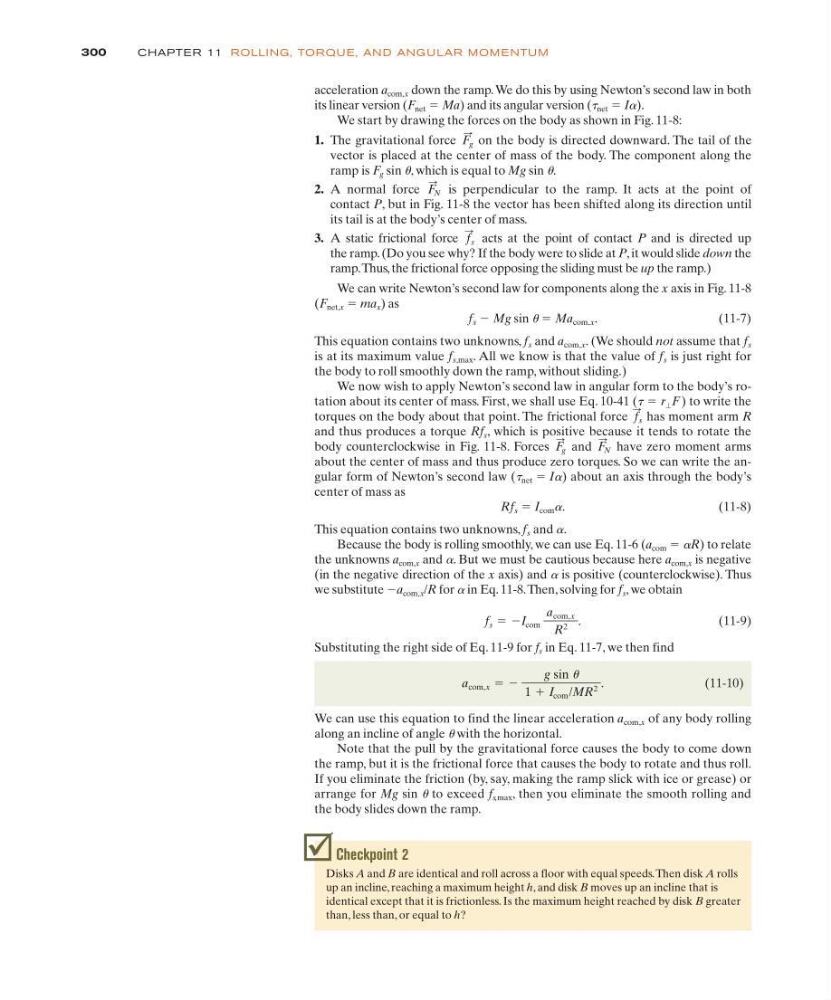
We start by drawing the forces on the body as shown in Fig. 11-8:
1. The gravitational force
on the body is directed downward. The tail of the
vector is placed at the center of mass of the body. The component along the
ramp is F g sin u, which is equal to Mg sin u.
2. A normal force
is perpendicular to the ramp. It acts at the point of
contact P, but in Fig. 11-8 the vector has been shifted along its direction until
its tail is at the body’s center of mass.
3. A static frictional force
acts at the point of contact P and is directed up
the ramp. (Do you see why? If the body were to slide at P, it would slide down the
ramp.Thus, the frictional force opposing the sliding must be up the ramp.)
We can write Newton’s second law for components along the x axis in Fig. 11-8
(F net,x ϭ ma x ) as
f s Ϫ Mg sin u ϭ Ma com,x .
( 1 1 - 7 )
This equation contains two unknowns, f s and a com,x . (We should not assume that f s
is at its maximum value f s,max . All we know is that the value of f s is just right for
the body to roll smoothly down the ramp, without sliding.)
We now wish to apply Newton’s second law in angular form to the body’s rotation about its center of mass. First, we shall use Eq. 10-41
to write the
torques on the body about that point. The frictional force has moment arm R
and thus produces a torque Rf s , which is positive because it tends to rotate the
body counterclockwise in Fig. 11-8. Forces
and
have zero moment arms
about the center of mass and thus produce zero torques. So we can write the angular form of Newton’s second law (t net ϭ Ia) about an axis through the body’s
center of mass as
Rf s ϭ I com a.
( 1 1 - 8 )
This equation contains two unknowns, f s and a.
Because the body is rolling smoothly, we can use Eq. 11-6 (a com ϭ aR) to relate
the unknowns a com,x and a. But we must be cautious because here a com,x is negative
(in the negative direction of the x axis) and a is positive (counterclockwise). Thus
we substitute Ϫa com,x /R for a in Eq. 11-8.Then, solving for f s , we obtain
(11-9)
Substituting the right side of Eq. 11-9 for f s in Eq. 11-7, we then find
(11-10)
We can use this equation to find the linear acceleration a com,x of any body rolling
along an incline of angle u with the horizontal.
Note that the pull by the gravitational force causes the body to come down
the ramp, but it is the frictional force that causes the body to rotate and thus roll.
If you eliminate the friction (by, say, making the ramp slick with ice or grease) or
arrange for Mg sin u to exceed f s,max , then you eliminate the smooth rolling and
the body slides down the ramp.
a com,x ϭ Ϫ
g sin u
1 ϩ I com /MR
2
.
f s ϭ ϪI com
a com,x
R
2
.
F
:
N
F
:
g
f
:
s
(t ϭ r Ќ F )
f
:
s
F
:
N
F
:
g
300
CHAPTE R 11 ROLLI NG, TORQU E, AN D ANG U L AR M OM E NTU M
Checkpoint 2
Disks A and B are identical and roll across a floor with equal speeds.Then disk A rolls
up an incline, reaching a maximum height h, and disk B moves up an incline that is
identical except that it is frictionless. Is the maximum height reached by disk B greater
than, less than, or equal to h?
its linear version (F net ϭ Ma) and its angular version (t net ϭ Ia).
We start by drawing the forces on the body as shown in Fig. 11-8:
1. The gravitational force
on the body is directed downward. The tail of the
vector is placed at the center of mass of the body. The component along the
ramp is F g sin u, which is equal to Mg sin u.
2. A normal force
is perpendicular to the ramp. It acts at the point of
contact P, but in Fig. 11-8 the vector has been shifted along its direction until
its tail is at the body’s center of mass.
3. A static frictional force
acts at the point of contact P and is directed up
the ramp. (Do you see why? If the body were to slide at P, it would slide down the
ramp.Thus, the frictional force opposing the sliding must be up the ramp.)
We can write Newton’s second law for components along the x axis in Fig. 11-8
(F net,x ϭ ma x ) as
f s Ϫ Mg sin u ϭ Ma com,x .
( 1 1 - 7 )
This equation contains two unknowns, f s and a com,x . (We should not assume that f s
is at its maximum value f s,max . All we know is that the value of f s is just right for
the body to roll smoothly down the ramp, without sliding.)
We now wish to apply Newton’s second law in angular form to the body’s rotation about its center of mass. First, we shall use Eq. 10-41
to write the
torques on the body about that point. The frictional force has moment arm R
and thus produces a torque Rf s , which is positive because it tends to rotate the
body counterclockwise in Fig. 11-8. Forces
and
have zero moment arms
about the center of mass and thus produce zero torques. So we can write the angular form of Newton’s second law (t net ϭ Ia) about an axis through the body’s
center of mass as
Rf s ϭ I com a.
( 1 1 - 8 )
This equation contains two unknowns, f s and a.
Because the body is rolling smoothly, we can use Eq. 11-6 (a com ϭ aR) to relate
the unknowns a com,x and a. But we must be cautious because here a com,x is negative
(in the negative direction of the x axis) and a is positive (counterclockwise). Thus
we substitute Ϫa com,x /R for a in Eq. 11-8.Then, solving for f s , we obtain
(11-9)
Substituting the right side of Eq. 11-9 for f s in Eq. 11-7, we then find
(11-10)
We can use this equation to find the linear acceleration a com,x of any body rolling
along an incline of angle u with the horizontal.
Note that the pull by the gravitational force causes the body to come down
the ramp, but it is the frictional force that causes the body to rotate and thus roll.
If you eliminate the friction (by, say, making the ramp slick with ice or grease) or
arrange for Mg sin u to exceed f s,max , then you eliminate the smooth rolling and
the body slides down the ramp.
a com,x ϭ Ϫ
g sin u
1 ϩ I com /MR
2
.
f s ϭ ϪI com
a com,x
R
2
.
F
:
N
F
:
g
f
:
s
(t ϭ r Ќ F )
f
:
s
F
:
N
F
:
g
300
CHAPTE R 11 ROLLI NG, TORQU E, AN D ANG U L AR M OM E NTU M
Checkpoint 2
Disks A and B are identical and roll across a floor with equal speeds.Then disk A rolls
up an incline, reaching a maximum height h, and disk B moves up an incline that is
identical except that it is frictionless. Is the maximum height reached by disk B greater
than, less than, or equal to h?