

(at point T ) is moving at speed 2v com , faster than any other portion of the
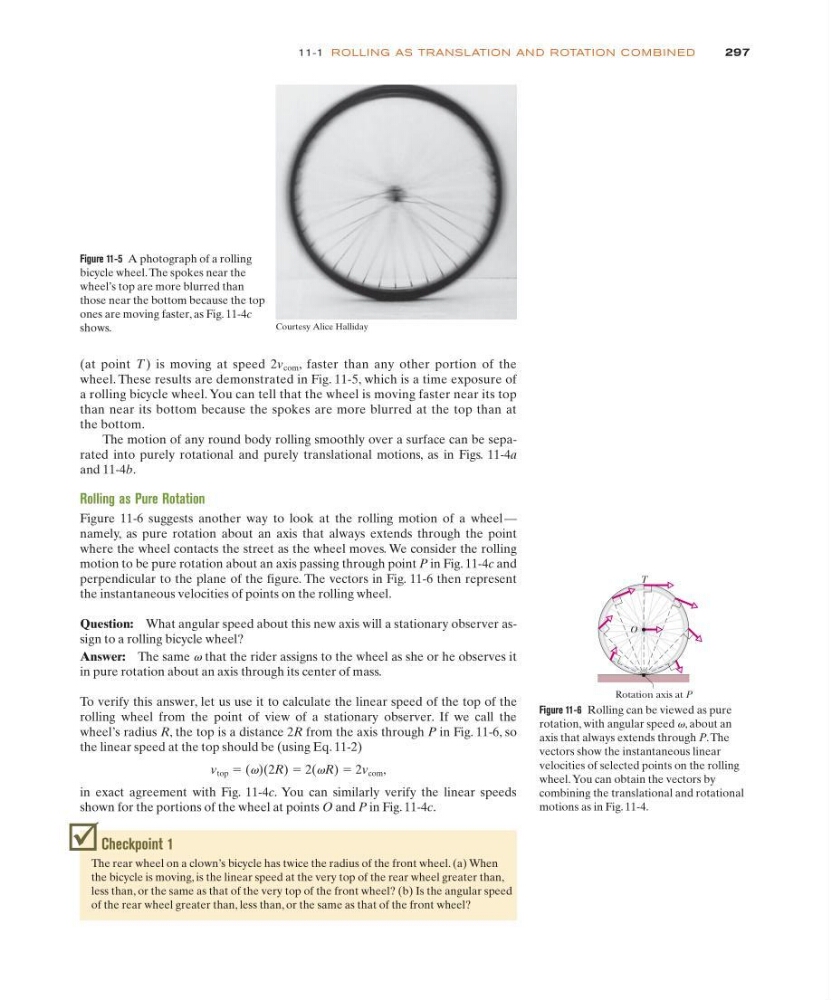
wheel. These results are demonstrated in Fig. 11-5, which is a time exposure of
a rolling bicycle wheel. You can tell that the wheel is moving faster near its top
than near its bottom because the spokes are more blurred at the top than at
the bottom.
The motion of any round body rolling smoothly over a surface can be separated into purely rotational and purely translational motions, as in Figs. 11-4a
and 11-4b.
Rolling as Pure Rotation
Figure 11-6 suggests another way to look at the rolling motion of a wheel —
namely, as pure rotation about an axis that always extends through the point
where the wheel contacts the street as the wheel moves. We consider the rolling
motion to be pure rotation about an axis passing through point P in Fig. 11-4c and
perpendicular to the plane of the figure. The vectors in Fig. 11-6 then represent
the instantaneous velocities of points on the rolling wheel.
Question: What angular speed about this new axis will a stationary observer assign to a rolling bicycle wheel?
Answer: The same v that the rider assigns to the wheel as she or he observes it
in pure rotation about an axis through its center of mass.
To verify this answer, let us use it to calculate the linear speed of the top of the
rolling wheel from the point of view of a stationary observer. If we call the
wheel’s radius R, the top is a distance 2R from the axis through P in Fig. 11-6, so
the linear speed at the top should be (using Eq. 11-2)
v top ϭ (v)(2R) ϭ 2(vR) ϭ 2v com ,
in exact agreement with Fig. 11-4c. You can similarly verify the linear speeds
shown for the portions of the wheel at points O and P in Fig. 11-4c.
297
11-1 ROLLI NG AS TRANSL ATION AN D ROTATION COM B I N E D
Figure 11-5 A photograph of a rolling
bicycle wheel. The spokes near the
wheel’s top are more blurred than
those near the bottom because the top
ones are moving faster, as Fig. 11-4c
shows.
Courtesy Alice Halliday
Checkpoint 1
The rear wheel on a clown’s bicycle has twice the radius of the front wheel. (a) When
the bicycle is moving, is the linear speed at the very top of the rear wheel greater than,
less than, or the same as that of the very top of the front wheel? (b) Is the angular speed
of the rear wheel greater than, less than, or the same as that of the front wheel?
Figure 11-6 Rolling can be viewed as pure
rotation, with angular speed v, about an
axis that always extends through P.The
vectors show the instantaneous linear
velocities of selected points on the rolling
wheel. You can obtain the vectors by
combining the translational and rotational
motions as in Fig. 11-4.
T
Rotation axis at P
O
wheel. These results are demonstrated in Fig. 11-5, which is a time exposure of
a rolling bicycle wheel. You can tell that the wheel is moving faster near its top
than near its bottom because the spokes are more blurred at the top than at
the bottom.
The motion of any round body rolling smoothly over a surface can be separated into purely rotational and purely translational motions, as in Figs. 11-4a
and 11-4b.
Rolling as Pure Rotation
Figure 11-6 suggests another way to look at the rolling motion of a wheel —
namely, as pure rotation about an axis that always extends through the point
where the wheel contacts the street as the wheel moves. We consider the rolling
motion to be pure rotation about an axis passing through point P in Fig. 11-4c and
perpendicular to the plane of the figure. The vectors in Fig. 11-6 then represent
the instantaneous velocities of points on the rolling wheel.
Question: What angular speed about this new axis will a stationary observer assign to a rolling bicycle wheel?
Answer: The same v that the rider assigns to the wheel as she or he observes it
in pure rotation about an axis through its center of mass.
To verify this answer, let us use it to calculate the linear speed of the top of the
rolling wheel from the point of view of a stationary observer. If we call the
wheel’s radius R, the top is a distance 2R from the axis through P in Fig. 11-6, so
the linear speed at the top should be (using Eq. 11-2)
v top ϭ (v)(2R) ϭ 2(vR) ϭ 2v com ,
in exact agreement with Fig. 11-4c. You can similarly verify the linear speeds
shown for the portions of the wheel at points O and P in Fig. 11-4c.
297
11-1 ROLLI NG AS TRANSL ATION AN D ROTATION COM B I N E D
Figure 11-5 A photograph of a rolling
bicycle wheel. The spokes near the
wheel’s top are more blurred than
those near the bottom because the top
ones are moving faster, as Fig. 11-4c
shows.
Courtesy Alice Halliday
Checkpoint 1
The rear wheel on a clown’s bicycle has twice the radius of the front wheel. (a) When
the bicycle is moving, is the linear speed at the very top of the rear wheel greater than,
less than, or the same as that of the very top of the front wheel? (b) Is the angular speed
of the rear wheel greater than, less than, or the same as that of the front wheel?
Figure 11-6 Rolling can be viewed as pure
rotation, with angular speed v, about an
axis that always extends through P.The
vectors show the instantaneous linear
velocities of selected points on the rolling
wheel. You can obtain the vectors by
combining the translational and rotational
motions as in Fig. 11-4.
T
Rotation axis at P
O