

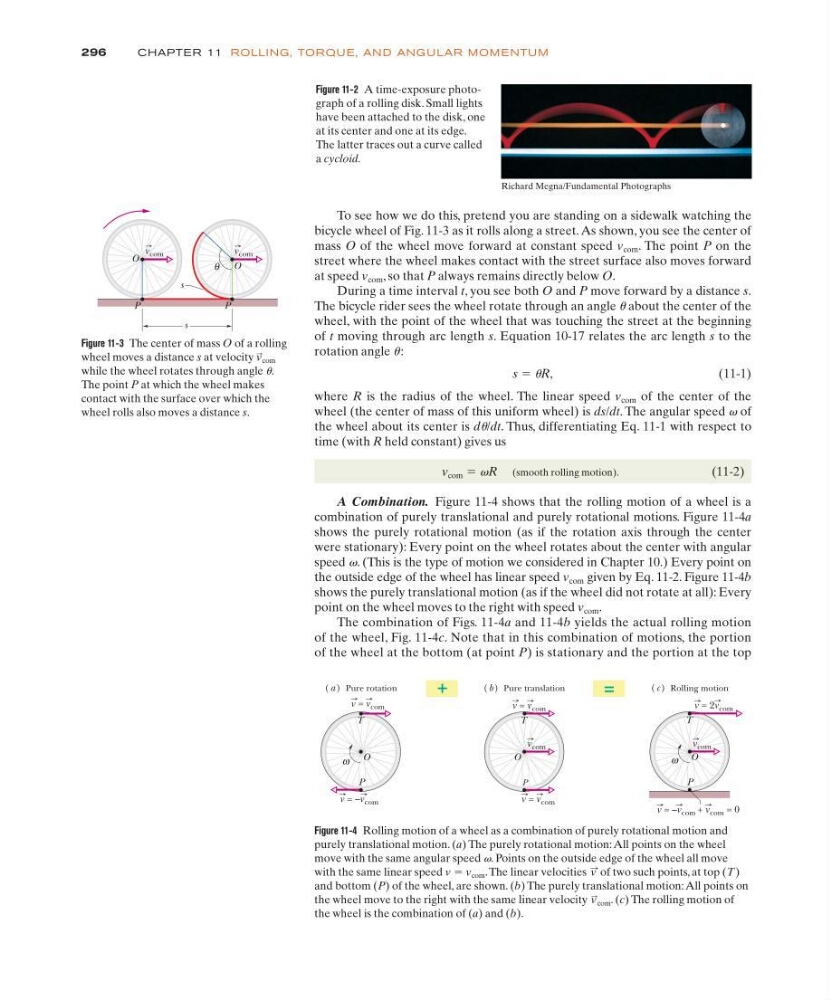
To see how we do this, pretend you are standing on a sidewalk watching the
bicycle wheel of Fig. 11-3 as it rolls along a street. As shown, you see the center of
mass O of the wheel move forward at constant speed v com . The point P on the
street where the wheel makes contact with the street surface also moves forward
at speed v com , so that P always remains directly below O.
During a time interval t, you see both O and P move forward by a distance s.
The bicycle rider sees the wheel rotate through an angle u about the center of the
wheel, with the point of the wheel that was touching the street at the beginning
of t moving through arc length s. Equation 10-17 relates the arc length s to the
rotation angle u:
s ϭ uR,
( 1 1 - 1 )
where R is the radius of the wheel. The linear speed v com of the center of the
wheel (the center of mass of this uniform wheel) is ds/dt. The angular speed v of
the wheel about its center is du/dt. Thus, differentiating Eq. 11-1 with respect to
time (with R held constant) gives us
v com ϭ vR (smooth rolling motion).
(11-2)
A Combination. Figure 11-4 shows that the rolling motion of a wheel is a
combination of purely translational and purely rotational motions. Figure 11-4a
shows the purely rotational motion (as if the rotation axis through the center
were stationary): Every point on the wheel rotates about the center with angular
speed v. (This is the type of motion we considered in Chapter 10.) Every point on
the outside edge of the wheel has linear speed v com given by Eq. 11-2. Figure 11-4b
shows the purely translational motion (as if the wheel did not rotate at all): Every
point on the wheel moves to the right with speed v com .
The combination of Figs. 11-4a and 11-4b yields the actual rolling motion
of the wheel, Fig. 11-4c. Note that in this combination of motions, the portion
of the wheel at the bottom (at point P) is stationary and the portion at the top
296
CHAPTE R 11 ROLLI NG, TORQU E, AN D ANG U L AR M OM E NTU M
Figure 11-2 A time-exposure photograph of a rolling disk. Small lights
have been attached to the disk, one
at its center and one at its edge.
The latter traces out a curve called
a cycloid.
Richard Megna/Fundamental Photographs
P
O
v com
T
v = 2v com
v = –v com + v com = 0
P
O
v com
T
v = v com
v = v com
P
O
T
v = v com
v = –v com
+ +
= =
( c ) Rolling motion
( b ) Pure translation
( a ) Pure rotation
ω
ω
Figure 11-4 Rolling motion of a wheel as a combination of purely rotational motion and
purely translational motion. (a) The purely rotational motion: All points on the wheel
move with the same angular speed v. Points on the outside edge of the wheel all move
with the same linear speed v ϭ v com .The linear velocities of two such points, at top (T)
and bottom (P) of the wheel, are shown. (b) The purely translational motion: All points on
the wheel move to the right with the same linear velocity
. (c) The rolling motion of
the wheel is the combination of (a) and (b).
v
:
com
v
:
Figure 11-3 The center of mass O of a rolling
wheel moves a distance s at velocity
while the wheel rotates through angle u.
The point P at which the wheel makes
contact with the surface over which the
wheel rolls also moves a distance s.
v
:
com
P
P
O
O
θ
s
v com
s
v com
bicycle wheel of Fig. 11-3 as it rolls along a street. As shown, you see the center of
mass O of the wheel move forward at constant speed v com . The point P on the
street where the wheel makes contact with the street surface also moves forward
at speed v com , so that P always remains directly below O.
During a time interval t, you see both O and P move forward by a distance s.
The bicycle rider sees the wheel rotate through an angle u about the center of the
wheel, with the point of the wheel that was touching the street at the beginning
of t moving through arc length s. Equation 10-17 relates the arc length s to the
rotation angle u:
s ϭ uR,
( 1 1 - 1 )
where R is the radius of the wheel. The linear speed v com of the center of the
wheel (the center of mass of this uniform wheel) is ds/dt. The angular speed v of
the wheel about its center is du/dt. Thus, differentiating Eq. 11-1 with respect to
time (with R held constant) gives us
v com ϭ vR (smooth rolling motion).
(11-2)
A Combination. Figure 11-4 shows that the rolling motion of a wheel is a
combination of purely translational and purely rotational motions. Figure 11-4a
shows the purely rotational motion (as if the rotation axis through the center
were stationary): Every point on the wheel rotates about the center with angular
speed v. (This is the type of motion we considered in Chapter 10.) Every point on
the outside edge of the wheel has linear speed v com given by Eq. 11-2. Figure 11-4b
shows the purely translational motion (as if the wheel did not rotate at all): Every
point on the wheel moves to the right with speed v com .
The combination of Figs. 11-4a and 11-4b yields the actual rolling motion
of the wheel, Fig. 11-4c. Note that in this combination of motions, the portion
of the wheel at the bottom (at point P) is stationary and the portion at the top
296
CHAPTE R 11 ROLLI NG, TORQU E, AN D ANG U L AR M OM E NTU M
Figure 11-2 A time-exposure photograph of a rolling disk. Small lights
have been attached to the disk, one
at its center and one at its edge.
The latter traces out a curve called
a cycloid.
Richard Megna/Fundamental Photographs
P
O
v com
T
v = 2v com
v = –v com + v com = 0
P
O
v com
T
v = v com
v = v com
P
O
T
v = v com
v = –v com
+ +
= =
( c ) Rolling motion
( b ) Pure translation
( a ) Pure rotation
ω
ω
Figure 11-4 Rolling motion of a wheel as a combination of purely rotational motion and
purely translational motion. (a) The purely rotational motion: All points on the wheel
move with the same angular speed v. Points on the outside edge of the wheel all move
with the same linear speed v ϭ v com .The linear velocities of two such points, at top (T)
and bottom (P) of the wheel, are shown. (b) The purely translational motion: All points on
the wheel move to the right with the same linear velocity
. (c) The rolling motion of
the wheel is the combination of (a) and (b).
v
:
com
v
:
Figure 11-3 The center of mass O of a rolling
wheel moves a distance s at velocity
while the wheel rotates through angle u.
The point P at which the wheel makes
contact with the surface over which the
wheel rolls also moves a distance s.
v
:
com
P
P
O
O
θ
s
v com
s
v com