

291
PROB LE M S
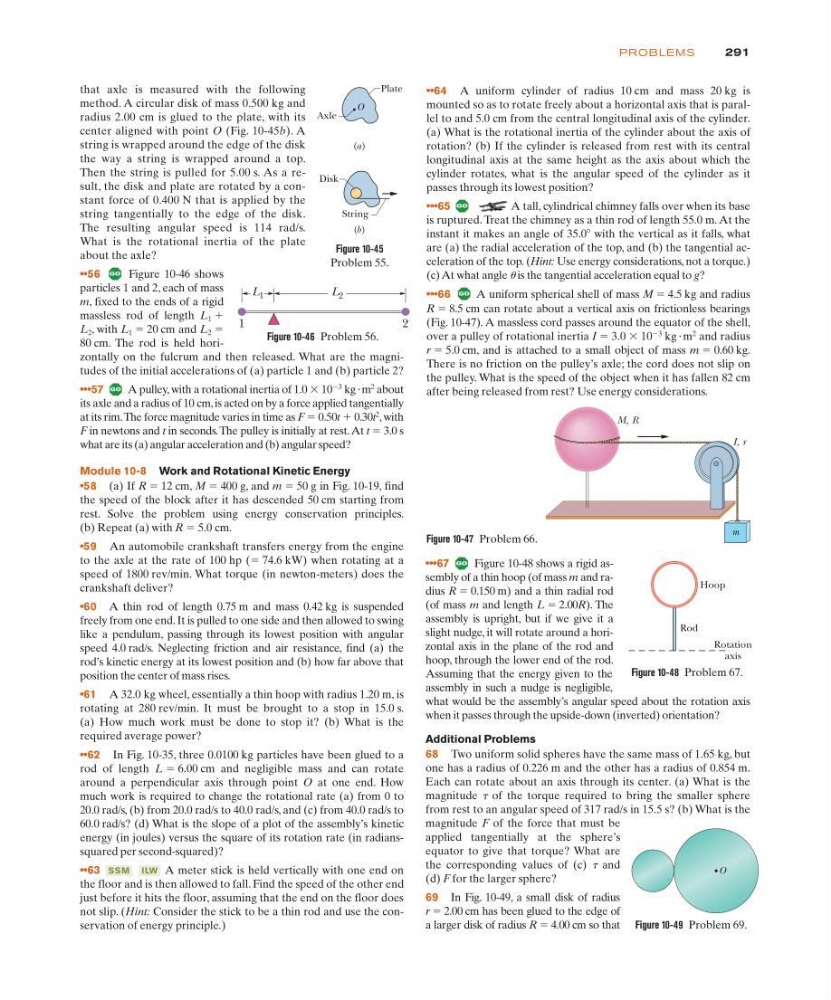
that axle is measured with the following
method. A circular disk of mass 0.500 kg and
radius 2.00 cm is glued to the plate, with its
center aligned with point O (Fig. 10-45b). A
string is wrapped around the edge of the disk
the way a string is wrapped around a top.
Then the string is pulled for 5.00 s. As a result, the disk and plate are rotated by a constant force of 0.400 N that is applied by the
string tangentially to the edge of the disk.
The resulting angular speed is 114 rad/s.
What is the rotational inertia of the plate
about the axle?
••56
Figure 10-46 shows
particles 1 and 2, each of mass
m, fixed to the ends of a rigid
massless rod of length L 1 ϩ
L 2 , with L 1 ϭ 20 cm and L 2 ϭ
80 cm. The rod is held horizontally on the fulcrum and then released. What are the magnitudes of the initial accelerations of (a) particle 1 and (b) particle 2?
•••57
A pulley, with a rotational inertia of 1.0 ϫ 10
Ϫ3
kg иm
2
about
its axle and a radius of 10 cm, is acted on by a force applied tangentially
at its rim.The force magnitude varies in time as F ϭ 0.50t ϩ 0.30t
2
, with
F in newtons and t in seconds. The pulley is initially at rest. At t ϭ 3.0 s
what are its (a) angular acceleration and (b) angular speed?
Module 10-8 Work and Rotational Kinetic Energy
•58 (a) If R ϭ 12 cm, M ϭ 400 g, and m ϭ 50 g in Fig. 10-19, find
the speed of the block after it has descended 50 cm starting from
rest. Solve the problem using energy conservation principles.
(b) Repeat (a) with R ϭ 5.0 cm.
•59 An automobile crankshaft transfers energy from the engine
to the axle at the rate of 100 hp (ϭ 74.6 kW) when rotating at a
speed of 1800 rev/min. What torque (in newton-meters) does the
crankshaft deliver?
•60 A thin rod of length 0.75 m and mass 0.42 kg is suspended
freely from one end. It is pulled to one side and then allowed to swing
like a pendulum, passing through its lowest position with angular
speed 4.0 rad/s. Neglecting friction and air resistance, find (a) the
rod’s kinetic energy at its lowest position and (b) how far above that
position the center of mass rises.
•61 A 32.0 kg wheel, essentially a thin hoop with radius 1.20 m, is
rotating at 280 rev/min. It must be brought to a stop in 15.0 s.
(a) How much work must be done to stop it? (b) What is the
required average power?
••62 In Fig. 10-35, three 0.0100 kg particles have been glued to a
rod of length L ϭ 6.00 cm and negligible mass and can rotate
around a perpendicular axis through point O at one end. How
much work is required to change the rotational rate (a) from 0 to
20.0 rad/s, (b) from 20.0 rad/s to 40.0 rad/s, and (c) from 40.0 rad/s to
60.0 rad/s? (d) What is the slope of a plot of the assembly’s kinetic
energy (in joules) versus the square of its rotation rate (in radianssquared per second-squared)?
••63
A meter stick is held vertically with one end on
the floor and is then allowed to fall. Find the speed of the other end
just before it hits the floor, assuming that the end on the floor does
not slip. (Hint: Consider the stick to be a thin rod and use the conservation of energy principle.)
ILW
SSM
••64 A uniform cylinder of radius 10 cm and mass 20 kg is
mounted so as to rotate freely about a horizontal axis that is parallel to and 5.0 cm from the central longitudinal axis of the cylinder.
(a) What is the rotational inertia of the cylinder about the axis of
rotation? (b) If the cylinder is released from rest with its central
longitudinal axis at the same height as the axis about which the
cylinder rotates, what is the angular speed of the cylinder as it
passes through its lowest position?
•••65
A tall, cylindrical chimney falls over when its base
is ruptured. Treat the chimney as a thin rod of length 55.0 m. At the
instant it makes an angle of 35.0Њ with the vertical as it falls, what
are (a) the radial acceleration of the top, and (b) the tangential acceleration of the top. (Hint: Use energy considerations, not a torque.)
(c) At what angle u is the tangential acceleration equal to g?
•••66
A uniform spherical shell of mass M ϭ 4.5 kg and radius
(b)
(a)
O
Axle
Plate
Disk
String
Figure 10-45
Problem 55.
1
2
L 1
L 2
Figure 10-46 Problem 56.
Figure 10-47 Problem 66.
R ϭ 8.5 cm can rotate about a vertical axis on frictionless bearings
(Fig. 10-47). A massless cord passes around the equator of the shell,
over a pulley of rotational inertia I ϭ 3.0 ϫ 10
Ϫ3
kg иm
2
and radius
r ϭ 5.0 cm, and is attached to a small object of mass m ϭ 0.60 kg.
There is no friction on the pulley’s axle; the cord does not slip on
the pulley. What is the speed of the object when it has fallen 82 cm
after being released from rest? Use energy considerations.
M, R
I, r
m
•••67
Figure 10-48 shows a rigid assembly of a thin hoop (of mass m and radius R ϭ 0.150 m) and a thin radial rod
(of mass m and length L ϭ 2.00R). The
assembly is upright, but if we give it a
slight nudge, it will rotate around a horizontal axis in the plane of the rod and
hoop, through the lower end of the rod.
Assuming that the energy given to the
assembly in such a nudge is negligible,
what would be the assembly’s angular speed about the rotation axis
when it passes through the upside-down (inverted) orientation?
Additional Problems
68 Two uniform solid spheres have the same mass of 1.65 kg, but
one has a radius of 0.226 m and the other has a radius of 0.854 m.
Each can rotate about an axis through its center. (a) What is the
magnitude t of the torque required to bring the smaller sphere
from rest to an angular speed of 317 rad/s in 15.5 s? (b) What is the
magnitude F of the force that must be
applied tangentially at the sphere’s
equator to give that torque? What are
the corresponding values of (c) t and
(d) F for the larger sphere?
69 In Fig. 10-49, a small disk of radius
r ϭ 2.00 cm has been glued to the edge of
a larger disk of radius R ϭ 4.00 cm so that
Figure 10-48 Problem 67.
Rotation
axis
Hoop
Rod
O
Figure 10-49 Problem 69.
PROB LE M S
that axle is measured with the following
method. A circular disk of mass 0.500 kg and
radius 2.00 cm is glued to the plate, with its
center aligned with point O (Fig. 10-45b). A
string is wrapped around the edge of the disk
the way a string is wrapped around a top.
Then the string is pulled for 5.00 s. As a result, the disk and plate are rotated by a constant force of 0.400 N that is applied by the
string tangentially to the edge of the disk.
The resulting angular speed is 114 rad/s.
What is the rotational inertia of the plate
about the axle?
••56
Figure 10-46 shows
particles 1 and 2, each of mass
m, fixed to the ends of a rigid
massless rod of length L 1 ϩ
L 2 , with L 1 ϭ 20 cm and L 2 ϭ
80 cm. The rod is held horizontally on the fulcrum and then released. What are the magnitudes of the initial accelerations of (a) particle 1 and (b) particle 2?
•••57
A pulley, with a rotational inertia of 1.0 ϫ 10
Ϫ3
kg иm
2
about
its axle and a radius of 10 cm, is acted on by a force applied tangentially
at its rim.The force magnitude varies in time as F ϭ 0.50t ϩ 0.30t
2
, with
F in newtons and t in seconds. The pulley is initially at rest. At t ϭ 3.0 s
what are its (a) angular acceleration and (b) angular speed?
Module 10-8 Work and Rotational Kinetic Energy
•58 (a) If R ϭ 12 cm, M ϭ 400 g, and m ϭ 50 g in Fig. 10-19, find
the speed of the block after it has descended 50 cm starting from
rest. Solve the problem using energy conservation principles.
(b) Repeat (a) with R ϭ 5.0 cm.
•59 An automobile crankshaft transfers energy from the engine
to the axle at the rate of 100 hp (ϭ 74.6 kW) when rotating at a
speed of 1800 rev/min. What torque (in newton-meters) does the
crankshaft deliver?
•60 A thin rod of length 0.75 m and mass 0.42 kg is suspended
freely from one end. It is pulled to one side and then allowed to swing
like a pendulum, passing through its lowest position with angular
speed 4.0 rad/s. Neglecting friction and air resistance, find (a) the
rod’s kinetic energy at its lowest position and (b) how far above that
position the center of mass rises.
•61 A 32.0 kg wheel, essentially a thin hoop with radius 1.20 m, is
rotating at 280 rev/min. It must be brought to a stop in 15.0 s.
(a) How much work must be done to stop it? (b) What is the
required average power?
••62 In Fig. 10-35, three 0.0100 kg particles have been glued to a
rod of length L ϭ 6.00 cm and negligible mass and can rotate
around a perpendicular axis through point O at one end. How
much work is required to change the rotational rate (a) from 0 to
20.0 rad/s, (b) from 20.0 rad/s to 40.0 rad/s, and (c) from 40.0 rad/s to
60.0 rad/s? (d) What is the slope of a plot of the assembly’s kinetic
energy (in joules) versus the square of its rotation rate (in radianssquared per second-squared)?
••63
A meter stick is held vertically with one end on
the floor and is then allowed to fall. Find the speed of the other end
just before it hits the floor, assuming that the end on the floor does
not slip. (Hint: Consider the stick to be a thin rod and use the conservation of energy principle.)
ILW
SSM
••64 A uniform cylinder of radius 10 cm and mass 20 kg is
mounted so as to rotate freely about a horizontal axis that is parallel to and 5.0 cm from the central longitudinal axis of the cylinder.
(a) What is the rotational inertia of the cylinder about the axis of
rotation? (b) If the cylinder is released from rest with its central
longitudinal axis at the same height as the axis about which the
cylinder rotates, what is the angular speed of the cylinder as it
passes through its lowest position?
•••65
A tall, cylindrical chimney falls over when its base
is ruptured. Treat the chimney as a thin rod of length 55.0 m. At the
instant it makes an angle of 35.0Њ with the vertical as it falls, what
are (a) the radial acceleration of the top, and (b) the tangential acceleration of the top. (Hint: Use energy considerations, not a torque.)
(c) At what angle u is the tangential acceleration equal to g?
•••66
A uniform spherical shell of mass M ϭ 4.5 kg and radius
(b)
(a)
O
Axle
Plate
Disk
String
Figure 10-45
Problem 55.
1
2
L 1
L 2
Figure 10-46 Problem 56.
Figure 10-47 Problem 66.
R ϭ 8.5 cm can rotate about a vertical axis on frictionless bearings
(Fig. 10-47). A massless cord passes around the equator of the shell,
over a pulley of rotational inertia I ϭ 3.0 ϫ 10
Ϫ3
kg иm
2
and radius
r ϭ 5.0 cm, and is attached to a small object of mass m ϭ 0.60 kg.
There is no friction on the pulley’s axle; the cord does not slip on
the pulley. What is the speed of the object when it has fallen 82 cm
after being released from rest? Use energy considerations.
M, R
I, r
m
•••67
Figure 10-48 shows a rigid assembly of a thin hoop (of mass m and radius R ϭ 0.150 m) and a thin radial rod
(of mass m and length L ϭ 2.00R). The
assembly is upright, but if we give it a
slight nudge, it will rotate around a horizontal axis in the plane of the rod and
hoop, through the lower end of the rod.
Assuming that the energy given to the
assembly in such a nudge is negligible,
what would be the assembly’s angular speed about the rotation axis
when it passes through the upside-down (inverted) orientation?
Additional Problems
68 Two uniform solid spheres have the same mass of 1.65 kg, but
one has a radius of 0.226 m and the other has a radius of 0.854 m.
Each can rotate about an axis through its center. (a) What is the
magnitude t of the torque required to bring the smaller sphere
from rest to an angular speed of 317 rad/s in 15.5 s? (b) What is the
magnitude F of the force that must be
applied tangentially at the sphere’s
equator to give that torque? What are
the corresponding values of (c) t and
(d) F for the larger sphere?
69 In Fig. 10-49, a small disk of radius
r ϭ 2.00 cm has been glued to the edge of
a larger disk of radius R ϭ 4.00 cm so that
Figure 10-48 Problem 67.
Rotation
axis
Hoop
Rod
O
Figure 10-49 Problem 69.