

290
CHAPTE R 10 ROTATION
••53
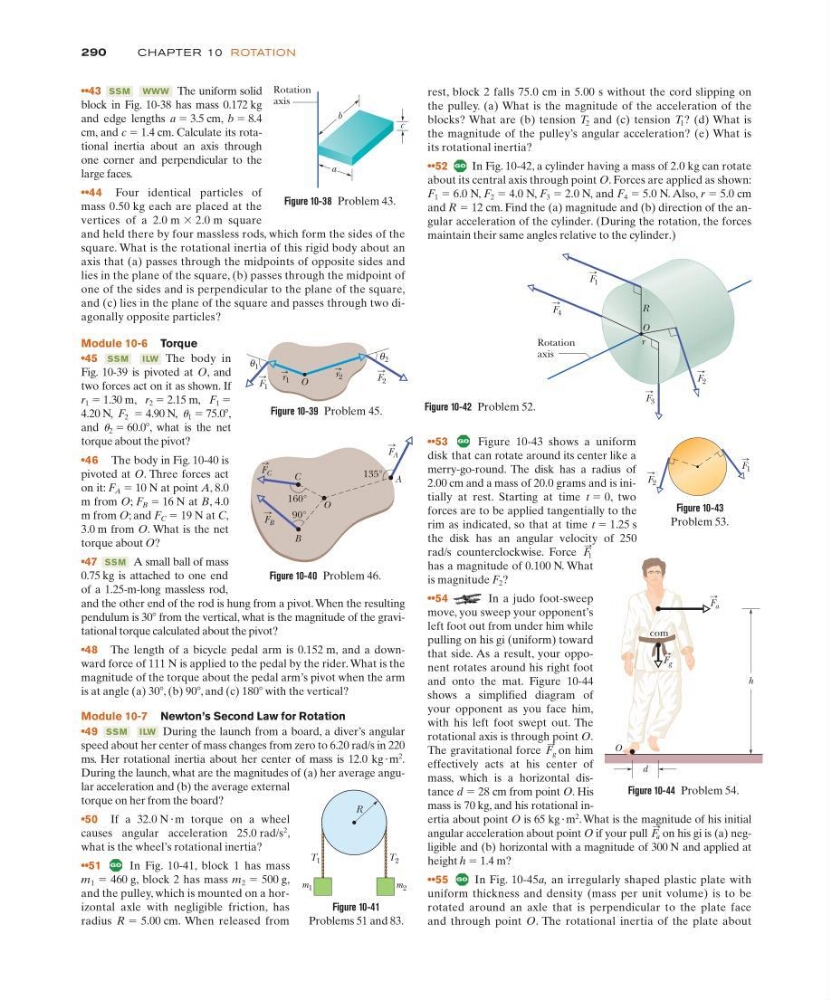
Figure 10-43 shows a uniform
disk that can rotate around its center like a
merry-go-round. The disk has a radius of
2.00 cm and a mass of 20.0 grams and is initially at rest. Starting at time t ϭ 0, two
forces are to be applied tangentially to the
rim as indicated, so that at time t ϭ 1.25 s
the disk has an angular velocity of 250
rad/s counterclockwise. Force
has a magnitude of 0.100 N. What
is magnitude F 2 ?
••54
In a judo foot-sweep
move, you sweep your opponent’s
left foot out from under him while
pulling on his gi (uniform) toward
that side. As a result, your opponent rotates around his right foot
and onto the mat. Figure 10-44
shows a simplified diagram of
your opponent as you face him,
with his left foot swept out. The
rotational axis is through point O.
The gravitational force
on him
effectively acts at his center of
mass, which is a horizontal distance d ϭ 28 cm from point O. His
mass is 70 kg, and his rotational inertia about point O is 65 kg иm
2
. What is the magnitude of his initial
angular acceleration about point O if your pull on his gi is (a) negligible and (b) horizontal with a magnitude of 300 N and applied at
height h ϭ 1.4 m?
••55
In Fig. 10-45a, an irregularly shaped plastic plate with
uniform thickness and density (mass per unit volume) is to be
rotated around an axle that is perpendicular to the plate face
and through point O. The rotational inertia of the plate about
F
:
a
F
:
g
F
:
1
••43
The uniform solid
block in Fig. 10-38 has mass 0.172 kg
and edge lengths a ϭ 3.5 cm, b ϭ 8.4
cm, and c ϭ 1.4 cm. Calculate its rotational inertia about an axis through
one corner and perpendicular to the
large faces.
••44 Four identical particles of
mass 0.50 kg each are placed at the
vertices of a 2.0 m ϫ 2.0 m square
and held there by four massless rods, which form the sides of the
square. What is the rotational inertia of this rigid body about an
axis that (a) passes through the midpoints of opposite sides and
lies in the plane of the square, (b) passes through the midpoint of
one of the sides and is perpendicular to the plane of the square,
and (c) lies in the plane of the square and passes through two diagonally opposite particles?
WWW
SSM
rest, block 2 falls 75.0 cm in 5.00 s without the cord slipping on
the pulley. (a) What is the magnitude of the acceleration of the
blocks? What are (b) tension
and (c) tension ? (d) What is
the magnitude of the pulley’s angular acceleration? (e) What is
its rotational inertia?
••52
In Fig. 10-42, a cylinder having a mass of 2.0 kg can rotate
about its central axis through point O. Forces are applied as shown:
F 1 ϭ 6.0 N, F 2 ϭ 4.0 N, F 3 ϭ 2.0 N, and F 4 ϭ 5.0 N. Also, r ϭ 5.0 cm
and R ϭ 12 cm. Find the (a) magnitude and (b) direction of the angular acceleration of the cylinder. (During the rotation, the forces
maintain their same angles relative to the cylinder.)
T 1
T 2
b
a
c
Rotation
axis
Figure 10-38 Problem 43.
F 2
F 1
Figure 10-43
Problem 53.
Figure 10-42 Problem 52.
F 1
F 4
R
r
O
Rotation
axis
F 2
F 3
Figure 10-39 Problem 45.
O
r 1
θ 1
F 1
r 2
θ 2
F 2
Module 10-6 Torque
•45
The body in
Fig. 10-39 is pivoted at O, and
two forces act on it as shown. If
r 1 ϭ 1.30 m, r 2 ϭ 2.15 m, F 1 ϭ
4.20 N, F 2 ϭ 4.90 N, u 1 ϭ 75.0Њ,
and u 2 ϭ 60.0Њ, what is the net
torque about the pivot?
•46 The body in Fig. 10-40 is
pivoted at O. Three forces act
on it: F A ϭ 10 N at point A, 8.0
m from O; F B ϭ 16 N at B, 4.0
m from O; and F C ϭ 19 N at C,
3.0 m from O. What is the net
torque about O?
•47
A small ball of mass
0.75 kg is attached to one end
of a 1.25-m-long massless rod,
SSM
ILW
SSM
and the other end of the rod is hung from a pivot. When the resulting
pendulum is 30Њ from the vertical, what is the magnitude of the gravitational torque calculated about the pivot?
•48 The length of a bicycle pedal arm is 0.152 m, and a downward force of 111 N is applied to the pedal by the rider. What is the
magnitude of the torque about the pedal arm’s pivot when the arm
is at angle (a) 30Њ, (b) 90Њ, and (c) 180Њ with the vertical?
Module 10-7 Newton’s Second Law for Rotation
•49
During the launch from a board, a diver’s angular
speed about her center of mass changes from zero to 6.20 rad/s in 220
ms. Her rotational inertia about her center of mass is 12.0 kg иm
2
.
During the launch, what are the magnitudes of (a) her average angular acceleration and (b) the average external
torque on her from the board?
•50 If a 32.0 N иm torque on a wheel
causes angular acceleration 25.0 rad/s
2
,
what is the wheel’s rotational inertia?
••51
In Fig. 10-41, block 1 has mass
, block 2 has mass
,
and the pulley, which is mounted on a horizontal axle with negligible friction, has
radius
. When released from
R ϭ 5.00 cm
m 2 ϭ 500 g
m 1 ϭ 460 g
ILW
SSM
Figure 10-44 Problem 54.
O
d
com
F g
F a
h
F C
C
F B
B
160°
90°
O
F A
A
135°
Figure 10-40 Problem 46.
m 1
T 1
T 2
m 2
R
Figure 10-41
Problems 51 and 83.
CHAPTE R 10 ROTATION
••53
Figure 10-43 shows a uniform
disk that can rotate around its center like a
merry-go-round. The disk has a radius of
2.00 cm and a mass of 20.0 grams and is initially at rest. Starting at time t ϭ 0, two
forces are to be applied tangentially to the
rim as indicated, so that at time t ϭ 1.25 s
the disk has an angular velocity of 250
rad/s counterclockwise. Force
has a magnitude of 0.100 N. What
is magnitude F 2 ?
••54
In a judo foot-sweep
move, you sweep your opponent’s
left foot out from under him while
pulling on his gi (uniform) toward
that side. As a result, your opponent rotates around his right foot
and onto the mat. Figure 10-44
shows a simplified diagram of
your opponent as you face him,
with his left foot swept out. The
rotational axis is through point O.
The gravitational force
on him
effectively acts at his center of
mass, which is a horizontal distance d ϭ 28 cm from point O. His
mass is 70 kg, and his rotational inertia about point O is 65 kg иm
2
. What is the magnitude of his initial
angular acceleration about point O if your pull on his gi is (a) negligible and (b) horizontal with a magnitude of 300 N and applied at
height h ϭ 1.4 m?
••55
In Fig. 10-45a, an irregularly shaped plastic plate with
uniform thickness and density (mass per unit volume) is to be
rotated around an axle that is perpendicular to the plate face
and through point O. The rotational inertia of the plate about
F
:
a
F
:
g
F
:
1
••43
The uniform solid
block in Fig. 10-38 has mass 0.172 kg
and edge lengths a ϭ 3.5 cm, b ϭ 8.4
cm, and c ϭ 1.4 cm. Calculate its rotational inertia about an axis through
one corner and perpendicular to the
large faces.
••44 Four identical particles of
mass 0.50 kg each are placed at the
vertices of a 2.0 m ϫ 2.0 m square
and held there by four massless rods, which form the sides of the
square. What is the rotational inertia of this rigid body about an
axis that (a) passes through the midpoints of opposite sides and
lies in the plane of the square, (b) passes through the midpoint of
one of the sides and is perpendicular to the plane of the square,
and (c) lies in the plane of the square and passes through two diagonally opposite particles?
WWW
SSM
rest, block 2 falls 75.0 cm in 5.00 s without the cord slipping on
the pulley. (a) What is the magnitude of the acceleration of the
blocks? What are (b) tension
and (c) tension ? (d) What is
the magnitude of the pulley’s angular acceleration? (e) What is
its rotational inertia?
••52
In Fig. 10-42, a cylinder having a mass of 2.0 kg can rotate
about its central axis through point O. Forces are applied as shown:
F 1 ϭ 6.0 N, F 2 ϭ 4.0 N, F 3 ϭ 2.0 N, and F 4 ϭ 5.0 N. Also, r ϭ 5.0 cm
and R ϭ 12 cm. Find the (a) magnitude and (b) direction of the angular acceleration of the cylinder. (During the rotation, the forces
maintain their same angles relative to the cylinder.)
T 1
T 2
b
a
c
Rotation
axis
Figure 10-38 Problem 43.
F 2
F 1
Figure 10-43
Problem 53.
Figure 10-42 Problem 52.
F 1
F 4
R
r
O
Rotation
axis
F 2
F 3
Figure 10-39 Problem 45.
O
r 1
θ 1
F 1
r 2
θ 2
F 2
Module 10-6 Torque
•45
The body in
Fig. 10-39 is pivoted at O, and
two forces act on it as shown. If
r 1 ϭ 1.30 m, r 2 ϭ 2.15 m, F 1 ϭ
4.20 N, F 2 ϭ 4.90 N, u 1 ϭ 75.0Њ,
and u 2 ϭ 60.0Њ, what is the net
torque about the pivot?
•46 The body in Fig. 10-40 is
pivoted at O. Three forces act
on it: F A ϭ 10 N at point A, 8.0
m from O; F B ϭ 16 N at B, 4.0
m from O; and F C ϭ 19 N at C,
3.0 m from O. What is the net
torque about O?
•47
A small ball of mass
0.75 kg is attached to one end
of a 1.25-m-long massless rod,
SSM
ILW
SSM
and the other end of the rod is hung from a pivot. When the resulting
pendulum is 30Њ from the vertical, what is the magnitude of the gravitational torque calculated about the pivot?
•48 The length of a bicycle pedal arm is 0.152 m, and a downward force of 111 N is applied to the pedal by the rider. What is the
magnitude of the torque about the pedal arm’s pivot when the arm
is at angle (a) 30Њ, (b) 90Њ, and (c) 180Њ with the vertical?
Module 10-7 Newton’s Second Law for Rotation
•49
During the launch from a board, a diver’s angular
speed about her center of mass changes from zero to 6.20 rad/s in 220
ms. Her rotational inertia about her center of mass is 12.0 kg иm
2
.
During the launch, what are the magnitudes of (a) her average angular acceleration and (b) the average external
torque on her from the board?
•50 If a 32.0 N иm torque on a wheel
causes angular acceleration 25.0 rad/s
2
,
what is the wheel’s rotational inertia?
••51
In Fig. 10-41, block 1 has mass
, block 2 has mass
,
and the pulley, which is mounted on a horizontal axle with negligible friction, has
radius
. When released from
R ϭ 5.00 cm
m 2 ϭ 500 g
m 1 ϭ 460 g
ILW
SSM
Figure 10-44 Problem 54.
O
d
com
F g
F a
h
F C
C
F B
B
160°
90°
O
F A
A
135°
Figure 10-40 Problem 46.
m 1
T 1
T 2
m 2
R
Figure 10-41
Problems 51 and 83.