

287
PROB LE M S
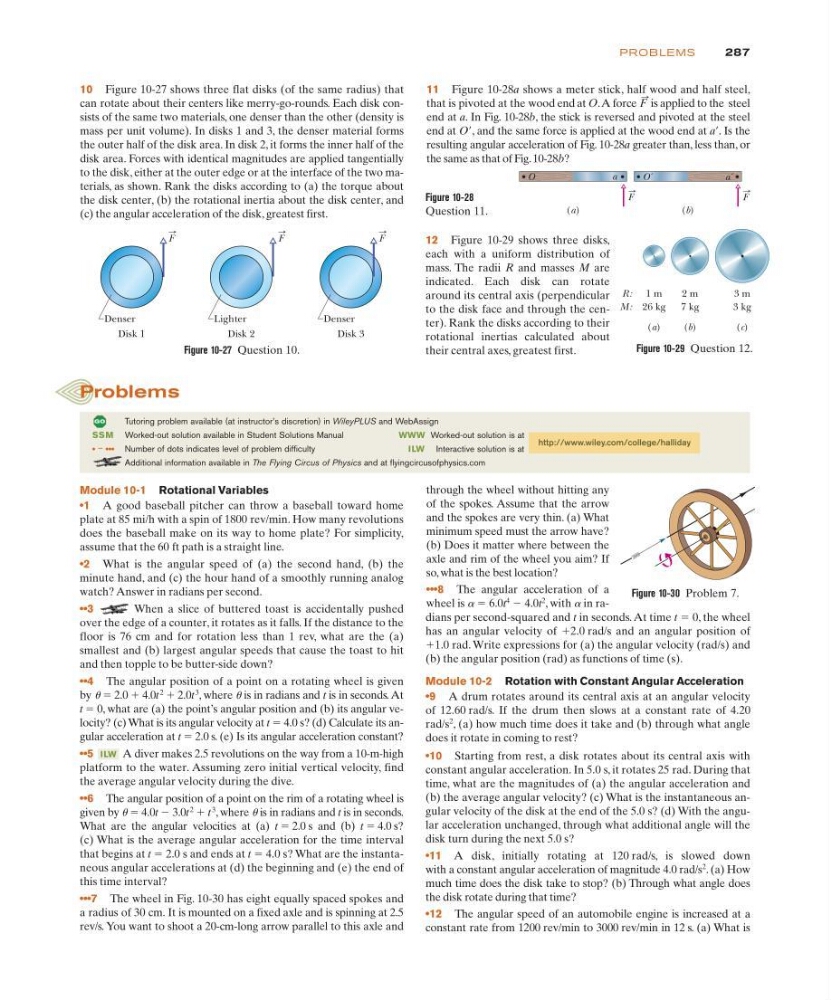
10 Figure 10-27 shows three flat disks (of the same radius) that
can rotate about their centers like merry-go-rounds. Each disk consists of the same two materials, one denser than the other (density is
mass per unit volume). In disks 1 and 3, the denser material forms
the outer half of the disk area. In disk 2, it forms the inner half of the
disk area. Forces with identical magnitudes are applied tangentially
to the disk, either at the outer edge or at the interface of the two materials, as shown. Rank the disks according to (a) the torque about
the disk center, (b) the rotational inertia about the disk center, and
(c) the angular acceleration of the disk, greatest first.
F
Denser
Disk 1
Denser
Disk 3
F
F
Lighter
Disk 2
Figure 10-27 Question 10.
11 Figure 10-28a shows a meter stick, half wood and half steel,
that is pivoted at the wood end at O.A force is applied to the steel
end at a. In Fig. 10-28b, the stick is reversed and pivoted at the steel
end at OЈ, and the same force is applied at the wood end at aЈ. Is the
resulting angular acceleration of Fig. 10-28a greater than, less than, or
the same as that of Fig. 10-28b?
F
:
R:
M:
1 m
26 kg
(a)
2 m
7 kg
(b)
3 m
3 kg
(c)
Module 10-1 Rotational Variables
•1 A good baseball pitcher can throw a baseball toward home
plate at 85 mi/h with a spin of 1800 rev/min. How many revolutions
does the baseball make on its way to home plate? For simplicity,
assume that the 60 ft path is a straight line.
•2 What is the angular speed of (a) the second hand, (b) the
minute hand, and (c) the hour hand of a smoothly running analog
watch? Answer in radians per second.
••3
When a slice of buttered toast is accidentally pushed
over the edge of a counter, it rotates as it falls. If the distance to the
floor is 76 cm and for rotation less than 1 rev, what are the (a)
smallest and (b) largest angular speeds that cause the toast to hit
and then topple to be butter-side down?
••4 The angular position of a point on a rotating wheel is given
by u ϭ 2.0 ϩ 4.0t
2 ϩ 2.0t
3
, where u is in radians and t is in seconds. At
t ϭ 0, what are (a) the point’s angular position and (b) its angular velocity? (c) What is its angular velocity at t ϭ 4.0 s? (d) Calculate its angular acceleration at t ϭ 2.0 s. (e) Is its angular acceleration constant?
••5
A diver makes 2.5 revolutions on the way from a 10-m-high
platform to the water. Assuming zero initial vertical velocity, find
the average angular velocity during the dive.
••6 The angular position of a point on the rim of a rotating wheel is
given by u ϭ 4.0t Ϫ 3.0t
2 ϩ t
3
, where u is in radians and t is in seconds.
What are the angular velocities at (a) t ϭ 2.0 s and (b) t ϭ 4.0 s?
(c) What is the average angular acceleration for the time interval
that begins at t ϭ 2.0 s and ends at t ϭ 4.0 s? What are the instantaneous angular accelerations at (d) the beginning and (e) the end of
this time interval?
•••7 The wheel in Fig. 10-30 has eight equally spaced spokes and
a radius of 30 cm. It is mounted on a fixed axle and is spinning at 2.5
rev/s. You want to shoot a 20-cm-long arrow parallel to this axle and
ILW
through the wheel without hitting any
of the spokes. Assume that the arrow
and the spokes are very thin. (a) What
minimum speed must the arrow have?
(b) Does it matter where between the
axle and rim of the wheel you aim? If
so, what is the best location?
•••8 The angular acceleration of a
wheel is a ϭ 6.0t
4 Ϫ 4.0t
2
, with a in raTutoring problem available (at instructor’s discretion) in WileyPLUS and WebAssign
SSM Worked-out solution available in Student Solutions Manual
• – ••• Number of dots indicates level of problem difficulty
Additional information available in The Flying Circus of Physics and at flyingcircusofphysics.com
WWW Worked-out solution is at
ILW Interactive solution is at
http://www.wiley.com/college/halliday
Problems
Figure 10-30 Problem 7.
(b)
(a)
O
O ´
a ´
a
F
F
Figure 10-28
Question 11.
Figure 10-29 Question 12.
12 Figure 10-29 shows three disks,
each with a uniform distribution of
mass. The radii R and masses M are
indicated. Each disk can rotate
around its central axis (perpendicular
to the disk face and through the center). Rank the disks according to their
rotational inertias calculated about
their central axes, greatest first.
dians per second-squared and t in seconds. At time t ϭ 0, the wheel
has an angular velocity of ϩ2.0 rad/s and an angular position of
ϩ1.0 rad. Write expressions for (a) the angular velocity (rad/s) and
(b) the angular position (rad) as functions of time (s).
Module 10-2 Rotation with Constant Angular Acceleration
•9 A drum rotates around its central axis at an angular velocity
of 12.60 rad/s. If the drum then slows at a constant rate of 4.20
rad/s
2
, (a) how much time does it take and (b) through what angle
does it rotate in coming to rest?
•10 Starting from rest, a disk rotates about its central axis with
constant angular acceleration. In 5.0 s, it rotates 25 rad. During that
time, what are the magnitudes of (a) the angular acceleration and
(b) the average angular velocity? (c) What is the instantaneous angular velocity of the disk at the end of the 5.0 s? (d) With the angular acceleration unchanged, through what additional angle will the
disk turn during the next 5.0 s?
•11 A disk, initially rotating at 120 rad/s, is slowed down
with a constant angular acceleration of magnitude 4.0 rad/s
2
. (a) How
much time does the disk take to stop? (b) Through what angle does
the disk rotate during that time?
•12 The angular speed of an automobile engine is increased at a
constant rate from 1200 rev/min to 3000 rev/min in 12 s. (a) What is
PROB LE M S
10 Figure 10-27 shows three flat disks (of the same radius) that
can rotate about their centers like merry-go-rounds. Each disk consists of the same two materials, one denser than the other (density is
mass per unit volume). In disks 1 and 3, the denser material forms
the outer half of the disk area. In disk 2, it forms the inner half of the
disk area. Forces with identical magnitudes are applied tangentially
to the disk, either at the outer edge or at the interface of the two materials, as shown. Rank the disks according to (a) the torque about
the disk center, (b) the rotational inertia about the disk center, and
(c) the angular acceleration of the disk, greatest first.
F
Denser
Disk 1
Denser
Disk 3
F
F
Lighter
Disk 2
Figure 10-27 Question 10.
11 Figure 10-28a shows a meter stick, half wood and half steel,
that is pivoted at the wood end at O.A force is applied to the steel
end at a. In Fig. 10-28b, the stick is reversed and pivoted at the steel
end at OЈ, and the same force is applied at the wood end at aЈ. Is the
resulting angular acceleration of Fig. 10-28a greater than, less than, or
the same as that of Fig. 10-28b?
F
:
R:
M:
1 m
26 kg
(a)
2 m
7 kg
(b)
3 m
3 kg
(c)
Module 10-1 Rotational Variables
•1 A good baseball pitcher can throw a baseball toward home
plate at 85 mi/h with a spin of 1800 rev/min. How many revolutions
does the baseball make on its way to home plate? For simplicity,
assume that the 60 ft path is a straight line.
•2 What is the angular speed of (a) the second hand, (b) the
minute hand, and (c) the hour hand of a smoothly running analog
watch? Answer in radians per second.
••3
When a slice of buttered toast is accidentally pushed
over the edge of a counter, it rotates as it falls. If the distance to the
floor is 76 cm and for rotation less than 1 rev, what are the (a)
smallest and (b) largest angular speeds that cause the toast to hit
and then topple to be butter-side down?
••4 The angular position of a point on a rotating wheel is given
by u ϭ 2.0 ϩ 4.0t
2 ϩ 2.0t
3
, where u is in radians and t is in seconds. At
t ϭ 0, what are (a) the point’s angular position and (b) its angular velocity? (c) What is its angular velocity at t ϭ 4.0 s? (d) Calculate its angular acceleration at t ϭ 2.0 s. (e) Is its angular acceleration constant?
••5
A diver makes 2.5 revolutions on the way from a 10-m-high
platform to the water. Assuming zero initial vertical velocity, find
the average angular velocity during the dive.
••6 The angular position of a point on the rim of a rotating wheel is
given by u ϭ 4.0t Ϫ 3.0t
2 ϩ t
3
, where u is in radians and t is in seconds.
What are the angular velocities at (a) t ϭ 2.0 s and (b) t ϭ 4.0 s?
(c) What is the average angular acceleration for the time interval
that begins at t ϭ 2.0 s and ends at t ϭ 4.0 s? What are the instantaneous angular accelerations at (d) the beginning and (e) the end of
this time interval?
•••7 The wheel in Fig. 10-30 has eight equally spaced spokes and
a radius of 30 cm. It is mounted on a fixed axle and is spinning at 2.5
rev/s. You want to shoot a 20-cm-long arrow parallel to this axle and
ILW
through the wheel without hitting any
of the spokes. Assume that the arrow
and the spokes are very thin. (a) What
minimum speed must the arrow have?
(b) Does it matter where between the
axle and rim of the wheel you aim? If
so, what is the best location?
•••8 The angular acceleration of a
wheel is a ϭ 6.0t
4 Ϫ 4.0t
2
, with a in raTutoring problem available (at instructor’s discretion) in WileyPLUS and WebAssign
SSM Worked-out solution available in Student Solutions Manual
• – ••• Number of dots indicates level of problem difficulty
Additional information available in The Flying Circus of Physics and at flyingcircusofphysics.com
WWW Worked-out solution is at
ILW Interactive solution is at
http://www.wiley.com/college/halliday
Problems
Figure 10-30 Problem 7.
(b)
(a)
O
O ´
a ´
a
F
F
Figure 10-28
Question 11.
Figure 10-29 Question 12.
12 Figure 10-29 shows three disks,
each with a uniform distribution of
mass. The radii R and masses M are
indicated. Each disk can rotate
around its central axis (perpendicular
to the disk face and through the center). Rank the disks according to their
rotational inertias calculated about
their central axes, greatest first.
dians per second-squared and t in seconds. At time t ϭ 0, the wheel
has an angular velocity of ϩ2.0 rad/s and an angular position of
ϩ1.0 rad. Write expressions for (a) the angular velocity (rad/s) and
(b) the angular position (rad) as functions of time (s).
Module 10-2 Rotation with Constant Angular Acceleration
•9 A drum rotates around its central axis at an angular velocity
of 12.60 rad/s. If the drum then slows at a constant rate of 4.20
rad/s
2
, (a) how much time does it take and (b) through what angle
does it rotate in coming to rest?
•10 Starting from rest, a disk rotates about its central axis with
constant angular acceleration. In 5.0 s, it rotates 25 rad. During that
time, what are the magnitudes of (a) the angular acceleration and
(b) the average angular velocity? (c) What is the instantaneous angular velocity of the disk at the end of the 5.0 s? (d) With the angular acceleration unchanged, through what additional angle will the
disk turn during the next 5.0 s?
•11 A disk, initially rotating at 120 rad/s, is slowed down
with a constant angular acceleration of magnitude 4.0 rad/s
2
. (a) How
much time does the disk take to stop? (b) Through what angle does
the disk rotate during that time?
•12 The angular speed of an automobile engine is increased at a
constant rate from 1200 rev/min to 3000 rev/min in 12 s. (a) What is